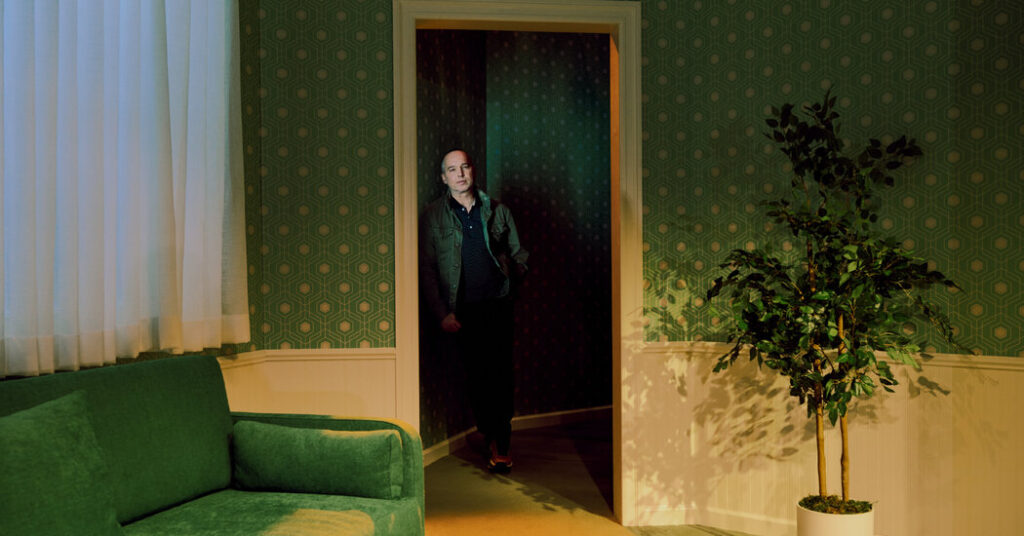
“I try not to write dystopia,” the playwright Jordan Harrison said. “Because it’s boring. I like to sit in an ambivalent place.”
This was on a recent Monday, Harrison’s day off, and he was sitting in an airy and uncrowded Brooklyn cafe. A lunchtime utopia, it was also a teasingly analog place to discuss Harrison’s recent work, sweet-bitter anatomies of human connection, as mediated through technology.
Harrison has explored what it means to be human in several recent plays, but never more trenchantly than in the 2014 play “Marjorie Prime,” a finalist for the Pulitzer Prize, now on Broadway.
Set some decades in the future (context clues suggest the 2060s), “Marjorie Prime” stars June Squibb as a woman in her 80s. For companionship and to stave off memory loss, Marjorie chats with a Prime, a holograph version of her late husband. Written when the conversation around generative A.I. was quieter, it has come to Broadway in a moment when that chatter is more fervid. Like all of Harrison’s plays, it is a drama about mortality and one that reflects his increasingly confident belief that technology will eventually supersede us.
“The idea that the human world would come to an end eventually is one that’s sitting with me for a while,” he said over a grain bowl. He didn’t sound so sad about it.
Harrison, 48, grew up on Bainbridge Island, Wash., just outside Seattle, when it was a relatively rural place and not yet a bedroom community for tech workers. And despite the focus on technology in much of his work, he has always been a late adopter or non-adopter of gadgetry. Even now, living in Brooklyn with his husband, Adam Green, the artistic director of Playwrights Horizons, he remains a social media holdout.
He recognizes that there are people in the world who have an unconflicted relationship with technology, “who don’t yearn for what their brain felt like in 1995,” he said. He isn’t one of them. He longs for a time when he could read a book without itching to look up the latest tennis scores. That time has fled.
“I’m the flaw, not the technology,” he said. “My own inability to say no, my own addict behavior.”
He is sympathetic to that addiction, at least as it relates to his writing. As a late Gen X-er, he has firsthand experience of the transition from an analog age to a digital one. Studying English at Stanford in the 1990s, gave him, he said, “a front-row seat to knowing that this would be the coming world, and that I was about to start a career in an increasingly obsolescent field.”
His fascination is with human behavior, aided and thwarted by the devices at our fingertips, those available now and those he only imagines.
“It feels fantastical, but all of it is within reach,” said Anne Kauffman, the director of “Marjorie Prime,” who has worked with Harrison for nearly 20 years. “He’s always dealing with the now and the present in some other fantastical world that he’s comparing it to.”
This friction between the analog and the digital first emerged in Harrison’s 2010 play, “Futura,” a thriller in which printed matter has been all but outlawed. These ideas were further developed in “Maple and Vine,” a 2011 play about a disaffected married couple who give up contemporary life to move to a community where it’s always 1955. As one character explains, “It’s a relief, the limitations.”
There’s less relief in “The Antiquities,” which premiered earlier this year at Playwrights Horizons, Harrison’s longtime home. A series of short scenes about humanity’s embrace of and submission to technology, it begins in the 19th century, with the likes of Mary Shelley, and ends long after, when post-human beings have created the Museum of Late Human Antiquities, elevating Betamax cassettes and shampoo bottles to the status of relics.
“They are prosthetics, of a sort,” an artificially intelligent docent explains, “intended to make the owner more powerful, more intelligent, more efficient, more immortal. More like us.”
When Harrison wrote the play in 2012, certain moments felt kooky, like a scene in which a writer frets that she’ll soon be replaced by A.I. Not long after that Harrison, who also writes for television, found himself on a Writers Guild picket line in 2023, striking for protections against A.I. screenwriting. This is not his only example of foresight. “Maple and Vine” seemed to anticipate the tradwife movement and while printed matter hasn’t been outlawed, the move toward digitization, as seen in “Futura,” has only increased.
When Harrison began “Marjorie Prime,” the idea that a person could chat with a simulacrum of a departed loved one also seemed speculative. He had recently read a book about the Turing Test, a challenge in which a human struggles to determine whether a conversation partner is human or machine. He decided that he would collaborate with a chatbot, leaving the audience to differentiate who had written what. But the publicly available chatbots of 2012 were fairly primitive, lousy playwrights. Harrison abandoned that idea, opting instead for a single-set family drama about a woman, Marjorie; her daughter and son-in-law; and a chatbot version of the woman’s husband.
Kauffman, who directed the Los Angeles premiere, had recently lost her mother. “I was really attracted to the idea of continuing a conversation past death,” she said. She was both moved and dazzled by the contours of Harrison’s imagination, which at the time felt radical.
Squibb, who saw the play in its debut, didn’t feel that she entirely understood it. “I think we just simply weren’t ready for it,” she said. But when she was sent the script this year, after chatbots had become a feature of daily life, she felt prepared. The world had caught up to the play.
On Broadway, Squibb plays Marjorie and later (this is a mild spoiler), the Marjorie Prime of the title. She considers these one role, though she notes how the bot differs from the real Marjorie. The Prime is stiffer, more formal. “Their intention is always to please,” she said.
A simpler play might have treated that intention as sinister, or merely creepy. “Marjorie Prime” sees it as something more melancholy, as a vector of mismatched longing. “There’s something in there about contending with inevitable loss as the fundamental human condition,” said Sarah Lunnie, a dramaturg who often works with Harrison. “And what is seductive about the idea of not having to lose.”
The Primes are almost human enough to salve the loss of a loved one. But in their equanimity and cheerfulness, they are not quite a true substitute for the human.
“Nothing is difficult for a chatbot,” Harrison said. “It doesn’t wrestle with things, doesn’t think about what’s right. It’s liberated from that and that also is a moral absence.”
That absence is likely here to stay. In the play, the Prime version of Marjorie’s husband, Walter (Chris Lowell), observes that their daughter, who dislikes the Primes, is afraid of the future. “Well, that’s no good,” Marjorie says. “It’ll be here soon, we might as well be friendly with it.”
Indeed, the technology that seemed so far away in 2014 has now arrived, able to provide credible audio and video (if not yet holograms) of any living person. Squibb believes it can’t quite replicate real human emotion, at least, not yet. “A human actor shows you a sense of a wide range of emotions and very honest, true emotions,” said. “The A.I. cannot do that.”
And A.I. can’t yet capture the searching, aching quality of Harrison’s writing, its fascination with death and the artifacts that might live on after.
“There’s a real sadness inside the work, but at the same time a real wonder and appreciation for what is irreplaceable and singular and passing before us only right now, never to be recovered,” Lunnie said. “He loves life, and is aware all the time that he is going to lose what he loves and be lost.”
Harrison can see a time when humanity will be in the rear view. “We won’t be around forever, humans, and we will be gone a little sooner than I definitely thought growing up,” he said. That’s bad news for humans, sure. But Harrison is curious, onstage and off, about what A.I. will create. And besides the future is always coming, we might as well be friendly with it.
“Everyone was afraid of the telephone, everyone was afraid of television,” Harrison said. “It’s just going to march on. And we’ll acclimate.”
Alexis Soloski has written for The Times since 2006. As a culture reporter, she covers television, theater, movies, podcasts and new media.
The post This Playwright Has Seen the Future. It Isn’t Human. appeared first on New York Times.