Elon Musk’s Tesla is no longer the top electric vehicle seller in the world as demand at home has cooled while competition heated up abroad.
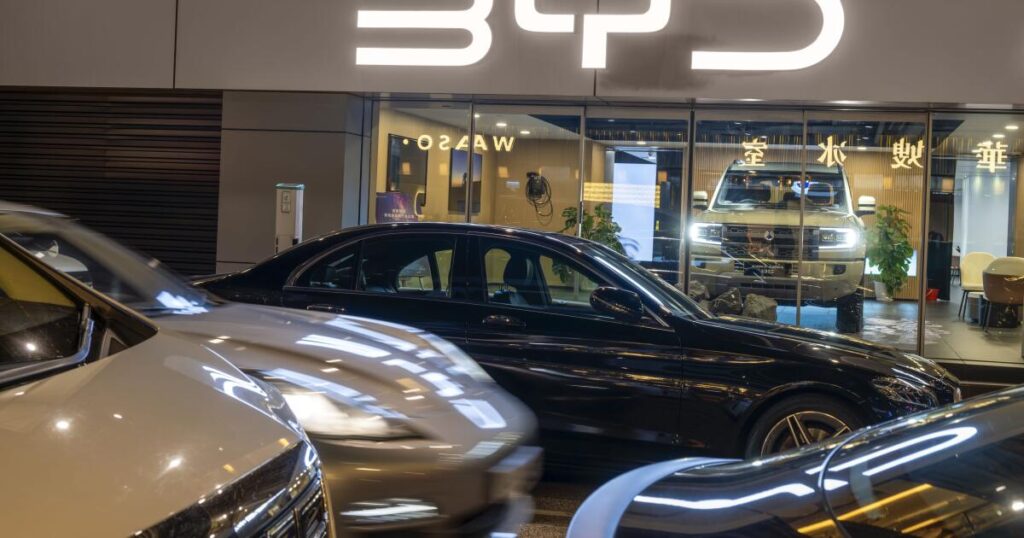
Tesla lost its pole position after reporting 1.64 million deliveries in 2025, roughly 620,000 fewer than Chinese competitor BYD.
Tesla struggled last year amid increasing competition, waning federal support for electric vehicle adoption and brand damage triggered by Musk’s stint in the White House.
Musk is turning his focus toward robotics and autonomous driving technology in an effort to keep Tesla relevant as its EVs lose popularity.
On Friday, the company reported lower than expected delivery numbers for the fourth quarter of 2025, a decline from the previous quarter and a year-over-year decrease of 16%. Tesla delivered 418,227 vehicles in the fourth quarter and produced 434,358.
According to a company-compiled consensus from analysts posted on Tesla’s website in December, the company was projected to deliver nearly 423,000 vehicles in the fourth quarter.
Tesla’s annual deliveries fell roughly 8% last year from 1.79 million in 2024. Its third-quarter deliveries saw a boost as consumers rushed to buy electric vehicles before a $7,500 tax credit expired at the end of September.
“There are so many contributing factors ranging from the lack of evolution and true innovation of Musk’s product to the loss of the EV credits,” said Karl Brauer, an analyst at iSeeCars.com. “Teslas are just starting to look old. You have a bunch of other options, and they all look newer and fresher.”
BYD is making premium electric vehicles at an affordable price point, Brauer said, but steep tariffs on Chinese EVs have effectively prevented the cars from gaining popularity in the U.S.
Other international automakers like South Korea’s Hyundai and Germany’s Volkswagen have been expanding their EV offerings.
In the third quarter last year, the American automaker Ford sold a record number of electric vehicles, bolstered by its popular Mustang Mach-E SUV and F-150 Lightning pickup truck.
In October, Tesla released long-anticipated lower-cost versions of its Model 3 and Model Y in an attempt to attract new customers.
However, analysts and investors were disappointed by the launch, saying the models, which start at $36,990, aren’t affordable enough to entice a new group of consumers to consider going green.
As evidenced by Tesla’s continuing sales decline, the new Model 3 and Model Y have not been huge wins for the company, Brauer said.
“There’s a core Tesla following who will never choose anything else, but that’s not how you grow,” Brauer said.
Tesla lost a swath of customerslast year when Musk joined the Trump administration as the head of the so-called Department of Government Efficiency.
Left-leaning Tesla owners, who were originally attracted to the brand for its environmental benefits, became alienated by Musk’s political activity.
Consumers held protests against the brand and some celebrities made a point of selling their Teslas.
Although Musk left the White House, the company sustained significant and lasting reputation damage, experts said.
Investors, however, remain largely optimistic about Tesla’s future.
Shares are up nearly 40% over the last six months and have risen 16% over the past year.
Brauer said investors are clinging to the hope that Musk’s robotaxi business will take off and the ambitious chief executive will succeed in developing humanoid robots and self-driving cars.
The roll-out of Tesla robotaxis in Austin, Texas, last summer was full of glitches, and experts say Tesla has a long way to go to catch up with the autonomous ride-hailing company Waymo.
Still, the burgeoning robotaxi industry could be extremely lucrative for Tesla if Musk can deliver on his promises.
“Musk has done a good job, increasingly in the past year, of switching the conversation from Tesla sales to AI and robotics,” Brauer said. “I think current stock price largely reflects that.”
Shares were down about 2% on Friday after the company reported earnings.
The post Tesla dethroned as the world’s largest EV maker appeared first on Los Angeles Times.