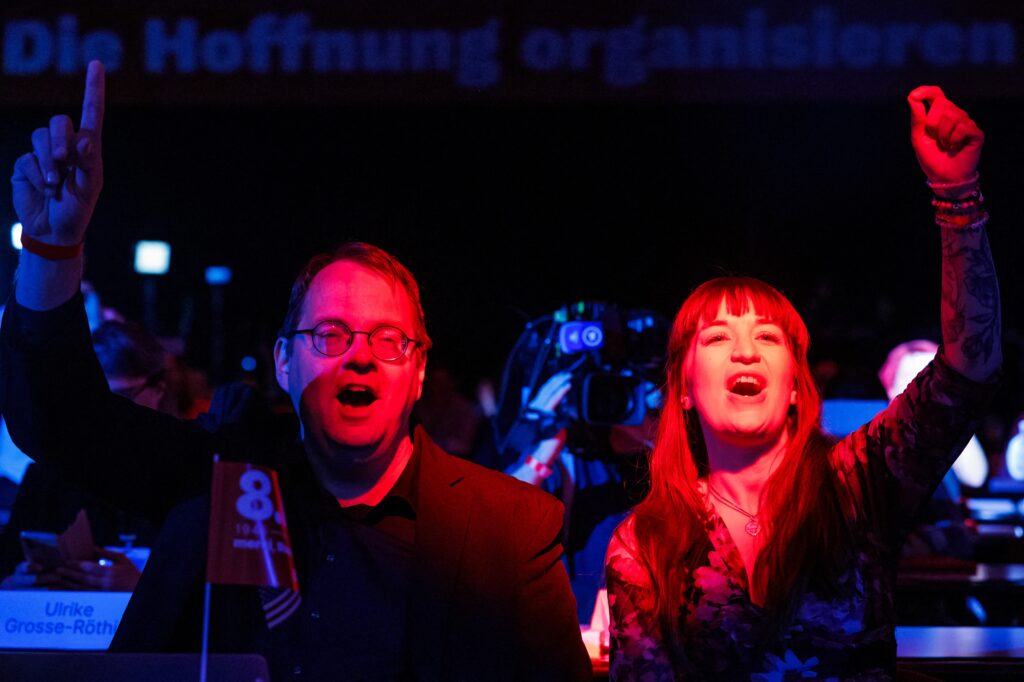
LEIPZIG, Germany — The rise of the far right has hit German politics like an earthquake — especially in the former Communist East Germany and among voters under 60. But in the gritty Connewitz neighborhood of Leipzig, one of the biggest eastern cities, it’s hard to find young residents who voted for any party other than Die Linke — whose name means “The Left.”
Die Linke, the successor to the former East German socialist party, long lingered on the margins but is enjoying a surge in appeal among Gen Z and younger millennials that’s sending its own tremors through the political system. Like an electric car, its rise has accelerated far more quietly than the roaring nationalist Alternative for Germany (AfD) party but with just as much power.
Die Linke, quite suddenly, is by far the most popular party among voters under 25, with overwhelming leads among young women and students, according to federal election data and opinion polls.
“It’s the only party that aligns with my views, that isn’t sexist, or at least tries to minimize sexism, homophobia, racism, ableism and that kind of stuff,” said Pauline Mannig, 33, smoking a cigarette with friends outside a heavily graffitied Connewitz storefront. “And now even more so than before,” Mannig said, “because the whole government is shifting further and further to the right.”
Put together, the surging far left and far right pose an existential challenge to the establishment centrist parties that have held sway since World War II. In Germany’s parliamentary system, they could soon make it impossible for the mainstream parties to form a governing coalition without including one of the extremes.
The meteoric rise of the anti-immigration party AfD, which is now Germany’s leading party according to many opinion polls, is mirrored by gains among right-wing nationalist, anti-immigrant parties across Europe. But the surging far left in Germany, the European Union’s most populous country, stands apart.
In federal elections in February, Die Linke won 27.3 percent of 18- to 24-year-old voters, a higher share than the AfD, which won 19 percent, and more than double the governing Christian Democratic Union (CDU) and its Bavarian sister party, which together won 13 percent.
Die Linke’s steep ascent caught even its leaders off guard.
“I was surprised,” said Sören Pellmann, 48, Die Linke’s co-leader in the German parliament, who’s been a party member for more than 30 years and represents the Leipzig district that includes Connewitz. “Especially by the membership numbers. We’ve almost tripled our membership. I’ve never experienced anything like that in the party before.”
“It’s like a fever dream,” said Heidi Reichinnek, 37, the party’s other leader in the Bundestag, the German parliament.
Overall in the 2025 federal election, Die Linke won 8.8 percent of the vote, a modest fifth-place finish but one that vastly exceeded expectations. Some analysts had predicted that the party would fail to reach the 5 percent threshold for entering the Bundestag. Since then, its poll numbers have continued to climb.
“At the end of [2024], we were left for dead,” Reichinnek said.
Crowned Germany’s “social media queen,” Reichinnek — or at least a four-inch digital version of her — gets the most credit for the party’s resurrection. Her adept use of TikTok has won her a place in the hearts, minds and phones of legions of younger Germans.
Surveys show that most young Germans, including Mannig, get their news from social media at least some of the time. And a study by the Friedrich Ebert Foundation, an organization aligned with Germany’s center-left Social Democratic Party (SPD), found that while the AfD dominated social media feeds in 2024, last year Die Linke received about as many mentions — and far more positive mentions.
The party’s surge both on social media and at the polls arguably began with a controversial decision by Chancellor Friedrich Merz, of the center-right CDU.
In January 2025, just before being elected chancellor, Merz, then his party’s leader in parliament, rankled many politicians and voters by relying on AfD support to pass a resolution for stricter immigration rules. That seeming violation of his party’s “fire wall” against cooperation with the AfD was celebrated by AfD leaders as a “historic day.”
Reichinnek, enraged, took to the Bundestag floor and delivered a searing speech accusing Merz of forming a pact with the far right. “To the barricades!” she implored her followers. When she posted a clip of the tirade on TikTok, it went viral and has now been viewed nearly 8 million times.
“That was essentially the starting gun for the new Die Linke,” said Manfred Güllner, founder and director of the Forsa Institute, a leading German political polling firm.
Young voters across the world historically have been more inclined to radicalization than older voters, but in Germany — where memories of murderous Nazi furor have long driven appeal for moderate politics and politicians — even 18- to 24-year-olds consistently favored the center-right CDU or center-left SPD.
That changed in 2021, when those voters cast the largest share of their ballots for two parties that are slightly farther from the center but still considered mainstream: the Greens on the left and the pro-business Free Democrats on the right. But the full rupture with the establishment came last year, when Die Linke ranked first among young voters and the AfD placed second.
That puts Merz’s CDU in a bind. The party has ruled out coalitions with either the AfD or Die Linke — a stance that could become unviable if the parties continue to expand their support.
This year, the AfD is expected to win the highest vote share in elections in two eastern states, forcing the CDU to consider abandoning its fire wall and joining the AfD in a coalition — presuming the AfD doesn’t win outright majorities.
But if current trends continue, the mainstream parties may find themselves short of the numbers needed to band together to form even an unwieldy coalition at the federal level following elections planned for 2029. The AfD now scores above 25 percent in many polls, with Die Linke consistently in double digits.
An annual “polarization barometer” produced by the Dresden University of Technology found high levels last year of “affective polarization” — an emotional orientation that creates a feeling of hostility toward opposing camps, rather than disagreements about specific policies.
This polarization “is more difficult to overcome,” said political scientist Hans Vorländer, part of the team behind the barometer, and was especially deep around the issues of immigration, climate change and the war in Ukraine.
Die Linke’s leaders attribute their party’s success to bread-and-butter issues, not broad political forces.
Die Linke focused on reducing rents and other living costs “while everyone else was talking about migration and security policy,” Reichinnek said.
The party’s three main themes are affordable housing, affordable living, and a well-equipped and affordable public transit system, Pellmann said — sounding a lot like Zohran Mamdani, who despite being portrayed as the vanguard of a national leftist movement won New York’s mayoralty largely on a platform of lower living costs, including cheaper mass transit.
Pellmann’s Leipzig district — the only one outside Berlin where Die Linke came in first place last year — encapsulates the party’s increasingly diverse coalition. It includes the historic city center, where crowds have thronged the picturesque Christmas market each holiday season since 1458, but also one of Germany’s largest Communist-era housing complexes and Connewitz, the heart of Leipzig’s alternative scene.
What many voters here share is a feeling of alienation from the mainstream parties, which in their view have all come to resemble one another. Political polarization itself is partly to blame: As the AfD and Die Linke have made gains, the only way for the mainstream parties to form governing majorities has been through coalitions with onetime ideological foes, forcing them to compromise on core principles. Those compromises alienated some supporters and made it difficult to enact notable policy.
“I don’t think any other party even tries to think about social issues anymore,” said Nicola, 28, a Die Linke voter waiting for a bus in Connewitz, who spoke on the condition of using only his first name because, like many left-wing Germans, he is worried about data privacy. “They’re just concerned about economics.”
“There’s a lack of alternatives,” agreed Lisa D., a 32-year-old Connewitz artist, identified by only her last initial because she fears becoming a target of right-wing violence.
Such fear is part of what drives some voters to Die Linke — a sense that they need to push back against the nationalist far right that’s rising all around them, particularly in the leftist Connewitz oasis within the AfD-dominated former East Germany.
“We’re still in the East, after all,” Lisa D. said, adding, “I don’t want some Nazi ringing my doorbell.”
The post Surging left-wing party challenges politics-as-usual in Germany appeared first on Washington Post.