The basement bar in the Swiss Alpine resort town was crowded, but not packed, with young revelers in the first moments of 2026.
Noa Bersier was playing billiards with friends. Waiters were hurrying past, he noted, and some were carrying bottles of Champagne topped with small fireworks that sent showers of sparks into the air.
Then Mr. Bersier, 20, became alarmed. The ceiling was on fire, and the flames were quickly spreading.
He grabbed his jacket and rushed for the stairs, ascending through a scrum of bodies. He felt a wave of heat pulse through him.
“I saw my hands decomposing,” he said. “I felt like I was on fire.”
Mr. Bersier emerged with serious burns, but alive.
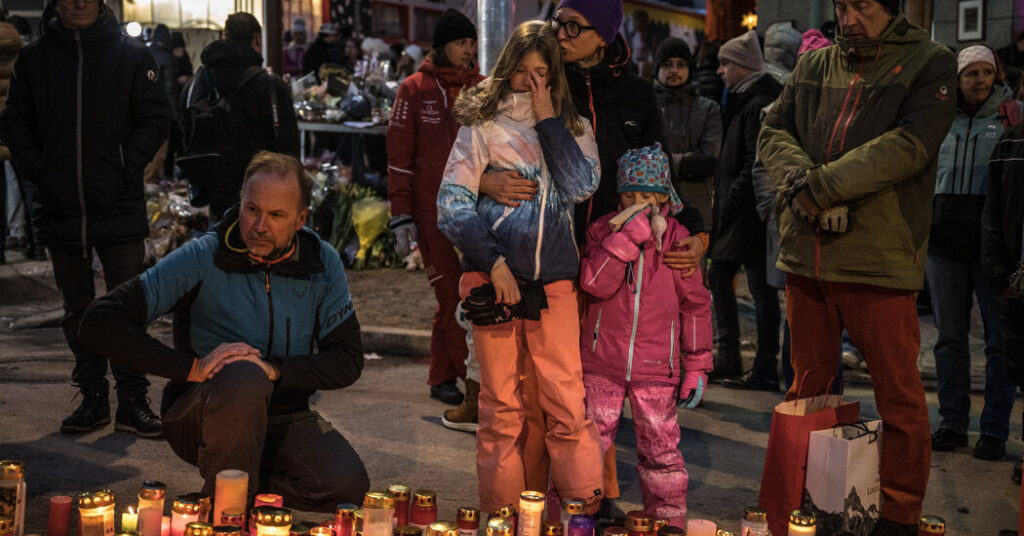
More details surfaced Friday about the New Year’s fire at the Constellation bar, a short walk from the ski lifts in the high-end resort of Crans-Montana. Swiss authorities described the disaster as one of the deadliest conflagrations in the country’s history. Forty people were killed, they said, and the dozens who were critically burned were flown to hospitals across Switzerland, as well as in France and Italy.
Beatrice Pilloud, the prosecutor general of the Valais canton near Lake Geneva, said Friday that the likely cause of the fire had been the sparkling devices, known in French as feux de Bengale — finger-size fireworks that send up a fountain of sparks — which had ignited the ceiling insulation.
“From there, a rapid, very rapid, and general ignition occurred,” she said at a news conference on Friday.
Videos posted by French news organizations and on social media appeared to show the earliest moments of the fire, with young people dancing to thumping music as some revelers shouted “Oh là ça brûle, oh là ça brûle!” It’s burning, it’s burning!
A man was seen trying to extinguish the flames by swatting a piece of clothing at the ceiling.
The fire was so intense that the authorities have assigned a team of more than 30 people, including dentists, to identify remains.
Anguished, desperate parents and other family members walked the streets of Crans-Montana on Friday and posted pleas on social media for information about their missing children, many of them teenagers.
The injured included 71 Swiss, 14 French and 11 Italian citizens, as well as people from Australia, Belgium, Poland and Portugal. The nationalities of 14 people have not yet been confirmed, said Frédéric Gisler, the police chief of the Valais canton.
Among those killed was Emanuele Galeppini, a 17-year-old Italian golfer, the country’s golf federation said.
The Swiss authorities said on Friday that investigators would focus on details about the bar itself — construction materials, licenses, fire safety measures, emergency exits, maximum capacity — to determine how the disaster had unfolded. No one has been arrested or charged in the case, but Ms. Pilloud said investigators would look into whether negligence had led to the fire, and whether anyone could be held criminally liable.
Feux de Bengale are fireworks commonly found at birthday parties and soccer victory celebrations. Ms. Pilloud described them as “birthday candles that you can buy at any shop.”
But they can be dangerous. On a web page dedicated to the use of fireworks, the government of Quebec described feux de Bengale this way: “Considered harmless, they nevertheless burn at very high temperatures, can ignite clothing, and cause serious injuries. Once extinguished, they remain very hot. Immerse them immediately in water to prevent burns.”
Samir Melly, a regular at the Constellation bar, said in an interview Friday that he had spoken to the police after the New Year’s fire about a potential problem with the bar’s basement ceiling. It was covered in soundproof foam that had come unstuck and was hanging loose when Mr. Melly visited the bar earlier in the week, he said.
The bar’s owner, Jacques Moretti, told Tribune de Genève that the bar had been inspected by local authorities three times in 10 years and that “everything was done according to the standards.” The New York Times has not yet been able to reach the owners. Local law in the region calls for yearly fire safety inspections in buildings open to the public or that present special risks.
Several witnesses describing hearing an explosion at the bar during the fire, which experts said was likely caused by a phenomenon known as a flashover: the ignition of hot gases that rise to the ceiling.
“All the wood, all the seats, all of the decorations and everything else in the room would be heated to the ignition temperature,” said Steve Kerber, the executive director of the Fire Safety Research Institute in Maryland. “If you have very combustible materials, like plastics, it happens very fast.”
In a town popular with wealthy tourists, the bar was known as a casual nightspot with more affordable drinks than many of the village’s upmarket nightspots.
It did not charge an entrance fee, making it popular with teenagers and young adults. The legal drinking age in Switzerland is 16 for beer and wine, and 18 for high-proof alcohol.
A downstairs area was often turned into a dance floor, where D.J.s performed. Swiss officials said that most of the 40 people who were killed in the fire were found in the basement, where the fire started.
On the night of the fire, Nestor Fischer, a 17-year-old New Year’s partygoer, was outside the club. He described hearing screams coming from inside and seeing smoke seeping from its doors.
He tried to force open a glass door on the right-hand side of the bar, he said.
“It was stuck,” he said. “We tried to break it with a stool, we tried hitting the window, but it wouldn’t open.”
Then, Mr. Fischer said, “I just ripped it off.”
The inside of the bar was a “furnace,” he said.
“I saw people falling inside the veranda,” he continued. “Because of the lack of oxygen, they were fainting. People were screaming.”
Using the flashlights on their phones, Mr. Fischer said, he and other bystanders tried to guide people inside the bar to safety outside. As they emerged, he said, the victims “were completely disfigured.”
“They had no hair, they were completely burned,” he said. “We could only see terror in their eyes.”
Mr. Fischer said he counted himself lucky because he had been inside the Constellation before midnight before leaving, finding it too quiet for a New Year’s celebration.
The authorities asked for patience on Friday as they attempted to identify the dead, but that did nothing to assuage the torment of those searching for loved ones.
Posts on Facebook and Instagram appealing for information about family and friends included photos of young people, some as young as 15.
Laetitia Brodard-Sitre was among those who had posted an appeal on Facebook, with a picture of her 16-year-old son Arthur Brodard reclining with a small dog.
“We don’t know if he’s alive,” she wrote.
She spent all of Thursday and Friday searching for her son after he celebrated New Year’s Eve at the bar.
“If he is in the hospital, I don’t know which hospital he is in,” she told BFMTV, a French television station, on Friday. “If he is in a morgue, I don’t know which morgue he is in.”
Dozens of families were caught in the same, terrible purgatory. Some repeatedly called relatives’ phones, which rang without answer.
Pierre Pralong, a grandfather of one of the missing, told BFMTV on Thursday that he had not heard from his granddaughter, Émilie, who he said is 22 years old. The situation, he said, is “agonizing.”
Mr. Pralong said he hoped his granddaughter might be injured in a hospital. But, he said, the family was bracing for worse news.
“We cannot dream,” he said. “We have to be realistic.”
Mr. Bersier, who escaped the bar by way of the crowded staircase, recounted the horrors of the evening from his hospital bed on Friday.
He said that, when he made it outside, he looked down at his hands.
“The skin hanging off on all sides,” he said. “My face was half-burned. I could tell that my hair was burned. I stank of burns.”
Friends drove him to the nearest major hospital, a half-hour away in the city of Sion, he said. Doctors have since told him that he suffered burns on his head, hands, lower back and a leg, though they did not disclose the degree, he said.
“I’m really grateful to still be here today,” he said, “compared with others who couldn’t make it.”
Ségolène Le Stradic and Aurelien Breeden reported from Crans-Montana, Switzerland, and Thomas Fuller from San Francisco. Reporting was contributed by Amelia Nierenberg, Jenny Gross, Elisabetta Povoledo, Nick Cumming-Bruce, Isabella Kwai, John Yoon, Til Bürgy, Aric Toler, Christiaan Triebert and Pranav Baskar.
Ségolène Le Stradic is a reporter and researcher covering France.
The post Sparklers Probably Caused New Year’s Fire at Bar, Swiss Authorities Say appeared first on New York Times.