Good morning. It’s Friday. Today we’ll look back at the first year of President Trump’s anti-immigration campaign with two Times journalists who have been covering it.
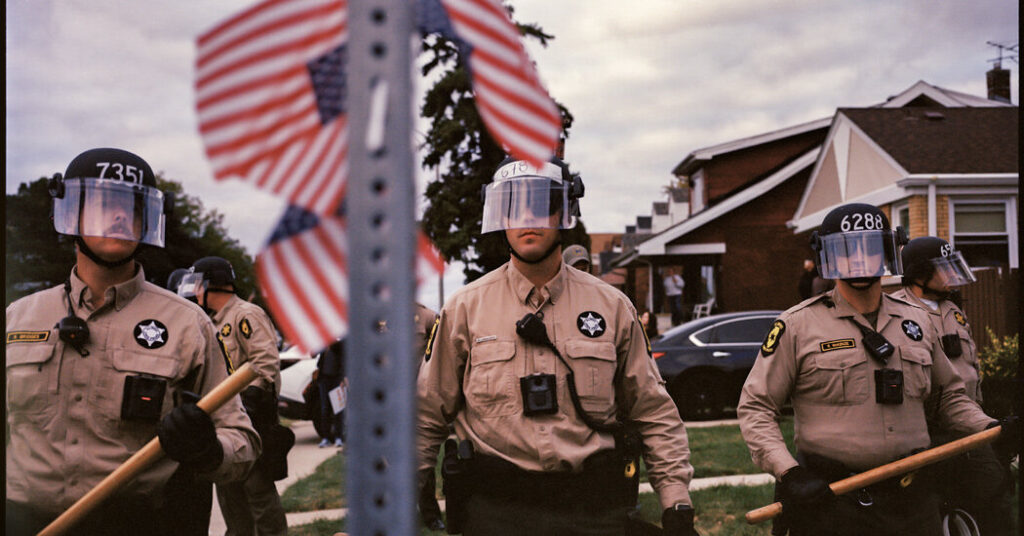
In the first year of his return to the White House, President Trump embarked on a sweeping crackdown on immigration that led to more than 500,000 people being deported from the United States.
My colleagues Luis Ferré-Sadurní and Todd Heisler traveled from New York City to the southern border and Mexico to document the effort — what happened and who was left behind.
Ferré-Sadurní, a reporter, and Heisler, a photographer, answered questions from me over email about how they approached the story and what they learned.
This interview has been condensed and lightly edited.
Where did you travel in 2025 to report on immigration, and how did you decide where to go?
L.F.S.: I largely reported from New York and New Jersey, which are my areas of coverage on the Metro desk. But Todd and I flew down to the U.S.-Mexico border for a few days in October.
We believed it was important to revisit a part of the country that holds so much sway over the nation’s immigration debate. We visited Texas and New Mexico and even crossed into Ciudad Juárez in Mexico to document how things have markedly changed in less than a year.
T.H.: I also traveled to Miami, Chicago and Syracuse and reported extensively in New York City. A lot of my travel was based around covering the news and at the same time looking for images that resonated differently for this project.
You both most likely encountered sources who did not want to reveal their identities publicly. How did you handle that?
T.H.: In early 2025, I found even people who were born and raised here were now reluctant to be photographed. Sources who were really open just months earlier were no longer willing to cooperate. So I had to think of new ways to photograph the humanity of this year, often in the absence of people.
I used a medium-format film camera to document what’s left behind in the wake of these new policies and how spaces have been transformed. I chose film not only because I wanted it to look different from my daily work, but also because the process slows things down and forces me to look at things differently.
L.F.S.: I’ve found that immigrants are, generally, much more open to talk about their stories with journalists than many people might expect, even in the current climate.
I always identify myself as a Times reporter, explain what I’m writing about, make sure they understand the newspaper’s reach and ask if it’s OK to use their names. Some immigrants, especially if they lack legal status, might be more comfortable using just their first or last name, and that’s something we sometimes allow in order to give readers a window into important stories that are otherwise hard to tell.
Todd, what is your favorite photo you took this year, and why?
T.H.: The still life of the recently cleaned sneakers was a revelation in my understanding of how to tell the story of deportation.
I was meeting the mother of two teenage brothers from El Salvador who were raised in the U.S. and recently deported to a country they barely knew. When I arrived, I noticed their aunt had just washed their shoes in preparation to send them to El Salvador. Many other times this year in documenting the homes of people who were deported, there were shoes left by the door. It just felt so abrupt.
You’re both experienced journalists. But were you surprised by anything this year?
L.F.S.: We knew Trump was going to shake things up, but I was taken aback by the pace at which his administration has transformed the immigration landscape. It began with a barrage of executive orders on Jan. 20 and hasn’t stopped since.
Every day, week and month brings new policy changes, new lawsuits, new raids and new enforcement trends.
Do you speak any languages besides English? How do you use these languages while reporting?
L.F.S.: I was born and raised in Puerto Rico, so Spanish is my native language. I use Spanish almost every day in my reporting, to talk with Latin American immigrants on the street or over WhatsApp.
Most important, knowing Spanish and being from the Caribbean has allowed me to overcome cultural barriers in order to more easily gain the trust of many immigrants and access to their communities.
My French, which I learned in high school and college, is rusty, but I sometimes use it for basic communication with West African migrants.
T.H.: I speak Spanish, and though it is not my first language, being able to communicate with people directly is important in gaining trust in these communities. This type of reporting requires a lot of time on the street just chatting with people, listening to their stories.
Luis, you’ve written about a new wave of fear sweeping across migrant communities this year. What are people afraid of, and how are they coping?
L.F.S.: There’s the fear of going to work and getting arrested by ICE on your way back home. There’s the fear of getting separated from your children, especially if you’re a parent without legal status and your children are citizens. There’s the fear of getting sent to a country you were trying to flee, or some other country you’ve never heard of.
There’s been grass-roots organizing and resistance and know-your-rights sessions. Parents have prepared their children in case they’re detained. Some families limit their time outside nowadays. Others have self-deported.
But many have no option but to continue going to work every day, living their lives and pushing the uncertainty out of their minds.
Where do you think Mr. Trump’s immigration crackdown could lead in 2026?
L.F.S.: I’m expecting more raids and more sustained efforts in places like New York, where large raids did not materialize as often. ICE just got billions of dollars from Congress, and the agency has been recruiting more officers to deploy nationwide.
Trump’s relationship with Mayor Zohran Mamdani could also affect the intensity of ICE efforts in New York.
And I’ve recently been wondering how the midterm elections could affect the pace or reach of the president’s deportation efforts. Is there powerful enough backlash against ICE in swing districts that changes the politics of immigration once again? Or does the White House continue with its efforts full steam ahead?
Weather
Today will start out cloudy and gradually become mostly sunny, with temperatures near 32. Expect partly cloudy conditions tonight, with a low around 22.
ALTERNATE-SIDE PARKING
In effect until Tuesday (Three Kings’ Day).
The latest New York news
-
New York City has a new mayor: Zohran Mamdani officially took office as mayor after the New Year’s Eve ball drop, in a private ceremony held at an abandoned subway station. In the afternoon, he held a public ceremony before a large crowd outside City Hall. Senator Bernie Sanders and Representative Alexandria Ocasio-Cortez took part in the event.
-
Mamdani changes his mind: In a major shift, Zohran Mamdani said he would no longer seek to end mayoral control of the New York City schools.
-
The second-snowiest day in Syracuse history: Syracuse got about 24.2 inches of snow, the most in a single day since 1946. Forecasters warned that more snow could fall in the coming days.
-
Adams’s final acts: On his last day as mayor, Eric Adams announced the creation of a third charter commission and pushed the button to begin the countdown for New Year’s Eve ball drop.
-
Protections for horseshoe crabs: Gov. Kathy Hochul signed legislation that will ultimately ban the catch and biomedical use of horseshoe crabs in New York State waters by 2029.
METROPOLITAN diary
Nice place
Dear Diary:
When I lived in Park Slope over 20 years ago, I once had to call an ambulance because of a sudden, violent case of food poisoning.
Two paramedics, a man and a woman, entered our third-floor walk-up with a portable chair. Strapping me in, the male medic quickly inserted an IV line into my arm.
Out of the corner of my eye, I could see his partner circling around and admiring the apartment.
“Nice place you’ve got here,” she said. “Do you own it?”
“Yeah,” I muttered, all but unconscious.
Once I was in the ambulance, she returned to her line of inquiry.
“Do you mind me asking how much you paid for your apartment?”
“$155,000,” I croaked.
“Wow! You must have bought during the recession.”
“Yeah,” I said.
They dropped me off at Methodist Hospital, where I was tended to by a nurse as I struggled to stay lucid.
At some point, the same medic poked her head into the room with one last question:
“You wouldn’t be wanting to sell any time soon, would you?”
— Melinda DeRocker
Illustrated by Agnes Lee. Tell us your New York story here and read more Metropolitan Diary here.
Glad we could get together here. — C.B.
P.S. Here’s today’s Mini Crossword and Spelling Bee. You can find all our puzzles here.
Davaughnia Wilson and Ed Shanahan contributed to New York Today. You can reach the team at [email protected].
Sign up here to get this newsletter in your inbox.
Camille Baker is a Times reporter covering New York City and its surrounding areas.
The post One Year and More Than 500,000 Deportations appeared first on New York Times.