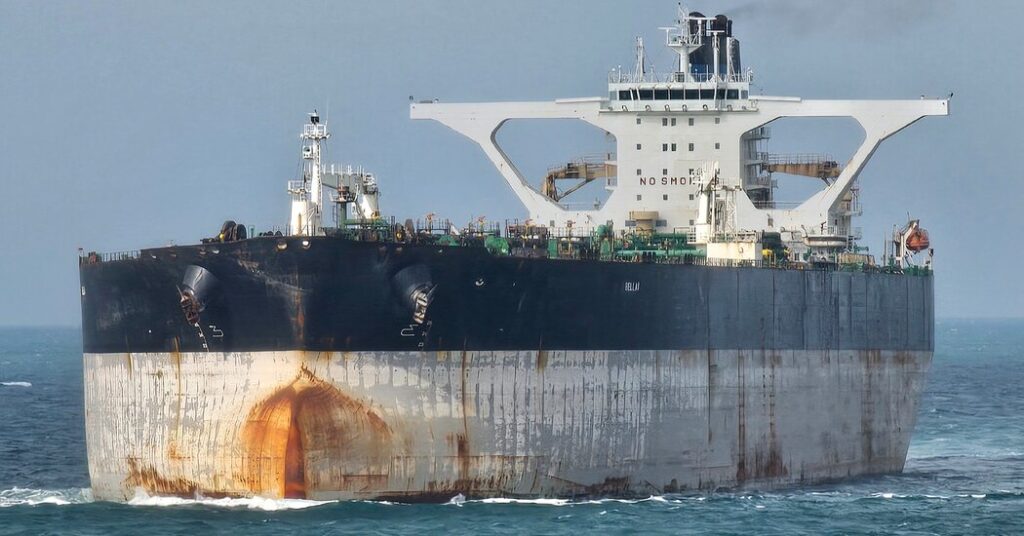
The oil tanker evading U.S. forces is broadcasting its location after more than two weeks of sailing dark, revealing that it is heading northeast in the North Atlantic Ocean.
The ship that had been known as Bella 1, which is still being tracked by the U.S. Coast Guard, is on a course that could take it between Iceland and Britain, according to data published by Pole Star Global, a ship-tracking company. From there, it is possible that the vessel could head around Scandinavia to Murmansk, Russia’s ice-free Arctic port.
The tanker recently claimed Russian protection. On Wednesday, the Russian government formally asked the United States to stop chasing the ship, which the Coast Guard tried to intercept last month as it traversed the Caribbean Sea on its way to pick up oil in Venezuela. The Bella 1 recently appeared in Russia’s official register of ships under a new name, the Marinera, with a home port of Sochi, on the Black Sea.
Ships like the Bella 1, part of a so-called shadow fleet that transports oil for Russia, Iran and Venezuela in violation of sanctions imposed by the United States and other countries, often turn off their transponders to hide their locations.
The pursuit of the tanker comes as President Trump intensifies his pressure campaign on the government of Nicolás Maduro of Venezuela. Mr. Trump has instituted a quasi-blockade on some tankers transporting oil from the country, a longtime ally of Russia, and the United States has already boarded and taken possession of two other tankers in the Caribbean. American officials have said they plan to seize more ships.
The Bella 1 last broadcast its location on Dec. 17, showing it was in the Atlantic heading toward the Caribbean.
The Coast Guard stopped the ship on Dec. 20, saying it was not flying a valid national flag and that the United States had a seizure warrant. But the Bella 1 refused to be boarded and sailed back into the Atlantic.
The next day, the tanker began sending radio distress signals that showed it traveling northeast, more than 300 miles from Antigua and Barbuda.
As the slow-speed chase continued, the vessel claimed Russian protection, a diplomatic chess move that could complicate U.S. efforts to seize it. Boarding a moving vessel with a potentially hostile crew on the high seas is a dangerous mission that would require a specialized team of Coast Guard or Navy operators.
Last week, in a call between the foreign ministers of Russia and Venezuela, Moscow “reaffirmed its all-out support and solidarity with the leaders and people of Venezuela,” according to a summary of the call from Russia’s foreign ministry.
Tyler Pager and Edward Wong contributed reporting.
Christiaan Triebert is a Times reporter working on the Visual Investigations team, a group that combines traditional reporting with digital sleuthing and analysis of visual evidence to verify and source facts from around the world.
The post Oil Tanker Fleeing U.S. Coast Guard Broadcasts Location in North Atlantic appeared first on New York Times.