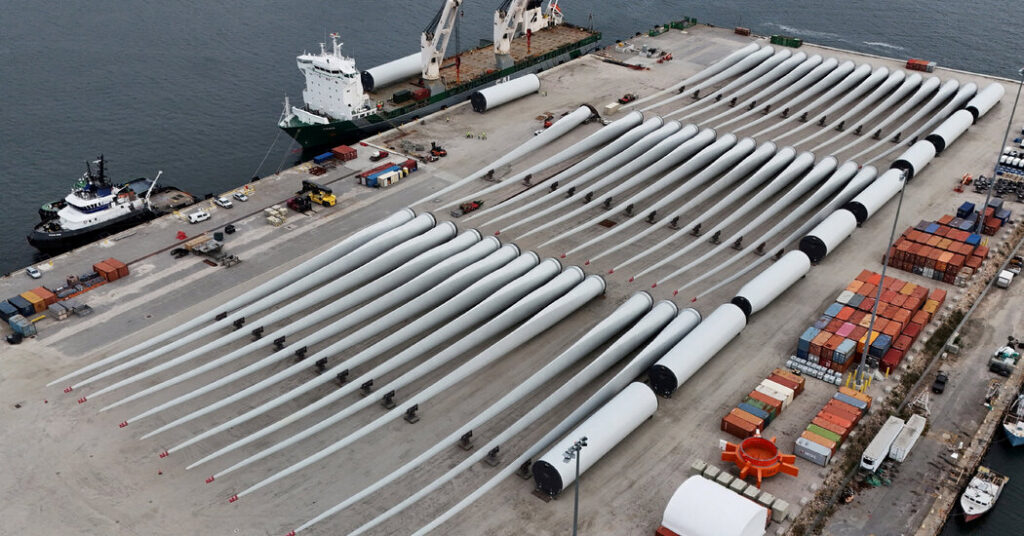
Developers of five offshore wind farms that were ordered last week by the Trump administration to halt construction are suing to restart work on at least three of the projects.
The Interior Department on Dec. 22 ordered companies to halt work on five wind farms in various stages of construction along the East Coast. They were: Sunrise Wind and Empire Wind, both off the coast of New York; Revolution Wind off Rhode Island and Connecticut; Vineyard Wind 1 off the coast of Massachusetts; and Coastal Virginia Offshore Wind off Virginia.
The administration cited unspecified national security concerns about the projects.
On Thursday, Orsted, the Danish energy giant that is building Revolution Wind, filed a lawsuit in the U.S. District Court for the District of Columbia. On Friday Equinor, the developer of Empire Wind, did the same.
Both companies said they are seeking preliminary injunctions that would allow construction to continue as the litigation proceeds. Orsted is also building Sunrise Wind and said it was considering a similar legal challenge to restart work on that project, too.
The action this week comes after Dominion Energy, the developer of Coastal Virginia Offshore Wind, filed the first legal challenge, on Dec. 23. In its complaint in federal court in Virginia, Dominion said the administration’s actions were causing “immediate, irreparable harm” and $5 million in losses per day. The Virginia project is the largest of the five. A judge has scheduled hearing for Jan. 9.
Avangrid, the developer of the fifth wind farm, Vineyard Wind 1 off the Massachusetts coast, has not indicated whether it plans to fight the administration. Vineyard Wind is already partly running, with about half of the project’s planned 62 turbines sending power to the electric grid.
The Interior Department did not respond to a request for comment.
At stake overall is about $25 billion of investment in the five wind farms. The projects were expected to create 10,000 jobs and to power more than 2.5 million homes and businesses.
Revolution Wind is more than 87 percent complete, and the company has already installed all offshore foundations as well as 58 of 65 wind turbines. Empire Wind is more than 60 percent complete and is slated to deliver power to the grid in 2027.
Orsted and Equinor said their projects went through lengthy federal reviews that included addressing any concerns about national security before they received permits under the Biden administration. They said they are working with Trump officials to address whatever new issues have arisen, but described the suspensions as illegal.
“Litigation is a necessary step to protect the rights of the project” and avoid “substantial harm” to the project if the suspension order remained in place, Orsted said in a statement.
In its lawsuit, Equinor said the Interior Department’s Bureau of Ocean Energy Management ordered it to halt work “with no meaningful explanation or attempt to first engage Empire Wind in addressing new concerns that it alleges have arisen.”
The company said the administration claimed it has a classified report containing new information about security threats posed by offshore wind for more than a month before ordering the suspension. “The United States’ non-explanation for its about-face is as hollow as it is pretextual,” the lawsuit said.
The court filings this week are the latest in a series of legal disputes between the Trump administration and the offshore wind industry.
Mr. Trump has falsely claimed that wind farms kill whales (scientists have said there is no evidence to support that) and that turbines “litter” the country and are like “garbage in a field.” Immediately upon returning to the White House last January, Mr. Trump issued a moratorium on federal approvals for new offshore wind projects.
In April, Mr. Trump halted work on Empire Wind and Revolution Wind. After weeks of negotiations with Gov. Kathy Hochul, Democrat of New York, the administration allowed construction to resume. White House officials suggested they had relented only after Ms. Hochul agreed to approve new gas pipelines in the state. She has denied that any such agreement was made, saying her recent approval of a gas pipeline was part of a broader effort to bring more energy to the state.
A federal judge lifted the administration’s order to stop work on Revolution Wind.
“It is literally weeks away from beginning to deliver power,” Senator Jack Reed, Democrat of Rhode Island, said on Friday about Revolution Wind. He said he called the deputy secretary of defense to ask for information about what national security concerns offshore wind creates and was told it was classified. “Which means, we don’t have a reason, we just want to do it,” the senator said.
This week President Trump posted on social media a photo of a bird beneath a windmill and suggested it was a bald eagle killed in the United States by a wind turbine. “Windmills are killing all of our beautiful Bald Eagles,” the president wrote. It was also posted by the White House and the Department of Energy.
The post turned out to be a 2017 image from Israel, and the animal was likely a kestrel. On Friday Mr. Trump posted on Truth Social again, this time an image of birds flying around a wind turbine, that read, ”Killing birds by the millions!”
Wind energy is responsible for less than 0.01 percent of human-caused bird fatalities, per federal data, significantly less than buildings, cats or oil pits. The Audubon Society says that climate change poses a bigger threat to birds than wind power.
Lisa Friedman is a Times reporter who writes about how governments are addressing climate change and the effects of those policies on communities.
The post Offshore Wind Projects Challenge Trump Administration’s Order to Stop Work appeared first on New York Times.