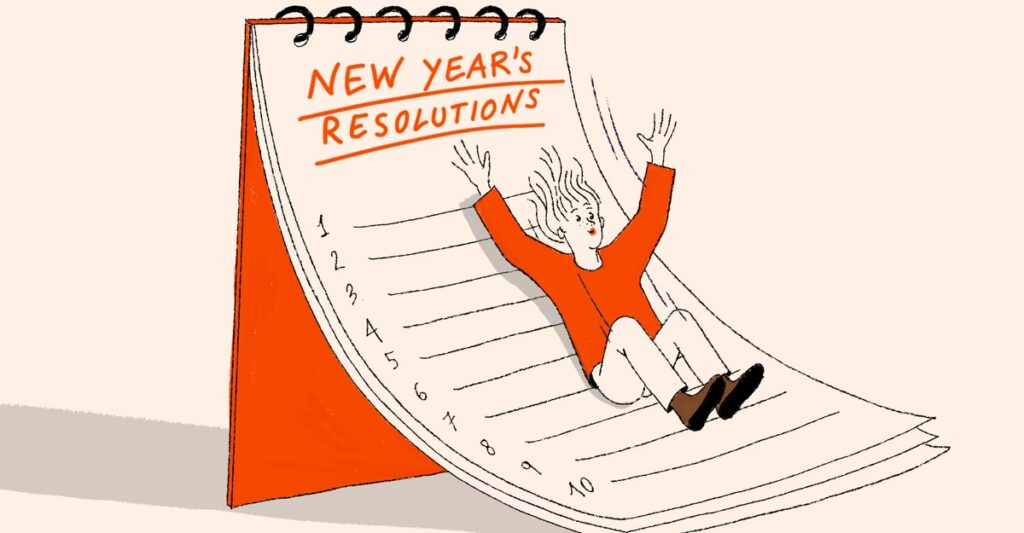
Along with champagne and fireworks, nothing is more quintessential to New Year’s than abandoning one’s best efforts at self-improvement. Surveys have found that less than 10 percent of Americans who make resolutions stick to them for a year. By the end of February 2024, according to a survey conducted by the Harris Poll, about half of respondents who set resolutions had already given up on them. (I’m impressed they lasted that long. My latest resolution was to stop wasting time scrolling, and minutes later I was online, researching what people typically do to spend less time online.)
Clearly, the way Americans have been approaching this whole resolution business—that is, tackling our challenges head-on—simply does not work. If you want 2026 to be different, you have to try something new and bold. So let me offer a counterintuitive piece of advice: To make your New Year’s promise stick this year, consider breaking it before you even get started.
Absurd as it may sound, purposefully working against what you would like to achieve is a well-established intervention in psychology. Paradoxical intent, as it’s known, is commonly used to treat conditions such as insomnia. Imagine that you’re having trouble drifting off at night and lie in bed for hours, desperate for sleep to take hold, which only makes you more anxious and awake. A paradoxical strategy—for example, trying to stay awake—has been shown to be effective at improving sleep, and is a widely used tool in cognitive behavioral therapy for insomnia.
Some studies suggest that paradoxical intent works in clinical settings in part because it decreases performance pressure, especially among patients who are prone to anxiety. Most people are distressed by the condition or habit they’re seeking treatment for, so they fear that addressing it less than perfectly will result in failure and make them miserable. But when you intentionally seek the failure you fear, you learn pretty fast that nothing catastrophic happens (usually). In some therapeutic situations, paradoxical intent might involve elements of exposure therapy or breaking down daunting projects into smaller, easier tasks, both of which might contribute to its power. A therapist might, for example, encourage an anxious patient who’s been putting off studying for a major exam to review for an insufficient amount of time—say, five minutes each day. But perhaps most valuable of all, paradoxical intent has an absurd, even humorous quality that can jolt you out of an anxiety-induced impasse and help you get what you want.
[Read: Anxiety is like exercise]
No randomized clinical trials have studied the effect of paradoxical intent on New Year’s resolutions. But there’s reason to suspect that it might work. Many New Year’s resolutions fail not because people lack motivation, but because fixating on a goal can initiate a self-defeating cycle of avoidance. Let’s say that you’re sick of procrastinating: You’re in trouble with your boss for not getting projects done on time, and your friends are fed up because you always arrive late. If you resolve to never procrastinate again, the chance of failure is high, which could make you anxious and lead you to stop trying—better to simply give up than to risk failure. So instead of making a punishing schedule of activities, or setting endless alarms to keep yourself on track, at some point this month, try to take as long as you can, working in the least efficient way possible, to complete a low-stakes task such as organizing your closet. Want to save money? Buy one small item you know you’ll immediately regret! Want to spend more time with your friends or get outdoors? Schedule a day to rot alone on your couch with TikTok! The specific prescription matters less than your commitment to temporarily, but wholeheartedly, working against your best interest.
Last year, I tried this theory out on a patient of mine, who had long been out of shape and finally resolved to get fit. He quickly hired a trainer and hauled himself off to the gym, but at the first session, he was overwhelmed by the trainer’s ambitious plan. Discouraged, he quit and did not exercise again for several weeks. So I suggested that he go to the gym and just loll about—if he really wanted, he could try doing just five minutes of low-exertion activity, but nothing strenuous was allowed. My patient laughed at me and pointed out that doing something strenuous is the whole point of exercise. But it did the trick: He returned to the gym and eventually contacted his trainer again.
Paradoxical intent may be a poor fit for other resolutions. If, say, you have a drinking problem and want to stop or cut back on your alcohol consumption, drinking all you want in January would be harmful and ineffective. That’s because problematic drinking is a complex behavior that is driven by powerful neurobiological factors, not primarily by the kind of performance pressure and anxiety that stops people from lifting weights or arriving at dinner on time. Similarly, if you have an eating disorder, deliberately bingeing or restricting would not be for you. But if, like many people, you don’t have such a problem and simply want to cut back on junk food, giving yourself permission to indulge—at least once!—might ease your path to self-control in the long run.
In this age of endless self-improvement, perhaps Americans have lost sight of the true purpose of New Year’s: to prepare for a dark, cold season by celebrating with loved ones. Paradoxical intent allows you to embody that hedonistic spirit—in the service of getting a little bit better. Besides, if your New Year’s resolution is statistically doomed to fail, you might as well bungle it on purpose.
The post Just Break Your New Year’s Resolution Now appeared first on The Atlantic.