While serving in the Florida state legislature, Randy Fine helped pass legislation that provides some protection under certain circumstances to drivers who hit protesters blocking roadways. In Congress, the Republican representative has introduced a similar bill — what he calls the “Thump Thump Act” — for drivers who may encounter protesters in other parts of the country.
“When the consequences for inappropriate behavior are severe enough, people will stop doing it,” Fine said. “Blocking roads is a form of political terrorism. They should get run over.”
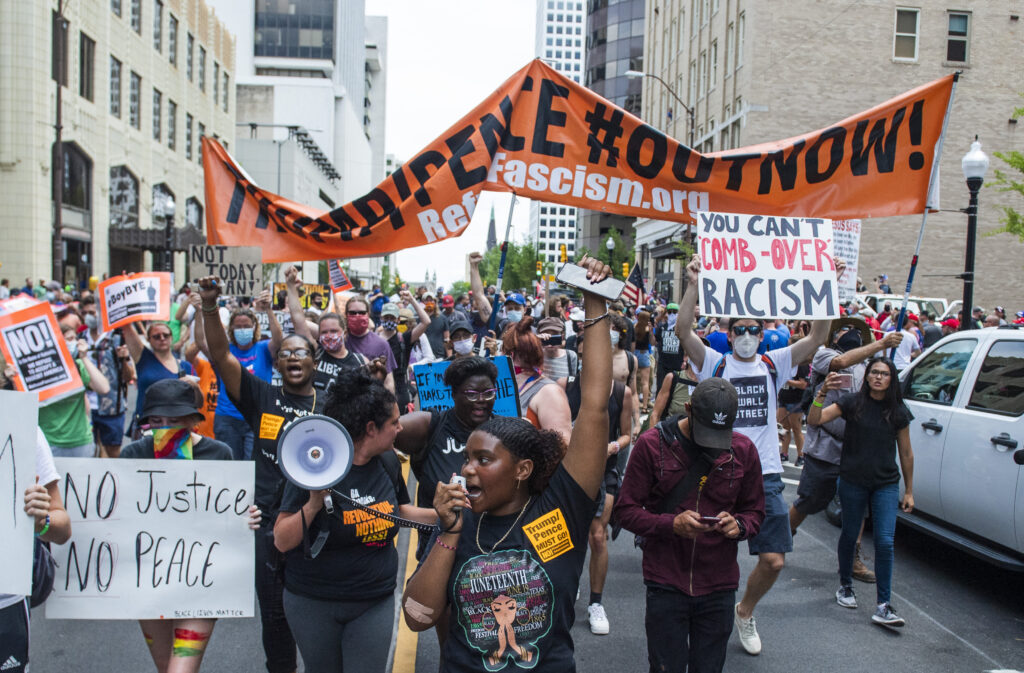
Florida is one of more than a dozen states that have cracked down on protests in recent years, passing laws that often equate political demonstrations with riots in ways that First Amendment experts say could be illegal.
Since 2017, 23 states have passed at least 55 laws to address how and when people can protest, according to the International Center for Not-for-Profit Law, which tracks such statutes. The laws do such things as mandate at least 30 days in jail for rioting — often loosely defined as a group involved in tumultuous or potentially violent behavior — restrict protests on college campuses, and imprison and fine people who block sidewalks, streets and highways.
Some lawmakers like Fine want federal legislation that mirrors those efforts. Among the 16 pending federal bills are proposals to tighten restrictions on protesting near federal judges, jurors or court staff; strip nonprofits of their tax status for certain protest-related activities; and block people convicted of rioting from small business aid.
First Amendment advocates warn that the patchwork of state laws, pending federal bills and court battles risk rewriting the rules of public demonstrations. There are already laws to prosecute violent behavior, making these new efforts unnecessary, they say.
There have been few arrests or prosecutions under the recently passed protest laws, but free-speech advocates say the measures can be used to control or dissuade would-be demonstrators.
“What we have consistently seen is lawmakers responding to protest movements by introducing new laws that restrict the right to protest,” said Elly Page, senior legal adviser for U.S. programs at the International Center for Not-for-Profit Law.
This clash over protest, civil disobedience, political violence and public safety has deepened during President Donald Trump’s second term. Trump and senior administration officials repeatedly threatened to invoke the Insurrection Act — a centuries-old law that enables a president to deploy the military on U.S. soil in extraordinary circumstances — to addresses large protests.
Since June, Trump has deployed the National Guard and Marines to Los Angeles; Washington; Chicago; Memphis; and Portland, Oregon, saying they were needed to protect federal property amid demonstrations against the government’s immigration or crime crackdowns. The moves led to legal challenges and helped test a little-known part of U.S. law that spells out when protest crosses into rebellion.
The U.S. Court of Appeals for the 9th Circuit, which covers much of the West, ruled that the law gives the president broad discretion to decide when civil unrest gives way to revolt. But the 7th Circuit, based in Illinois, disagreed, writing: “A protest does not become a rebellion merely because protesters advocate for legal or policy changes, are well organized, call for major changes to the U.S. government, use civil disobedience, or exercise their Second Amendment right to carry firearms.”
The Trump administration appealed to the Supreme Court, which has blocked the deployments for now while litigation continues.
Some legal scholars warn that the recent push to pass laws that restrict protest risks conflating speech with violence, especially when there are existing laws that criminalize dangerous conduct.
It “presents a real risk of selective enforcement,” said Anastasia Boden, a senior attorney at Pacific Legal Foundation, a libertarian law firm based in Sacramento.
“Sometimes what people are really upset by isn’t actually something like physical violence but the ideas themselves,” Boden said of peaceful protests that devolve into destruction and chaos. “If they are really upset about the externalities, then regulate the externalities.”
Fine, the lawmaker from Florida, often says roadblocking protesters can keep “a pregnant woman from getting to the hospital” or “adults from getting to work.” When The Washington Post asked for specific examples, Fine acknowledged he didn’t have any.
“People want to stand on the sidewalk and yell and scream and say whatever they want, they should do that,” Fine said. “But blocking a road is not a legitimate form of political protest.” Instead, he called it “political violence” that warrants people “getting run over.”
The Florida law gives drivers who hit protesters far less protection that Fine often describes. The Florida Supreme Court ruled that the law cannot be applied to people merely attending a protest that turns violent, meaning drivers aren’t shielded for hitting bystanders who aren’t taking part in disorderly conduct.
It doesn’t grant drivers blanket immunity from criminal charges, nor does it apply to peaceful protesters.
It also makes blocking a roadway during a riot punishable for up to 15 years in prison.
Advocates say there so far have been no prosecutions under the law — which is beside the point for Fine, who said he was focused on deterrence and not enforcement. The goal, he said, is to stop unwanted behavior by making the consequences severe enough to discourage it.
Protest organizers nationwide said they have become more intentional and careful in planning their rallies and marches because of these kinds of laws. That includes asking people to RSVP, which helps keep track of who’s there in case something does happen; keeping some locations secret until after people register to limit counterprotests and police surveillance; connecting people to bail funds; recruiting legal observers; and training people to de-escalate confrontations.
Supporters of the laws have created “a narrative campaign of misinformation” that can have a chilling impact on protest, said Alana Greer, director and co-founder of Community Justice Project and a lawyer who sued Florida over its law. “So much of what they have attempted to do is put out a narrative that encourages vigilante violence and discourages folks because of a generalized idea that things are prohibited.”
She gets calls from organizers double-checking the legality of having news conferences in a public area or a march on a sidewalk — “things no one would have thought twice about before,” she said.
The Rev. Lee Hall-Perkins said knew he was taking a risk this summer when he gathered more than 100 people onto a Florida college campus to protest Medicaid cuts and immigration enforcement.
“We do have the anti-demonstration laws here,” the 36-year-old pastor said afterward.
Most protests are held off campus, but he said he called ahead requesting a meeting with U.S. Rep. Anna Paulina Luna, a Republican whose district office is on college grounds.
“We felt as if we had access and the right to be there,” said Hall-Perkins, who is the senior pastor of Mount Zion United Methodist Church in Clearwater.
They sang freedom songs, held signs and prayed before a casket on loan from a local funeral home as part of the “Moral Monday” campaign. The protest laws try to stop people from “speaking truth to power,” said Hall-Perkins, who added there were no arrests.
“If they want to arrest people for praying and arrest people for having a funeral procession and putting on clergy robes, then that’s on them because it’s going to arrest the attention of the nation,” said Bishop William J. Barber II, president of Repairers of the Breach and the force behind the Moral Monday protests.
The post How new protest laws are impacting political demonstrations appeared first on Washington Post.