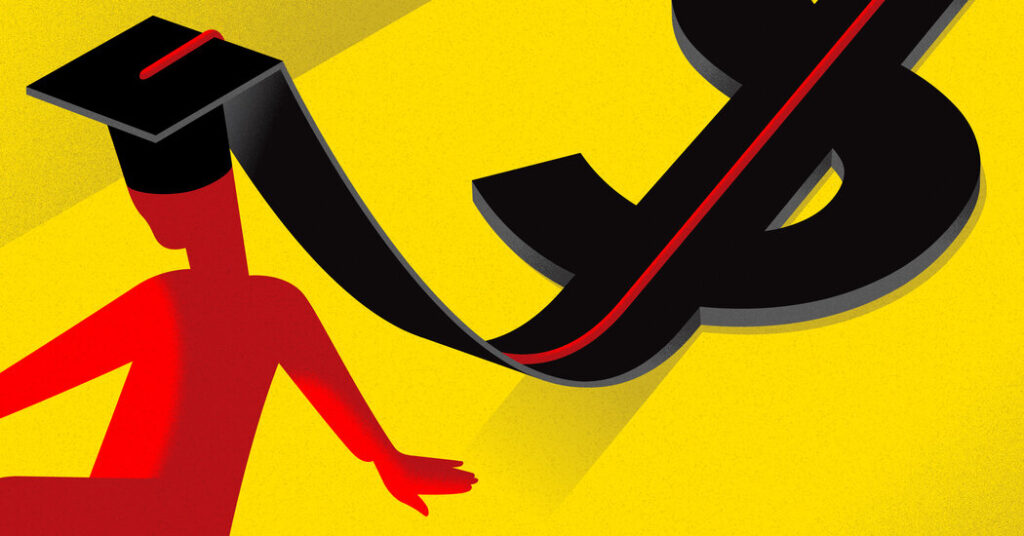
Millions of borrowers have fallen behind on their federal student loans, and the government is preparing to take aggressive steps to collect in 2026.
The federal student loan system, which has been in upheaval because of lawsuits and legislation, remains in flux. In late 2023, the federal government ended a pandemic-era pause on payments and, a year later, resumed reporting late payments to credit bureaus.
If you’re struggling to afford your monthly payments, there are steps you can take to stay current and avoid going into default, which can lead to having payments forcibly deducted from your paycheck or your tax refund. Experts recommend reviewing affordable options now and taking action if needed, to avoid potentially severe consequences.
Here’s what to know.
How many borrowers are behind on student loans?
Almost 10 million borrowers are in default, including about 3.4 million who haven’t been formally moved to the government’s program for defaulted loans, said the financial aid expert Mark Kantrowitz, according to his analysis of federal loan data as of Sept. 30. That represents about a quarter of all federal student loan borrowers. About three million more borrowers have missed payments but aren’t yet in default, Mr. Kantrowitz said.
What’s more, an additional seven million or so borrowers in the doomed SAVE plan will probably be required to choose a new plan and start repaying sooner than many expected. Payments for SAVE borrowers have been paused for more than a year because of litigation, and borrowers may struggle to readjust to making payments, said Abby Shafroth, managing director of advocacy at the National Consumer Law Center. “They’ll be at risk.”
The situation is raising concerns about a wave of fresh defaults, as borrowers also contend with high living costs, an uncertain job market and health insurance turmoil. Nearly half of borrowers said they were making trade-offs to pay both loan payments and basic needs, according to a recent survey of 1,010 federal borrowers conducted for the Institute for College Access and Success, an education research and advocacy group.
“We are concerned that people are not going to be able to afford their payments,” said Michele Zampini, the institute’s associate vice president of federal policy and advocacy.
The Education Department said it encourages borrowers to check StudentAid.gov for online tools and repayment tips.
What if I can’t afford my payments?
The government’s menu of income-driven plans that make payments more affordable by linking them to a borrower’s earnings is changing, and is scheduled to shrink to a single, less generous alternative plan for new borrowers.
But for now, several plans remain available that can reduce monthly costs compared with a standard 10-year payment plan. (In addition to income-driven plans, other variations are available to current borrowers, including a “graduated” option that increases monthly payments over time.) About half of borrowers in the institute’s survey, however, said they had heard just “a little” about such plans, and 15 percent had heard “nothing at all.”
There are currently three available plans, with varying terms, which take a borrower’s income and family size into account when setting monthly payment amounts: income-based repayment, known as I.B.R.; income-contingent repayment, or I.C.R.; and pay-as-you-earn, or PAYE.
Loan experts advise using a loan repayment simulator tool on the federal student aid website to check your eligibility (some types of loans don’t work with certain plans) and see your estimated payment. Then, you can apply online at StudentAid.gov for the plan you prefer.
“The best-case scenario is to find a plan you can afford,” Ms. Shafroth said.
If you’re not sure which payment plan you are on now, check online at your Federal Student Aid dashboard, or with your loan servicer — the company that sends you statements and handles your payments.
The I.C.R. and PAYE plans are scheduled to be discontinued by July 1, 2028. However, if either of those plans offers you a lower payment now, it may be worth enrolling, even though you’ll eventually have to switch, said Persis Yu, deputy managing director and managing counsel at Protect Borrowers, an advocacy group.
The I.B.R. option remains available to people who have already borrowed for college as long as they don’t take out new loans after July 1, 2026. Previously, borrowers had to show “partial financial hardship” to enroll in I.B.R., but that requirement was removed as part of last summer’s federal budget legislation. The loan simulator now reflects the change, according to a Dec. 22 Federal Student Aid website update.
A new income-driven plan, the Repayment Assistance Program, or RAP, is scheduled to begin next July; it is intended to eventually be the sole alternative option for new student loans. Changes will also be made as of July to the standard repayment plan for fresh loans.
How quickly can I move to an income-driven plan?
The Education Department says switching plans is “quick and easy” if borrowers consent to let the department retrieve their tax data directly from the Internal Revenue Service. Scott Buchanan, executive director of the Student Loan Servicing Alliance, a trade group, said that a backlog of applications had largely been resolved and that 90 percent are now processed in two days.
What if I can’t afford my payments, even on a special plan?
Options for managing temporary financial or medical setbacks, like a forbearance or deferment, remain available, loan experts say. Both options allow you to suspend payments for a period of time. But there are drawbacks. In most cases, interest continues to accrue. (With a deferment, interest doesn’t accrue on more affordable subsidized loans.)
And if you are pursuing a loan-forgiveness program that allows your debt to be canceled after making a required number of payments — typically for 20 or 25 years, depending on the plan — a suspension may extend the time to reach forgiveness.
To apply, contact your loan servicer. In some cases, you may need to supply documentation, such as medical bills or proof of unemployment benefits.
If you’re squeezed by credit-card bills, a reputable nonprofit credit-counseling program may be able to help you manage your other debt and tweak your budget so you can pay your student loans. You can search online at the National Foundation for Credit Counseling.
What if I just stop paying my loans?
You’ll be setting yourself up for even more financial woes if you ignore your payments, said Betsy Mayotte, president and founder of the Institute of Student Loan Advisors, which offers free loan counseling. “You’re really going to struggle if you let it default,” she said.
When you default, your loan balance becomes due in full. And your credit score will take a serious hit.
To get out of default, you’ll need to agree to either rehabilitate your loan, which typically involves making a number of affordable payments over a period of time, or consolidate your debt into a new loan. Rehabilitation is generally preferable, Mr. Buchanan said, because the record of default is removed from your credit history (although the record of late payments remains).
To discuss your options, contact your loan servicer; if you are in the late stage of default, you may be referred to Maximus Federal Services, which manages the government’s default resolution program.
If you don’t take action, the debt doesn’t disappear. The federal government has restarted its collections program, which lets it take money directly from your paycheck (called garnishing) to pay your debt. The Trump administration announced in December that it had notified about 1,000 borrowers it would begin to garnish their wages in early 2026, and expects to send out more warnings over time.
“Many people don’t realize the default machinery has turned back on,” Ms. Yu said.
The government also is expected to seize income tax refunds in 2026 to help repay defaulted loans. Many families rely on their refunds, Ms. Yu said, including those resulting from the earned-income tax credit for low-income workers, to pay for costs like medical bills and car repairs. “It’s going to be a huge shock,” she said.
What if I’m in the SAVE repayment plan?
SAVE, the most affordable alternative repayment plan, was already going to be discontinued, and may now be discontinued fairly soon as a result of a settlement between the Education Department and the State of Missouri, which had sued to end the plan. The settlement, announced Dec. 9, awaits a judge’s approval. Under proposed terms, no new borrowers may enroll, any pending applications will be denied and participants must move to new repayment plans. The timeline for the changes isn’t clear; the department has given varying estimates of when it will contact borrowers.
SAVE borrowers who are pursuing loan forgiveness through an income-driven repayment plan, and who have made 25 years (300 months) of qualifying payments, should consider asking to switch to I.B.R. or I.C.R., because they will now be eligible to have their loans canceled in those plans, the National Consumer Law Center advised. The center’s website offers more details about the effects of the settlement.
The post Big Changes Are Coming to Student Loans. Here’s What to Know if You’re Struggling. appeared first on New York Times.