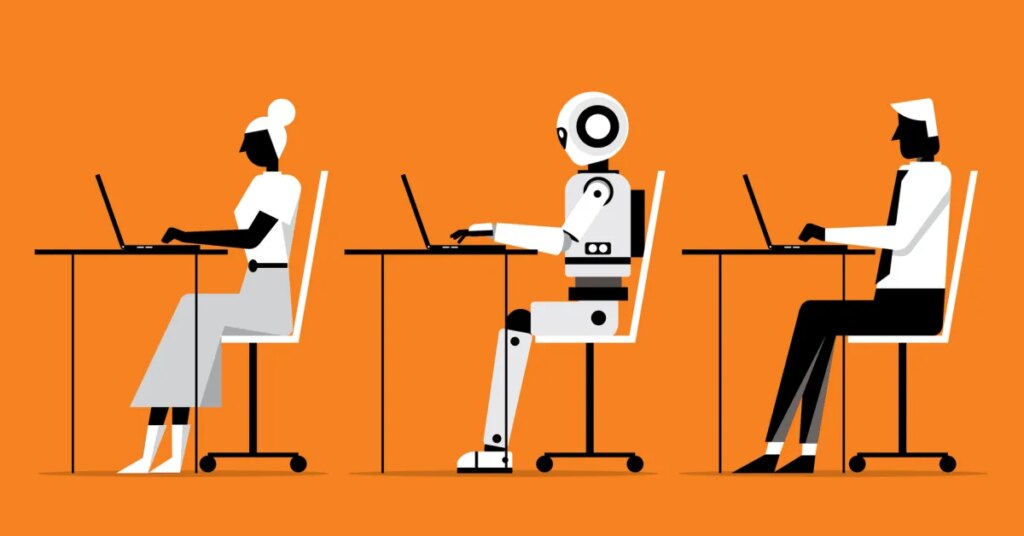
Future historians will see that the seeds of a profound transformation were planted in 2025. By 2050, most people will command workforces larger than the biggest multinational corporations of today. But our “employees” won’t be people sitting in cubicles or standing on factory floors. They will be fleets of AI agents—digital workers which can perform tasks like design products, write code, negotiate supply chains, run complex experiments, and devise marketing campaigns while we sleep.
The speed at which agentic AI has spread throughout the workforce accelerated over the past year. A survey of business executives by PwC indicates that 79% of companies are leveraging agentic AI. And though many have understandably criticized companies which have invested in AI without immediate bottom-line benefits—a phenomenon I call the “productivity J-curve”—agentic AI promises to drive true productivity gains, fueling further adoption.
[time-brightcove not-tgx=”true”]
The most pressing question for the era ahead: What will happen to human workers?
To understand the significance of the agentic AI shift for humans, we must deconstruct the nature of work itself. Almost every valuable task can be broken down into three distinct phases:
- Asking the right question: Defining the problem and the goal.
- Execution: Carrying out the steps to reach that goal.
- Evaluation: Verifying the results and refining the objective.
For most of human history, human workers have had to do all three. But the defining characteristic of this era is that AI is getting astonishingly good at Part 2: Execution.
In my research with Tom Mitchell, we explored how machine learning unlocks “tacit knowledge”—the things we know how to do but cannot explain, like recognizing a face or riding a bike. Previously, we couldn’t automate these tasks because we couldn’t write the rules for them. But agentic AI has changed the game. By learning from data and trial-and-error (often via “reinforcement learning”), AI can now execute complex sequences of actions without needing explicit instructions for every step. It can navigate the digital world, optimize logistics, or write working software code, often better and faster than any human.
This changes the fundamental economics of value. Economics teaches us that when a resource becomes cheap and abundant, the value shifts to its complements. As execution becomes commoditized, the bottleneck—and the value—shifts to asking the right questions and evaluating results.
Consequently, in this new world, many workers will become what I call Chief Question Officers (CQO).
In the coming years, a CQO’s primary job will be to possess the judgment to know what to ask, why it matters, and how to evaluate if the AI has actually succeeded. We will be the architects; the AI will be the builders.
This shift promises an explosion of entrepreneurship and innovation. When anyone with a creative spark can orchestrate a cloud of AI agents to build prototypes, analyze markets, and test hypotheses, the cost of trying something new plummets. We will see a “Cambrian explosion” of new products and services as AI lowers the barrier to entry for solving the world’s hardest problems.
This future, however, is not inevitable. It is a choice.
The “Turing Trap” is the temptation to use AI merely to mimic and replace humans, driving down wages and concentrating power. The same technologies that could empower billions of CQOs could instead be used by a handful of firms or governments to centralize control and surveillance.
The promise of the second machine age is a world where machines augment our minds, not just replace our muscles. But whether AI leads to broad-based empowerment or rigid centralization isn’t a technological question; it is a societal one.
By 2050, the most important question about AI will not be what it can do, but who gets to decide what it does.
The post AI Changed Work Forever in 2025 appeared first on TIME.