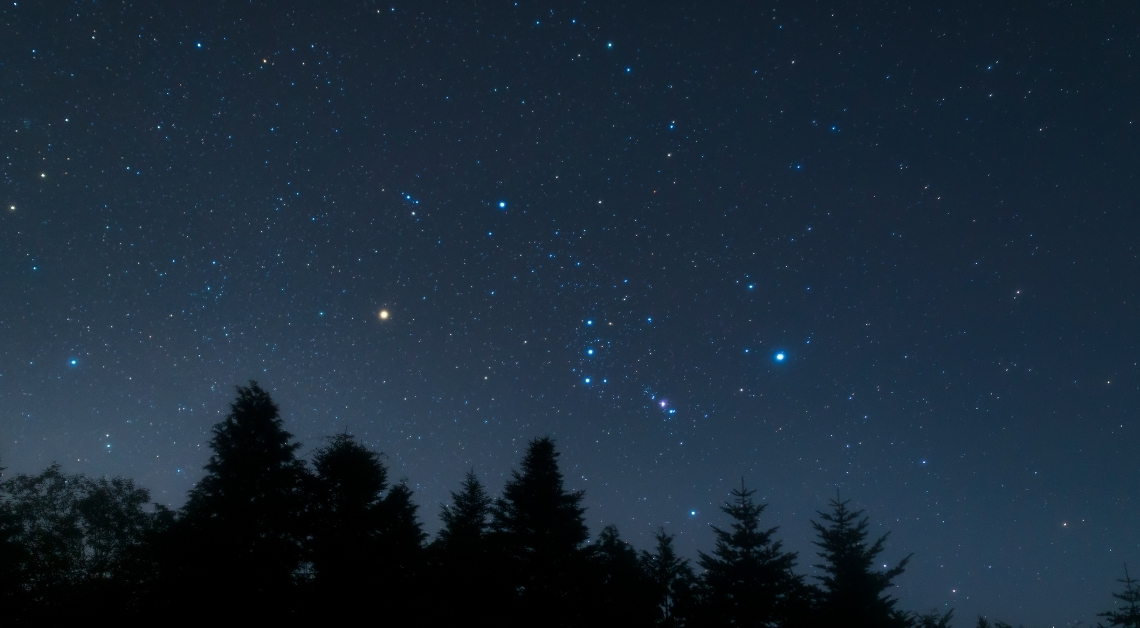
Winter is a fantastic time for wannabe stargazers. The nights start early, the skies tend to be clearer, and the Northern Hemisphere sky fills up with bright stars that form obvious shapes. You don’t need to know celestial coordinates or own serious gear. Just learn a few simple patterns, and you’ll be spotting constellations like a pro.
You also don’t need much equipment. Warm clothes are your biggest asset. Your eyes are enough to get started. Binoculars help once you know where to look. And a small telescope can take things to the next level.
Here are the easiest winter constellations to find, plus what they offer once you’ve locked them in.
1. Orion
If winter had a logo, this would be it. Look south or southeast in the evening for three bright stars in a short straight line. That’s Orion’s Belt. Once you see it, the rest of the figure snaps into place. Betelgeuse glows reddish above, Rigel shines blue-white below. With binoculars, Orion’s Sword reveals the Orion Nebula, a bright cloud where stars are forming.
What you need: Naked eye to recognize it, binoculars to appreciate it.
2. Taurus
Find Orion, then look above him for a V-shaped group of stars anchored by orange Aldebaran. That’s Taurus. Above it sits the Pleiades, a tight cluster that looks like a tiny dipper. You can see it without help, but binoculars turn it into a spray of stars that feels almost unreal.
What you need: Naked eye for structure, binoculars for the Pleiades.
3. Gemini
Two bright stars side by side give Gemini away. Castor and Pollux mark the Twins’ heads. The rest of the constellation is fainter, but once you spot the pair, it’s easy to trace. Binoculars near one foot reveal M35, a loose open cluster.
What you need: Naked eye for orientation, binoculars for detail.
4. Auriga
Look high overhead for Capella, one of the brightest stars in the winter sky. It anchors Auriga, a rough pentagon that shows up even under city lights. Sweep the area below Capella with binoculars and you’ll run into three open clusters, M36, M37, and M38.
What you need: Naked eye to find it, binoculars to explore it.
5. Canis Major
This one is about a single star. Sirius, the brightest star in the night sky, sits low in the south. It flashes colors as it twinkles, an effect caused by Earth’s atmosphere bending its intense light, according to NASA. Once you see Sirius, the rest of Canis Major follows easily.
What you need: Naked eye. Binoculars make the color flicker obvious.
6. Cassiopeia
Look north for a crooked W shape. Cassiopeia circles the North Star all night, making it reliable. From its middle stars, binoculars can pick up the Andromeda Galaxy as a faint, elongated glow on dark nights.
What you need: Naked eye to spot it, binoculars for Andromeda.
7. Ursa Major
The Big Dipper sits low in early winter evenings and climbs higher later at night. Focus on the handle. The middle star looks slightly fuzzy because it’s actually two stars, Mizar and Alcor. Splitting them is a classic eyesight test.
What you need: Naked eye on a good night, binoculars to confirm.
Learn a handful of these patterns and the sky gets a lot less mysterious. You’ll spend less time squinting and more time actually knowing what you’re looking at.
The post 7 Constellations Even Beginners Can Find in the Winter Sky appeared first on VICE.