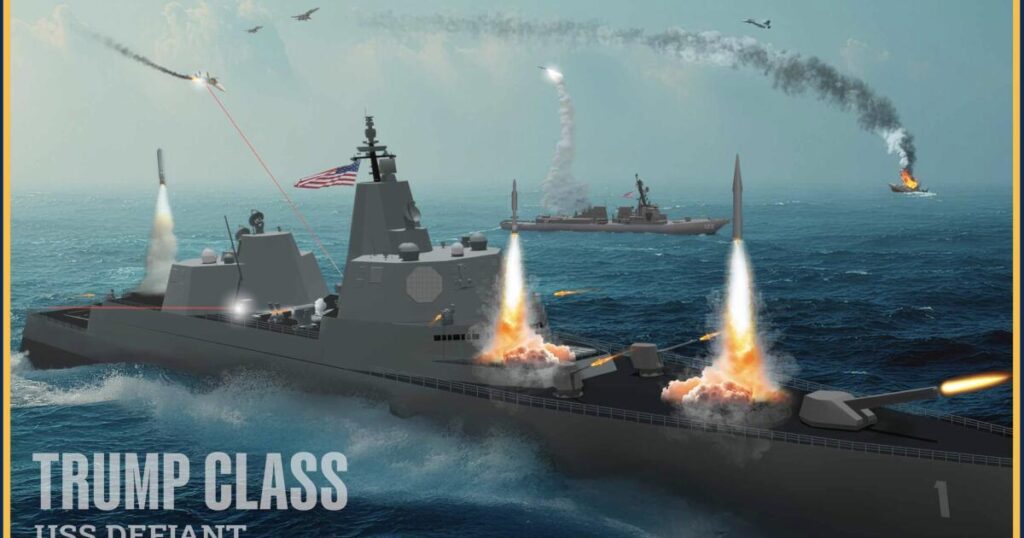
On Dec. 22 at Mar-a-Lago, President Trump — flanked by Defense Secretary Pete Hegseth, Secretary of State Marco Rubio and Navy Secretary John Phelan — announced a plan to build battleships that would be “the largest we’ve ever built.”
He said that starting with his first term, he had been asking, “Why aren’t we doing battleships like we used to?” The new ships, he said, would be known as “Trump Class” vessels. Two will be built at the outset, he said, with as many as 25 ultimately deployed.
Much of the reportage in subsequent days focused on the impropriety of a president’s naming a military program after himself. But that was missing the point, big-time. To answer his question, there are several reasons the U.S. isn’t building battleships like we used to. These big and overarmed behemoths have been obsolete in warfare for many decades.
The cost of the Trump battleships — between $9 billion and $14 billion each — would easily bust the budget for Pentagon procurement. They would contradict the Navy’s existing strategic and tactical doctrines, which call for distributed firepower, not the concentration envisioned in a new battleship fleet. They would take so long to design and build that the first vessels would not be deployable until well into the 2030s.
“If we say 2032 for laying the keel of the first ship, that’s a good six years and at least one additional presidential administration for things to go wrong, and well before the program is capable of building a foundation of political support among labor and industry that might protect it from budget cutting down the line,” notes Robert Farley, an authority and blogger on military strategy.
Mark F. Cancian of the Center for Strategic and International Studies, a Marine veteran with years of official experience working on Defense Department funding, was rather more blunt: “A future administration will cancel the program before the first ship hits the water.”
Trump announced his new battleships with all the hyperbole of almost every announcement he has made as president, dating back to his exaggerated claim of the size of the crowd at his first inauguration.
He promised that his proposed vessels would be “the fastest, the biggest, and by far 100 times more powerful than any battleship ever built.” Well, no. At a maximum displacement of 40,000 tons, they would be about two-thirds the size of the Iowa-class battleships of World War II, which displaced 55,000 tons.
They also would be about half the size of the largest battleship ever built, Japan’s Yamato, which displaced 72,000 tons. The most powerful? Not even close: Cancian notes that the Trump-class guns are expected to be “the standard five-inch (projectile weight 55 pounds) rather than the battleship’s 16-inch (projectile weight over 2,000 pounds).”
That said, the new ships will be equipped with modern weaponry such as guided missiles, some carrying nuclear warheads, but according to standard naval nomenclature, that means they’re misnamed as “battleships.”
Trump’s proposed “Golden Fleet” would turn the clock back to a long-abandoned doctrine that held that bigger was better in warship construction. That idea came under fire as long ago as the 1920s, when advocates of air power showed that battleships were vulnerable to air attack. For one thing, they were fat targets. For another, their armor protected their hulls against attack — the design rationale being that they would chiefly engage enemy vessels in battleship-to-battleship engagements — but their decks were susceptible to assault from the skies.
Gen. Billy Mitchell, who led American air forces during World War I, staged a famous demonstration off the Virginia coast for Navy brass in 1921 with the captured German battleship Ostfriesland as the target. At the climactic sally, six aerial bombs were dropped; none scored a direct hit, but their detonations damaged the hull so severely that the ship sank in 21 minutes.
To promote his call for a separate air force, Mitchell exaggerated the outcome—including the apocryphal claim that admirals witnessing the demonstration “wept aloud” as the target went under. In any case, military planners ignored the lesson.
The next lesson was harder to dismiss. It came at Pearl Harbor on Dec. 7, 1941. Eight battleships were in the harbor when Japanese aircraft launched from carriers more than 200 miles away attacked, sinking four and badly damaging the four others. Pearl Harbor effectively ended the battleship era for the U.S. Navy. The realization was cemented six months later after Pearl Harbor by the Battle of Midway, when carrier-launched aircraft decimated the Japanese fleet in what is largely considered a decisive turning point in the Pacific war.
By the end of the war, the lesson had been learned that “battleships are too big, too expensive, require too many crewmembers, are tough to maintain, are slow and are easy targets for planes and submarines,” writes Allen Frazier of Military.com.
The battleship era received its final, fatal blow in April 1945 when Japan’s Yamato, touted as the ultimate warship and the largest battleship ever built, came under attack from a concentrated force of submarines and some 400 aircraft. The battleship endured two hours of attacks before sinking, with the estimated loss of 3,055 of its 3,332 crewmen.
The last battleship commissioned by the Navy was the Missouri, which was launched in 1944 and initially decommissioned in 1955; by then, the ship had been etched into history as the site of the Japanese surrender ceremony in 1945. She was reequipped, re-armored and recommissioned in 1984 by Ronald Reagan — who was engaged in his own effort to buff up the U.S. war fleet — and saw service during the Persian Gulf War before being decommissioned again in 1992. Like other remaining battleships, the Missouri now serves as a museum ship.
That points to the key question: What is Trump thinking?
To military experts, Trump’s fleet would be hopelessly unsuited to strategic and tactical threats that are already faced by American sea power and likely to become more dangerous by the time the vessels could be deployed.
Judging from Trump’s bluster about his battleships’ size and purported “lethality,” to use his description, “the ‘Trump class’ battleship program seems optimized more to produce a scary-looking vessel than to address the rapidly changing threats to American military power on the open seas,” observes Phillips Payson O’Brien, a professor of strategic studies at the University of St Andrews in Scotland.
Indeed, Trump’s plan conforms more to the he-man approach to defense policy, exemplified by Hegseth’s harangues to Pentagon officers and service members, than to any sober assessment of military needs.
Doubts about whether the Trump fleet will ever come into existence are underscored by the dismal fate of big-budget, long-term Pentagon programs in the recent past.
In November, Trump canceled the Constellation guided missile frigate program, which was originally envisioned to encompass 20 vessels to be built over 20 years at a total cost of more than $22 billion. The program, started in 2017, was beset by cost overruns and slipping deadlines. The cancellation left only two uncompleted ships still under construction after the expenditure of $5.5 billion and a continuing commitment to spend $3 billion more.
Then there’s the Zumwalt-class stealth destroyer program, which was started in 1998 with plans for 32 ships. Only three were ever built. The program was canceled in 2024, at a point when the cost of each vessel had ballooned from $1.3 billion at the program’s outset to more than $8 billion.
This record hints at why the general reaction of military procurement and strategic authorities appears to be that the Trump-class vessels will never see water. At this moment, the program doesn’t exist except in mock-up posters displayed at the Dec. 22 Mar-a-Lago announcement. It doesn’t meet strategic needs, it’s likely to suffer billions of dollars in cost overruns, and it may not survive the next change in administrations.
But that may not forestall the expenditure of billions of dollars between now and the end of the Trump term. Under the circumstances, those dollars will almost certainly be squandered, at a time when the White House and its Republican henchpersons in Congress are telling us that the U.S. can’t afford to provide healthcare to millions of Americans and disaster relief to needy communities coast to coast.
“There’s never been anything like these ships,” Trump said at his announcement. If we’re lucky, there never will be.
The post Trump’s proposed battleship is a budget-busting folly that will probably never sail appeared first on Los Angeles Times.