When an inmate named Ladale Kennedy stopped breathing one night in a New York State prison cell, no one paid it much mind.
No one opened a broad inquiry into the death of Mr. Kennedy, the 1,055th to be recorded in the prison system since 2014.
The local medical examiner classified the incident, in July 2022, as something of an official mystery: cause and manner “undetermined.”
In fact, just before he died, Mr. Kennedy, 41 and mentally ill, had been pepper sprayed by guards, beaten, handcuffed, held face-first under running water and fitted with a “spit hood” — a mesh restraint that is sometimes used to prevent inmates from biting or spitting on officers.
All because he had failed to return some food trays and cups that had been handed to him in his cell.
He had said, “I’m sorry” at least eight times as they pulled him from his cell, video shows. He had told the officers he could not breathe at least 20 times during the entire counter.
Over the past year, the prison system that held Mr. Kennedy has come under enormous scrutiny. Twenty guards were charged in the fatal beatings of two inmates, Robert L. Brooks and Messiah Nantwi. Lawmakers proposed a sweeping measure to strengthen prison oversight, and the governor signed it into law.
But Mr. Kennedy’s case, which passed by largely unnoticed, is a reminder that other men have died after beatings like Mr. Brooks and Mr. Nantwi did — and that the public still has not received a full accounting of those deaths.
The New York Times, after conducting dozens of interviews and reviewing thousands of pages of medical records, court filings and inmate death records, identified three other cases of inmates who died after beatings in the past three years, including Mr. Kennedy.
These new cases bear similarities to the high-profile deaths of Mr. Brooks and Mr. Nantwi. But where those cases stirred outrage, these have gone almost completely unnoticed.
Mr. Kennedy died at Upstate Correctional Facility.
Another inmate, Clement Lowe, 62, told his daughter that guards at Green Haven Correctional Facility had stomped on him and lashed his head with batons before he deteriorated and died of a massive brain bleed in November 2023.
The third occurred in October 2024, when Ameek Nixson, 39, began fighting with another inmate at Fishkill Correctional Facility and was beaten by officers until he went limp, according to records and interviews.
Mr. Nixson’s was the only one of the three deaths that was ruled a homicide, although investigators have yet to determine whether it was caused by the inmate he was fighting or the guards who intervened.
None of the deaths have resulted in criminal charges.
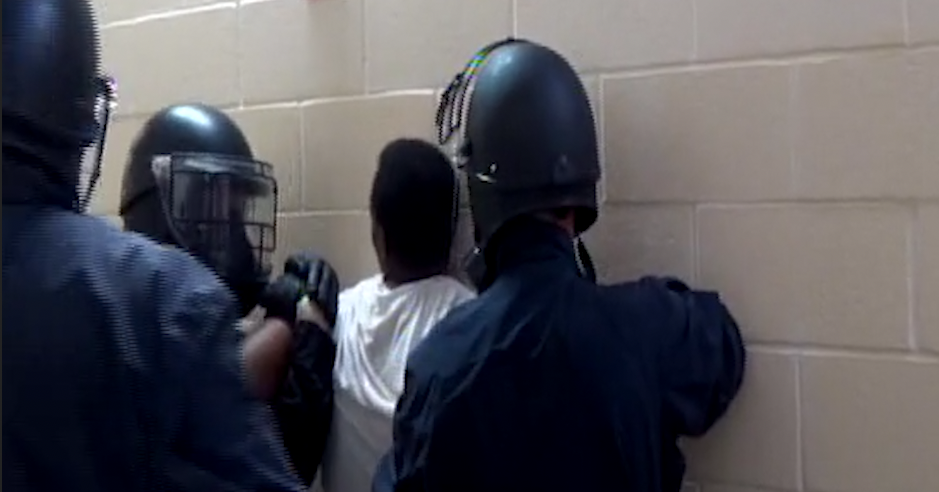
Only Mr. Kennedy’s beating was captured on video, but many of the recorded actions are obscured by poor angles or guards’ bodies.
The New York State attorney general’s office, which is required by law to conduct an inquiry into every in-custody death, took the rare step of hiring an independent reviewer in April to scrutinize the medical examiner’s ruling in the case.
That reviewer, Dr. Christopher Milroy, said he was not able to determine what caused Mr. Kennedy’s death.
One expert who reviewed the case at the request of The Times called the findings into question.
“They put a spit hood on, that you can see,” said the expert, Dr. Michael Baden. “He starts at that point saying he can’t breathe.”
Dr. Baden, a former New York City chief medical examiner and longtime consulting pathologist who spent decades on a state board reviewing in-custody deaths, said: “In my opinion, this was a death from asphyxia caused by the spit mask.”
In a statement, a spokeswoman for the New York State Department of Corrections and Community Supervision said that evidence had shown that the prison staff members had not caused the deaths of any of the three inmates.
The rate of deaths per year in the correctional facilities has been on the rise even though the number of people being held in the prisons has declined, the records show. Last year the death count hit 144 — the highest number in the past seven years.
State law requires each of those deaths to be investigated, but the results of those inquiries are often not made public. That makes it difficult to know what surfaced during the investigations and how thoroughly the cases were reviewed.
Current and former inmates, advocates for the incarcerated and state watchdog officials said they have long suspected that many more of those deaths followed violent encounters with guards than has been publicly known.
“There is no accountability,” said Jose Saldana, a former New York prison inmate who runs a nonprofit that lobbies for the release of older prisoners. “If Robert Brooks’s brutal murder wasn’t inadvertently captured on a camera, they would have gotten away with it.”
‘I can’t breathe’
After the killing of George Floyd by Minneapolis police officers in 2020, the New York State legislature passed a law requiring all in-custody deaths to be thoroughly investigated.
It assigned the task of reviewing the cases to a newly created unit within the attorney general’s office, which would be empowered to supersede local law enforcers, gather evidence and issue public reports.
Over the years, the law was refined to add more protections for the incarcerated, in particular, including a requirement that the corrections department post information about prisoner deaths online within 48 hours of notifying the prisoner’s next of kin.
But the case of Mr. Kennedy shows that even a system that was designed to be robust has its limitations.
Mr. Kennedy was still a teenager when, according to his mother, he fell in with the wrong crowd. At 17, he was accused of killing a man in the Bronx in a gang-related shooting, convicted of second-degree murder and sentenced to 25 years to life.
Inside the prison system, he began showing signs of mental illness — including fits of paranoia and hallucinations — and was often at odds with guards and other inmates.
In summer 2022, he had been accused of fighting another prisoner and ordered held in solitary confinement despite his often fragile mental state, prompting him to write to state officials that the guards at Upstate prison were torturing him and that he needed to be transferred “before an officer murders me.”
Not long after, on July 30, guards dressed in riot gear assembled outside Mr. Kennedy’s cell for a “cell extraction” over concerns that he had kept items from the mess hall.
Their actions were captured on a hand-held video camera in accordance with department policy.
Although the camera’s view is often obscured by the guards, the video shows the officers blasting Mr. Kennedy’s cell with pepper spray and storming inside. They appear to strike him as he calls out apologies and begs the officers not to kill him.
Soon, they walk him, handcuffed, down a corridor to a shower cell, where they turn on the water, and he can be heard gurgling as they hold his face in the stream, ostensibly to wash away the pepper spray.
One of the guards accuses Mr. Kennedy of spitting, and he is taken to another room, where they pull a mesh spit hood over his face.
A nurse enters the room and he tells her: “I can’t breathe, ma’am.”
“All right, well stop spitting,” she replies, and then leaves the room.
They ignore his repeated protests that he cannot breathe — and signs that his legs were giving way — and carry him back to his cell, where they leave him alone for the next several hours.
When prison guards finally opened the cell to check on him, they found he had stopped breathing.
A local forensic pathologist, Dr. Laura Schned, conducted an autopsy for the Franklin County Coroner’s Office, in which she noted lacerations to Mr. Kennedy’s head and body and fractured ribs — possibly caused by emergency efforts to revive him. He was found to have no toxic substances in his body.
Ultimately, Dr. Schned concluded that it was impossible to say what had led to his death. She marked down its cause and manner as “undetermined,” and Mr. Kennedy became one of 121 inmates over the past decade whose deaths were initially attributed to “unknown causes” — a number that included Mr. Brooks, records show, before his case was reclassified as a homicide.
Dr. Schned did not respond to requests for comment.
At that point, the New York State Police opened an investigation into Mr. Kennedy’s death and the attorney general’s office began a preliminary review, but months passed with seemingly no developments.
Earlier this year, unsure of Dr. Schned’s finding in the case, the attorney general’s office hired an independent expert, Dr. Milroy, a renowned forensic pathologist at the Ottawa Hospital in Ontario, Canada, to review her conclusions.
Dr. Milroy concluded that it appeared the guards had not caused his death.
In an interview he said he considered the spit hood as causing the death but added that, in his opinion, too much time had elapsed between when Mr. Kennedy was put in the hood and when he stopped breathing.
“The specific cause of death could not be determined, and I would stand by that,” he said. “People don’t typically die of delayed asphyxiation.”
The Times filed a freedom of information request for the report laying out the basis for his findings, but the attorney general’s office did not provide it before this article was published.
On Dec. 22, the office sent a letter to the local district attorney informing her that Mr. Kennedy’s death did not meet the criteria for further scrutiny from the in-custody death unit.
Nicole March, a corrections department spokeswoman, said that video showed that the force used during the cell extraction was consistent with agency policies and procedures and that Mr. Kennedy had been assessed by a nurse.
She said that his death had been thoroughly investigated by multiple agencies and that evidence supports that he was alive for 10 hours before he was found unresponsive in his cell.
Mr. Kennedy’s mother, Dorothy Charley, remains at a loss.
“Somebody killed him,” said Ms. Charley, who filed a still-pending lawsuit over her son’s death. “It seems like they can do all of this — and get away with it.”
Pleading for help
About a year after Mr. Kennedy died, Mr. Lowe was showing signs of medical distress in the same prison.
He had been incarcerated since 2000 and was serving up to 49 years for attempted murder, kidnapping and other crimes. For days, Mr. Lowe had been slurring his words, vomiting constantly and unable to hold eye contact with other people — all signs of a possible brain injury. But the prison officials in charge of his care failed to get him outside help until it was too late.
He died in a hospital in Albany on Nov. 7, 2023. After an autopsy, a forensic pathologist, Dr. Bernard T. Ng of Schenectady Pathology Associates, ruled his death to be of natural causes.
Mr. Lowe’s case underscores how inmate deaths can receive that classification even after the prisoner was involved in a violent encounter with guards.
He was 62 and had a history of stroke and diabetes. But on Oct. 7, 2023, weeks before he died, guards at Green Haven Correctional Facility had struck him with batons in the head, stomach and ribs, Mr. Lowe told his daughter.
The guards were upset over an assault they said another inmate had committed on a correction officer and had set out to teach the other prisoners a lesson, according to an inmate who witnessed the beatings and complaints received by a state watchdog panel.
After the beating, he was driven by bus some 300 miles to Upstate prison, where he began to deteriorate.
It was not a subtle process, said his daughter, Jessica Lawman, who recalled her desperate efforts to get him medical care. She said he was complaining of splitting headaches. Then that he could not hold a pen or feed himself. Then vomiting, slurring and an unsteady gait.
She went to visit him, and a guard pushed him out in a wheelchair, Ms. Lawman said. He was emaciated and drooling, she said.
Still, despite pleas from Mr. Lowe and Ms. Lawman, the prison medical staff offered him no additional care, Ms. Lawman said. They did not even ensure that he was getting his medication for diabetes and other ailments, she said.
“His death could have been avoided if he had gotten the care he needed and if he was never beaten,” said Ms. Lawman, who filed a lawsuit that is still pending in state court.
After the autopsy, Dr. Ng concluded that Mr. Lowe had died of a massive intracerebral hemorrhage.
In an interview, Dr. Ng said that he had not been aware of the beating Mr. Lowe received when he did the autopsy but that he found no signs of trauma on his body.
“Does severe head trauma in the past increase the likelihood of a stroke? Yes, that is possible, but also hypertension and diabetes can as well,” he said. “He had a number of things against him that can lead to the final clinical presentation.”
Dr. Baden, the pathologist consulted by The Times, said the ruling of death by natural causes seemed not to take into account Mr. Lowe’s complaints of being beaten before he fell ill — and the failure of the prison medical staff to care for him.
“There is evidence the person is getting worse,” Dr. Baden said. “It takes weeks for this to get this bad.”
Ms. March, the corrections department spokeswoman, said, “There was no evidence of trauma identified, which refutes the claim that an earlier beating of Lowe caused his death.”
She said that department investigators did, however, find evidence to show that certain Green Haven staff had engaged in an unnecessary use of force, and they were disciplined. One was arrested and prosecuted, she said.
Mr. Lowe was one of 978 people over the past decade whose deaths were attributed to natural causes while in the custody of the state prison system, records show.
Gray areas
More so than the cases of Mr. Kennedy and Mr. Lowe, the death of Mr. Nixson shows the gray areas that in-custody deaths can inhabit.
Mr. Nixson was 12 months into a five-year sentence for drug selling when he arrived at Fishkill Correctional Facility in fall 2024. He had been transferred there after an inmate at another prison had slashed his face, his mother, Laurie Willis, said in an interview.
Weeks later, for reasons that remain unclear, Mr. Nixson approached a prisoner with whom he had been friendly and took a swing at him in a housing area, according to that inmate and other prisoners who witnessed the incident.
The two men tussled briefly on the floor before guards intervened, the inmates said. One jumped on top of Mr. Nixson, landing with his knee on Mr. Nixson’s head, and others piled on, the inmates said.
After Mr. Nixson and the other man were handcuffed and separated, the guards began to beat them, according to the inmates and witness statements obtained by The Times.
They slammed Mr. Nixson onto a stove top, said one of the inmates, Jeffrey Wynn, in an interview at the prison.
Another witness, David Josaphat, 47, said the guards were punching Mr. Nixson in the head.
“They were bending their arms as far as they could,” said Mr. Josaphat, who was released from prison in March.
Other inmates shouted for the guards to stop, the inmates said, and the officers dragged the men into a hallway.
Accounts differ as to what happened next, but the man whom Mr. Nixson punched told The Times that after they were out of view of the other inmates, the guards kicked and punched them in the head, stomach and groin.
When the man looked over at Mr. Nixson, he said, Mr. Nixson’s eyes were fixed, his head lolled and it appeared he could not stand. The man spoke to The Times on condition of anonymity because he feared reprisals for Mr. Nixson’s death, which he said he did not cause.
Soon after, a nurse reported that Mr. Nixson was cold and clammy and had no pulse, according to the witness statements in a State Police investigative report obtained by The Times.
Mr. Nixson’s autopsy was conducted by a Dr. Jennifer L. Roman, a forensic pathologist in nearby Orange County.
Dr. Roman discovered that Mr. Nixson had severe heart disease that contributed to his death. But the manner, she concluded, was homicide.
Still, the case presented a challenge for investigators. It was not clear whether it was the fight with the inmate or the response by the guards that had caused his death.
The officers involved were wearing cameras, as required by policy, but none were activated during the incident, and no security cameras were installed in the housing area at the time, records show.
Four of the guards involved declined to speak with investigators without a union representative present.
The State Police opened an investigation but closed it months later. The attorney general’s office is still reviewing the case.
Ms. March, the correction department spokeswoman, said the agency’s investigators reached the same conclusion as the local pathologist.
“Staff did not cause the death of Ameek Nixson,” she said. “Nixson’s minor abrasions to his face and knee and small cut to his thumb were consistent with the fight he had engaged in with the other incarcerated individual and responding staff using force to break up the fight.”
She added, however, that staff members had been found to have violated department policy by failing to activate their body-worn cameras during the incident, and they were retrained on the policies.
Despite the murky circumstances, Mr. Nixson’s mother, Ms. Willis, remains convinced that the guards were responsible.
She has filed a lawsuit in the hopes that the civil courts can bring her the clarity that the criminal justice system has so far failed to provide.
“I know my son is in heaven right now saying, ‘My mom never gave up,’” she said, and then added: “I’m living a nightmare.”
Bianca Pallaro contributed reporting and Arijeta Lajka contributed reporting and video production. Amogh Vaz also contributed video production.
Jan Ransom is an investigative reporter for The Times focusing on the criminal justice system, law enforcement and incarceration in New York.
The post They, Too, Died After Beatings by Guards. No One Raised an Alarm. appeared first on New York Times.