Beasts of the Sea
by Iida Turpeinen
The action in Turpeinen’s BEASTS OF THE SEA (Little, Brown, 277 pp., $28) spans roughly 200 years, but its implications are timeless. Translated from the Finnish by David Hackston, this eloquent, impassioned novel uses the demise of a gentle mammal to chart mankind’s evolution from arrogant explorer of nature to “as great a threat as an asteroid or flood” to other species.
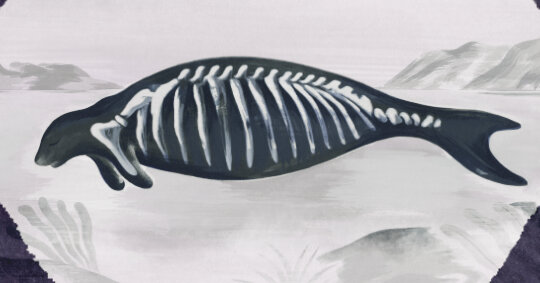
We first encounter Hydrodamalis gigas, commonly known as the sea cow, in 1741, through the eyes of Georg Wilhelm Steller, a naturalist accompanying Vitus Bering’s expedition to the Russian Far East. Its flesh, with a taste “like the finest veal,” sustains Bering’s crew after a shipwreck, which more or less seals its fate. By the time the novel returns to Alaska in 1859, the creature has been hunted to extinction. When a Finnish zoology professor turns up at the Russian governor’s mansion in search of a skeleton, no one has seen a living sea cow for a century.
What’s left are assortments of bones “put together in museums like enormous jigsaw puzzles” — a task taken up in the novel’s final section, set in the 1950s, by a Helsinki artist whose evenings have been spent cataloging the egg collection of an enormously rich viscount. One of the aristocrat’s prized possessions comes from a great auk, a bird that now, among an increasing number of others, shares the fate of the sea cow. Our final glimpse of this mysterious beast — “so large and so meek, so irrevocably departed” — is in the silent gallery of a local museum, evoking “a faint, all-consuming sorrow.”
I Am You
by Victoria Redel
The narrator of I AM YOU (SJP Lit/Zando, 304 pp., $28) is Gerta Wyntges, about whom little is known apart from her status as servant and apprentice to the 17th-century Dutch painter Maria van Oosterwijck. From this, Redel has reconstructed a vibrant depiction of Amsterdam’s golden age, filled with conspicuous consumption and even more conspicuous artistic rivalries.
Most intriguing, though, is the novel’s fevered emotional dynamic as Gerta, who was made to dress as a boy during her childhood years serving Maria’s family in provincial Voorburg, grows up to have ambitions and affections that strain her relationship with the woman who has lifted her out of poverty. Gerta’s own artistic talent is nurtured clandestinely, as is her growing intimacy with her employer. Two women living alone arouse gossip, but they’re also guarding a secret that could threaten them with financial ruin.
Over time, the purpose of Gerta’s service with Maria changes: Now it’s “to make possible an artistic life she could no longer accomplish alone.” Will her devotion to Maria be enough to sustain them? “At what point,” she asks, “was I my own creation? At what point was I creating her?”
The Jaguar’s Roar
by Micheliny Verunschk
Inspired by the portraits of two Indigenous children in an exhibit in São Paulo, as if they were “part of the fauna,” a modern-day Brazilian woman attempts to tell their story “through the cracks” of history. And so Verunschk becomes one of the characters in THE JAGUAR’S ROAR (Liveright, 159 pp., $27.99), her lyrical pastiche of colonial impressions. Chief among these invented perspectives is that of the young girl she calls Iñe-e, who was sold to a pair of German scientists in the early 1800s and brought from the Amazon jungle to the Bavarian court, where she and her male companion soon died.
Translated from the Portuguese by Juliana Barbassa (a former editor at the Book Review), Verunschk’s narrative provides a vivid sense of Iñe-e’s confusion and terror. Crossing the Atlantic, she is shocked to find herself on “a river with no banks.” Watching the scientists perform taxidermy, she fears they will inflict the same torture on her. In the palace, she’s frightened by the chilly stillness of the little princesses’ dolls, especially since she’s treated as yet another plaything. Worst, though, is catching a glimpse of her companion’s head on an office shelf, lopped off during an autopsy after he succumbed to pneumonia.
The Burning Grounds
by Abir Mukherjee
I’m late in discovering the acerbic charms of Mukherjee’s Wyndham and Banerjee historical crime novels, set in 1920s Calcutta. But that didn’t stop me from devouring his latest, THE BURNING GROUNDS (Pegasus Crime, 373 pp., $28.95), in which the murdered corpse of one of India’s most eminent philanthropists is discovered on the burning ghats, about to be cremated but for a fortuitous downpour.
Capt. Sam Wyndham of the Imperial Police Force is assigned to the investigation, and although he and his former associate, Surendranath Banerjee, are estranged, they reluctantly resume their partnership after one of Suren’s relatives goes missing under violent circumstances. Add to the mix a glamorous international movie star, a pushy American agent, the philanthropist’s discarded wife and his imperious son, and you have a properly complex plot that will draw Sam and Suren from a rural film set to the splendors of the Great Eastern Hotel and a seedy dive known as the Butterfly Canteen. Along the way, they will both suffer more of what Suren calls “life’s bruises … upon my soul.”
The post Sumptuous New Historical Fiction appeared first on New York Times.