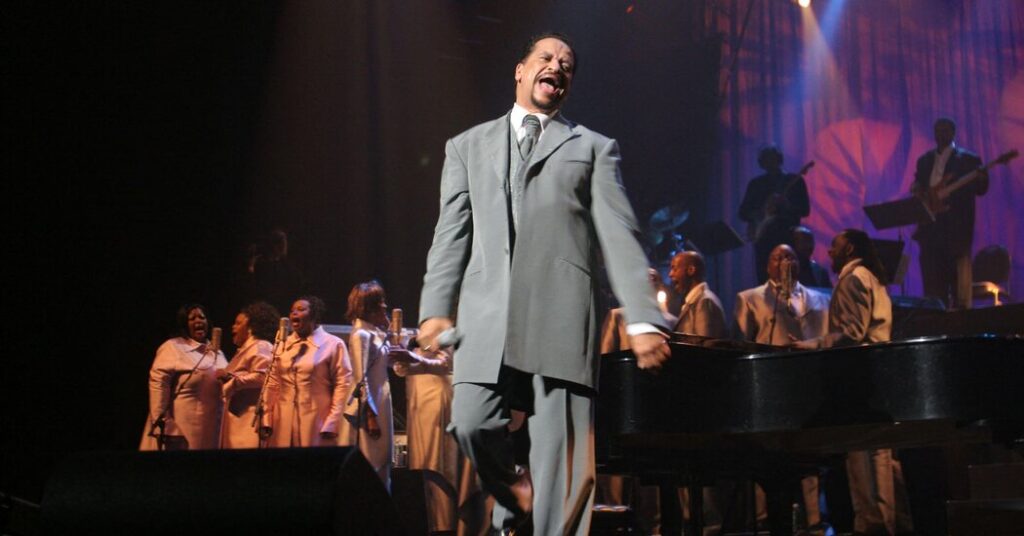
Richard Smallwood, a classically trained composer and singer who grafted Baroque influences onto traditional gospel sounds to create a steady stream of hits, many of which were later recorded by a long list of stars, including Stevie Wonder, Destiny’s Child and Whitney Houston, died on Tuesday in Sandy Spring, Md. He was 77.
His publicist, Bill Carpenter, said the death, in a rehabilitation facility, was from complications of kidney failure.
Mr. Smallwood emerged in the late 1970s as the head of his group the Richard Smallwood Singers, part of a wave of “progressive” gospel musicians who brought the sounds of the Black church into the musical mainstream.
After several years performing in Washington, their hometown, and other cities, the group released their first album, “The Richard Smallwood Singers,” in 1982. It spent 87 weeks on the Billboard Gospel charts.
Mr. Smallwood’s music was grounded in gospel traditions, and his lyrics always dealt with religious themes. But he also wove in secular and classical influences, making his work more widely appreciated but also somewhat controversial among gospel music purists.
“People in the industry said, ‘Why do you put that classical stuff in there?’” he said in a 2016 interview for the Grammy Awards website. “And I just said, ‘That’s me, that’s what I write.’”
At the same time, he resisted pressure to take out explicit references to Jesus and God in order to make his music palatable to more listeners.
“Then the song is completely watered down, and by the time they’re finished doctoring it so it can be accepted on a pop station, it’s actually not a gospel song anymore, as far as the message is concerned,” he told The Washington Post in 1989.
Mr. Smallwood was multitalented: He wrote and arranged the music, played piano and sang baritone. He was nominated for eight Grammy Awards, and he received four Dove Awards, given by the Gospel Music Association.
Ms. Houston, who grew up listening to Mr. Smallwood’s music, chose his song “I Love the Lord” for inclusion on her soundtrack for the 1996 movie “The Preacher’s Wife,” in which she also starred.
The album sold nearly three million copies, making it one of the best-selling gospel records of all time.
In recent decades, Mr. Smallwood spoke openly about his ongoing struggle with clinical depression, and how he learned over time to channel his feelings of sorrow and inadequacy into his music.
He wrote one of his best-known songs, “Total Praise,” after spending months caring for his aging mother, as well as for a friend who was dying of cancer.
“I felt left by God,” he told The Washington Post in 2015. “I was trying to write a pity-party song, but God pulled me to do a praise song. God said, ‘I want your praise no matter what the situation you are in, good or bad.’ It’s about trusting him.”
Richard Lee Smallwood was born on Nov. 20, 1948, in Atlanta. His mother, Mabel (Locklear) Smallwood, managed the home, and his father, the Rev. C.L. Smallwood, was a traveling preacher who, when Richard was 10, settled the family in Washington, where he founded the Unity Temple Baptist Church.
Richard had a strained relationship with his father, who regularly beat him. At the same time, Richard was heavily involved with the music program at Unity Temple, an early education that put him on his path toward a career in gospel.
He was equally inspired by his mother, a lover of classical music who took him to performances by the National Symphony Orchestra and bought him a baby grand piano before he was 10.
Shortly before his mother’s death in 2005, she told him that Mr. Smallwood was not his biological father; rather, she said, Richard was the product of a brief affair she had with another preacher, whose name she could not remember.
In high school, he was further encouraged to pursue music by a teacher who had recently graduated from Howard University, Roberta Flack, who would go on to lead her own chart-topping singing career.
Mr. Smallwood studied music at Howard, where his classmates and friends included the actress Phylicia Rashad, the singer and keyboardist Donny Hathaway and the actress and singer Debbie Allen. He graduated in 1971.
He later returned to Howard to study theology, receiving a Master of Divinity Degree in 2004.
He taught private music lessons and directed the choir at Unity Temple before founding the Richard Smallwood Singers in 1977.
Mr. Smallwood performed for three presidents — Richard M. Nixon, Ronald Reagan and Bill Clinton — and he and the Richard Smallwood Singers toured the Soviet Union in 1989, shortly before its collapse.
Mr. Smallwood never married. He is survived by two stepbrothers and three foster sisters.
The Richard Smallwood Singers released eight albums from 1982 to 1996, when Mr. Smallwood broke up the group. He soon started a new one, Vision, which continued to perform until his health problems left him unable to participate.
Mr. Smallwood received numerous honors during his career, including a 2006 induction into the Gospel Hall of Fame. In 2024 the National Symphony Orchestra put on a two-day celebration of his 75th birthday at the Kennedy Center.
“Songs of pain last,” Mr. Smallwood told The Washington Post in 2015. “They make a difference. My prayer has always been, ‘Give me songs that last.’ I want my songs to last after I’m gone.”
Clay Risen is a Times reporter on the Obituaries desk.
The post Richard Smallwood, 77, Choral Leader and Composer of Gospel Hits, Dies appeared first on New York Times.