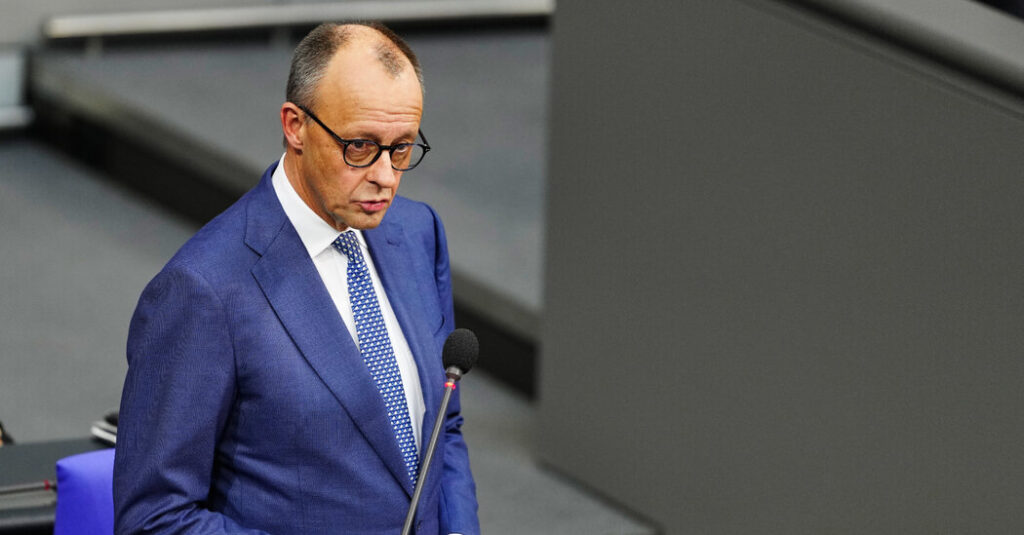
In his first New Year’s Eve address since taking office in May, Chancellor Friedrich Merz of Germany warned Germans on Wednesday that their country’s eight-decade partnership with the United States — the bedrock of Germany’s post-World War II security — is “changing.”
That shift, Mr. Merz said, would require European nations, including Germany, to do more to protect themselves against external threats, including Russia.
“Our partnership with the United States of America, which has long been the reliable guarantor of our security, is changing,” Mr. Merz said in his speech, copies of which were circulated to journalists ahead of its televised broadcast on Wednesday evening. “For us Europeans,” he continued, “this means that we must defend and assert our interests much more strongly by ourselves.”
Mr. Merz did not specify exactly how the relationship with the United States was changing, or why. But his intervention follows increasingly clear signals from the Trump administration that, breaking with 80 years of trans-Atlantic military partnership, it no longer sees Europe’s defense as a core American priority, even amid growing fears of Russian aggression.
In early December, the administration issued a new national security strategy paper that called for European nations to take “primary responsibility” for their own defense, said the United States should align with “patriotic European parties” — code for Europe’s far-right movements — and took aim at Europe’s centrist-led institutions.
Against that backdrop, Mr. Merz spoke in his speech of the need to “safeguard peace and freedom in Europe,” adding that, “After all, we are seeing more and more clearly that Russia’s aggression was and is part of a plan targeted against the whole of Europe. Germany is also facing sabotage, espionage and cyberattacks on a daily basis.”
Mr. Merz’s words marked a continuation of the government’s policy of preparing Germans, both psychologically and materially, for a new era of greater security risks. Already this year, Germany has removed limits on military spending from its Constitution, allowing the country to spend billions more on arms. And it has begun an initiative to increase the number of German soldiers by nearly 50 percent over the next decade.
Addressing the nation on Wednesday, Mr. Merz sought to reassure Germans that their country is in a position to weather the upheaval.
“We are not the victims of extraneous circumstances. We are not at the mercy of great powers. Our hands are not tied,” he said in the traditional New Year’s Eve address that is broadcast nationally on a number of public television and radio channels.
“Germany is a great country that has, time and again, reinvented itself, emerged stronger from crises, given rise to new cohesion and offers all of its citizens a livable and lovable home,” he said.
The speech comes almost eight months into Mr. Merz’s tenure, amid a general weariness with the government. Mr. Merz has record-low approval ratings as many wait for the German economy to emerge from a yearslong slump. A beneficiary of that disapproval is the far-right Alternative for Germany party, or AfD. Despite being labeled extremist by the country’s intelligence agency, the party has been polling neck and neck with Mr. Merz’s Christian Democrats for months.
Similar to a State of the Union address by the U.S. president, the tradition of a yearly speech by the German leader dates back to before World War I. The roughly 10-minute speech gives modern chancellors a chance to flaunt their successes and present their upcoming plans directly to their citizens. Unlike its American counterpart, it is not treated as a political event and no public rebuttals are broadcast.
While these speeches generally focus on domestic politics, Mr. Merz spent much of his time on international politics and Germany’s position in a world where conventions on both trade and diplomacy are rapidly devolving.
“We want to be able to defend ourselves so that we do not have to defend ourselves,” he said.
Christopher F. Schuetze is a reporter for The Times based in Berlin, covering politics, society and culture in Germany, Austria and Switzerland.
The post Relationship Between U.S. and Germany Is ‘Changing,’ German Leader Says appeared first on New York Times.