Mahsa Khanbabai peered through the small glass window of a locked door in an immigration jail in Basile, La., watching two Immigration and Customs Enforcement agents question a young Turkish woman.
For six weeks, Ms. Khanbabai, a lawyer, had been fighting to free the woman, Rumeysa Ozturk. That day, a judge had agreed, but that was courtroom success, legal success. The young woman was still behind bars.
Ms. Khanbabai had feared this. Since the woman’s dramatic March arrest in Somerville, Mass., the Trump administration had been eager to keep her in captivity. It was May 9, a Friday afternoon, and Ms. Khanbabai expected the jail to close for the weekend at 5 p.m. If Ms. Ozturk were not released by then, her lawyer worried, she might not be released at all.
But a few minutes earlier, the two agents had finally retrieved Ms. Ozturk. Through the window, Ms. Khanbabai could see her filling out final paperwork. So why was the lawyer, 5-foot-4 on tiptoe, perched at the window as if she could micromanage the process? Chiding herself, she glanced away.
When she looked back, the young woman had disappeared.
Ms. Khanbabai felt a stab of panic.
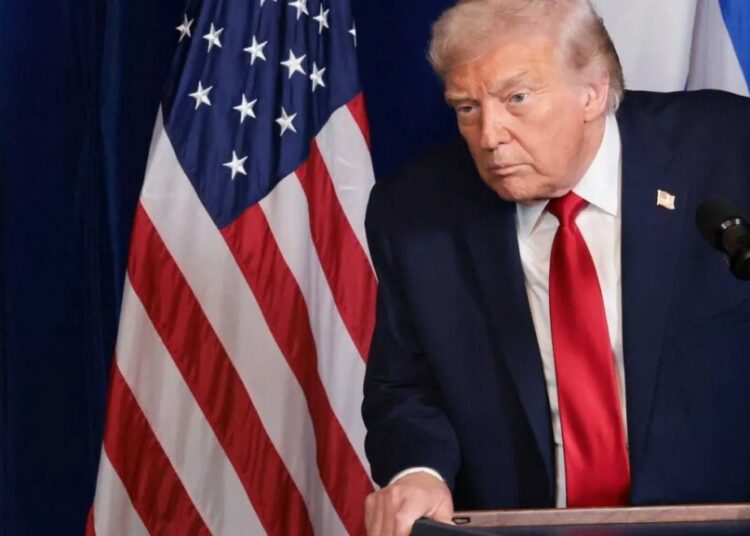
In the nine months since Ms. Ozturk’s detention, tens of thousands of people have been taken into ICE custody, a way station before their forced removal from the United States. The mass deportation of immigrants was a fundamental part of President Trump’s 2024 campaign, and voters were enthusiastic. But in some cases, the Trump administration has bent rules and tested laws, transporting detainees in the dead of night, on military planes, to countries not their own.
Ms. Khanbabai was among the first lawyers to confront the deportation machine in a high-profile episode. Few knew how the administration might behave, or what laws and norms would be heeded.
That day in Louisiana, Ms. Khanbabai had to improvise minute-by-minute decisions outside a rule-bound courtroom.
Ms. Ozturk declined to speak for this article, or to have her picture taken. But Ms. Khanbabai’s account provides a look into the experience this year of immigration lawyers, who are fighting for clients against an administration that they no longer trust to follow the rules.
“A David and Goliath situation,” said Ms. Khanbabai, in one of several interviews with The New York Times in which she shared details of the episode. “It feels overwhelming.”
Asked for comment, the Department of Homeland Security, which ICE is part of, provided a statement: “The Trump administration is committed to restoring the rule of law and common sense to our immigration system, and will continue to fight for the arrest, detention and removal of aliens who have no right to be in this country.”
‘Horrible Things Could Happen’
Ms. Khanbabai, 54, regularly travels to places where the rule of law is flimsy and the possibility of violence looms large — Syria and Lebanon, among others. She remembers thinking she could be picked up off the streets by security forces and nothing could be done to help her.
This year, it started happening in the United States as the Trump administration targeted students involved in pro-Palestinian demonstrations. In March, Mahmoud Khalil, a green card holder, was arrested in New York and rushed to a Louisiana jail. The same month, another legal resident, Yunseo Chung, went into hiding to escape ICE. Two weeks later, Ms. Ozturk, a 30-year-old Tufts graduate student wearing a hijab, was in the midst of a phone call when she was arrested on the street, and escorted toward a dark government vehicle.
Ms. Khanbabai felt her life had been leading to the moment of Ms. Ozturk’s arrest.
Born in Iran, she moved to Massachusetts as a child. Her father worked at a community hospital in Ware, Mass., a cosmopolitan oasis in an otherwise largely white town, where many of the other doctors were also immigrants: Filipinos, Indians, Egyptians.
While at Union College in Schenectady, N.Y., she participated in a Muslim student association, protesting on behalf of Palestinians. At Albany Law School, she was one of the few students who wore a hijab.
She graduated in 1998 and after a divorce found herself living at home in western Massachusetts, a single mother with no professional experience. But she put up fliers at the mosque and the bodega advertising her own practice. Clients began to call, many with immigration matters.
Years passed. In 2016, Mr. Trump was elected president, and Ms. Khanbabai fought his ban on travel from predominantly Muslim countries. She became vice chairwoman of the New England chapter of the immigration bar, then chair.
In 2024, the Gaza protests grew heated, and when Mr. Trump returned to office, new forms of repression were imminent. Even a foreign student who’d merely written an editorial in a college newspaper — as Ms. Ozturk had — was vulnerable.
“We had already started to think that horrible things could happen,” Ms. Khanbabai said.
Ms. Ozturk’s sudden arrest by masked agents was captured by a surveillance camera and the clip went viral. In the days that followed, Secretary of State Marco Rubio defended the arrest, saying that her visa had been revoked because she was participating in a movement that had brought chaos to university campuses. He linked her editorial to the most destructive actions of the pro-Palestinian student movement.
“Why would any country in the world allow people to come and disrupt?” he said, adding that it was a privilege to study in the United States — not a right.
News of Ms. Ozturk’s arrest also traveled through a more private social network. The student had been on the phone with her mother in Turkey. Her mother phoned a friend who phoned another friend who contacted an acquaintance of Ms. Khanbabai who got in touch with the lawyer herself.
That day, Ms. Khanbabai asked a federal judge to free Ms. Ozturk.
Anxiety
Things that should have been simple were complicated. After Ms. Ozturk’s arrest, ICE had quickly moved her across state lines — New Hampshire, then Vermont and finally Louisiana — making it difficult to know which court should even hear her case.
Ms. Khanbabai had little faith in the immigration courts, given that they were overseen by Trump’s Justice Department. In April, an immigration judge denied Ms. Ozturk’s release.
She had asthma, and her attacks were becoming more frequent and more intense. She was stressed, anxious and exhausted. She and Ms. Khanbabai were talking almost every day.
Then, finally, a Vermont federal judge set a bail hearing for May 9. It would be held in a Vermont courtroom, and Ms. Ozturk would attend remotely from Louisiana. So on the afternoon of May 8, a Thursday, Ms. Khanbabai flew south to be by her side.
From New Orleans, she drove northwest toward a Cajun country town called Basile. The landscape transformed, the city giving way to serene countryside, the sun setting over Lake Pontchartrain.
Ms. Khanbabai found the whole thing surreal. Outside her window, everything was so calm and beautiful, and yet she was driving toward a jail, unsure whether the government was going to follow the law.
Ms. Khanbabai entered the South Louisiana ICE Processing Center early that Friday morning: high fences, barbed wire, prefab buildings connected by cement walkways. Inside, it smelled dank, humid and stale. Ms. Khanbabai was led through locked doors to a large, fluorescently lit room. Pictures on the wall showed children frolicking on playgrounds and people of different races holding hands.
She waited for Ms. Ozturk. The lawyer expected Ms. Ozturk to be interrogated by Vermont’s top federal prosecutor about the article she’d cowritten for a Tufts University student newspaper. It was, apparently, the sole reason Ms. Ozturk had been detained. It called on the school’s administration to recognize Israel-related resolutions passed by the student senate.
Ms. Ozturk entered the visitation room, and smiled at her lawyer. Ms. Khanbabai silenced the chatter that had dominated her thoughts, and tried to project calm and encouragement.
In the movie “Bridge of Spies,” a lawyer played by Tom Hanks asks a client facing the death penalty why he doesn’t seem worried. Each time, the client responds, “Would it help?”
That was Ms. Khanbabai’s mantra whenever her own anxiety began to build: Would it help?
Her Day in Court
The two women were escorted into a different building, where they logged on to the hearing.
It started poorly. Ms. Khanbabai struggled to read the courtroom, 1,500 miles away. The judge, William K. Sessions, seemed skeptical, and when Ms. Ozturk tried to testify about her asthma, Judge Sessions cut her short.
But when it was the government’s turn to question Ms. Ozturk, the prosecutor declined. Ms. Khanbabai began to believe her client would be released. She squeezed Ms. Ozturk’s arm, smiling.
Oh my God, she thought. I can’t believe this is finally going to happen. And immediately, she began looking ahead: If the government throws up more obstacles, how are we going to get out of here?
The government might thwart the judge’s order. A month earlier, the Supreme Court had ordered the administration to facilitate the return of a Salvadoran man from the harsh prison in that country where he had been sent. Rather than bring him back, the White House had waged a war over the meaning of “facilitate.” It took weeks for the man to be returned to the United States. He was released from jail earlier this month.
Judge Sessions began to speak: The government, he said, had introduced no evidence to suggest that Ms. Ozturk posed a public risk. Her detention could chill the speech of millions. To him, Ms. Ozturk seemed a quiet, book-loving member of the Tufts community, wholly committed to her academic career.
Shortly after noon, he ordered her release. Electronic monitoring was not required.
Alone Again
The end of the hearing marked a shift from the rule-governed environment of the courtroom to what Ms. Khanbabai saw as the caprice of an unscrupulous executive branch.
She did not want Ms. Ozturk to feel her concern.
“Let’s call your parents,” Ms. Khanbabai said, so they did, and laughed until one of the jail staffers chastised them: “You can’t make phone calls in here!”
Back in the visitation room with the sunny pictures, Ms. Khanbabai was concerned about the 5 p.m. deadline, expecting that the ICE agents might decree the day over and keep Ms. Ozturk in custody. There were hours to go.
What are they going to try to do to foil this, she thought — and what’s going to be my countermove?
They had not seen an agent since the hearing. Ms. Khanbabai asked the staff several times whether she could speak to ICE, and was assured that agents were on their way. She asked that Ms. Ozturk’s belongings be brought, too.
The hours ticked by. At 3:30 p.m., with 90 minutes to go, there was still no progress.
Then two ICE agents entered the family waiting area, both of them looming over Ms. Khanbabai. They began to review paperwork for Ms. Ozturk’s release. After some time, Ms. Khanbabai again asked for Ms. Ozturk’s belongings.
The men escorted Ms. Ozturk from the visitation room to the desk behind the locked door. Ms. Ozturk protested, but the agents insisted that the lawyer could not accompany her.
Ms. Khanbabai reassured her. “I’m going to stand right here by the door and look through the window and keep an eye on you,” she said.
She stationed herself at the window. Soon, Ms. Ozturk disappeared.
Standoff
For five long minutes, Ms. Khanbabai did not know where her client was.
Then, suddenly, Ms. Ozturk burst through the door, upset, trailed by the agents.
They’re demanding that I wear this, she told her lawyer.
She gestured at a cloth bag one of the agents held. Inside was an ankle bracelet. The agents had tried to place it on Ms. Ozturk, but she had refused.
The ICE agents told Ms. Khanbabai that they would not let her client leave without it.
Ms. Khanbabai told the ICE agents that the judge’s order specifically said that there was to be no monitoring of any kind. The agents said that they had been told the ankle bracelet was mandatory.
Ms. Khanbabai asked who had told them. “It’s from D.C.,” they said. “From headquarters.”
It was a standoff.
If Ms. Ozturk refused the bracelet, she might remain in captivity, her asthma attacks worsening. If she were forced to wear it, her imprisonment would not quite end. She would be bound by a physical reminder of her powerlessness.
Ms. Khanbabai decided that was unacceptable. Ms. Ozturk would refuse the bracelet, and the lawyer would refuse to leave the facility without her client.
Ms. Khanbabai texted the rest of Ms. Ozturk’s legal team, and her colleagues in New England raced to get a new order from the judge clarifying that Ms. Ozturk was to be released without the ankle bracelet. In Louisiana, Ms. Khanbabai and Ms. Ozturk huddled, talking quietly.
Shortly before 5, the judge gave the order that Ms. Ozturk’s team had requested. Ms. Ozturk was to be released immediately, without any ICE monitoring.
Ms. Khanbabai and Ms. Ozturk looked up at the agents, watching as they digested the order.
They said they would have to check with headquarters, and one made a phone call. Ms. Khanbabai tried not to imagine the worst. Would it help?
The call lasted a few minutes. When the agent was done, he walked over to Ms. Khanbabai and Ms. Ozturk.
Ms. Ozturk, he said, would not have to wear the ankle bracelet.
‘Say Something and Stand Up’
This month, Ms. Ozturk’s legal status as a student was restored; she is in the country lawfully. Nonetheless, Mr. Rubio’s revocation of her visa stands, which means that she continues to face the threat of deportation.
In its statement, the Homeland Security Department said that ICE had been right to terminate Ms. Ozturk’s legal status as a student.
“We also have the right to put illegal aliens on GPS monitors,” the statement said. “Visas provided to foreign students to live, study and work in the United States are a privilege, not a right.”
Ms. Khanbabai feels far more optimistic than she did on that day in May.
“Things have changed already so much within the legal community and their willingness to say something and stand up to the Trump administration,” she said.
That day in Basile, she was relieved, ecstatic that the system had worked. Ms. Ozturk was given her things and an officer led them to a door that led to the outside world. Ms. Khanbabai walked side by side with her client. Several more doors, then fresh air.
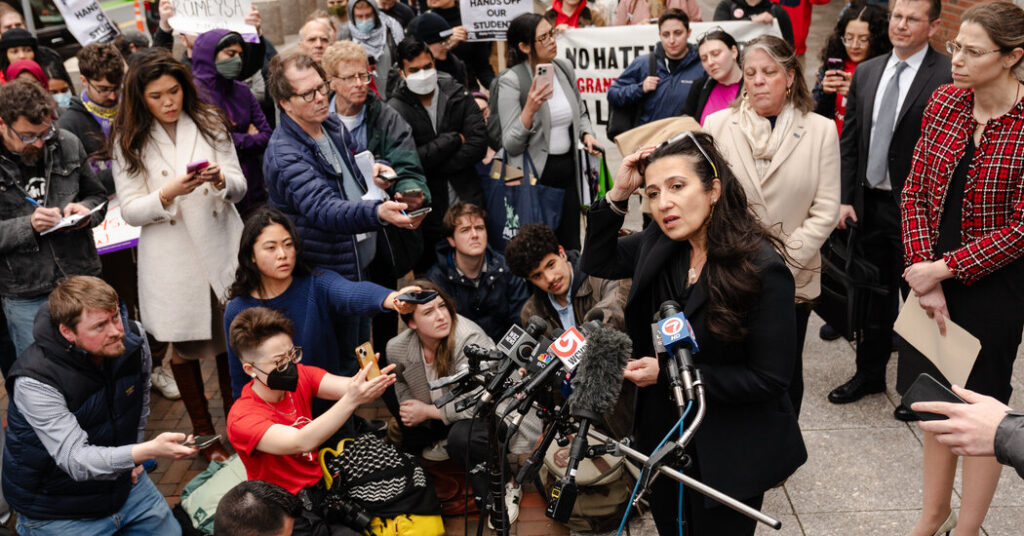
It was raining. Ms. Ozturk thanked reporters for being there, smiling and polite, but told them she was too tired to speak at length. She has barely spoken to the press since. She was yanked into public life against her will, and exited as soon as she could.
Ms. Khanbabai spoke to reporters far more effusively about the meaning of Ms. Ozturk’s release, emphasizing one specific point. “There is hope,” she told them.
Audio produced by Jack D’Isidoro and Adrienne Hurst.
Jonah E. Bromwich covers criminal justice in the New York region for The Times. He is focused on political influence and its effect on the rule of law in the area’s federal and state courts.
The post One Lawyer’s Standoff With Trump’s Deportation Machine appeared first on New York Times.