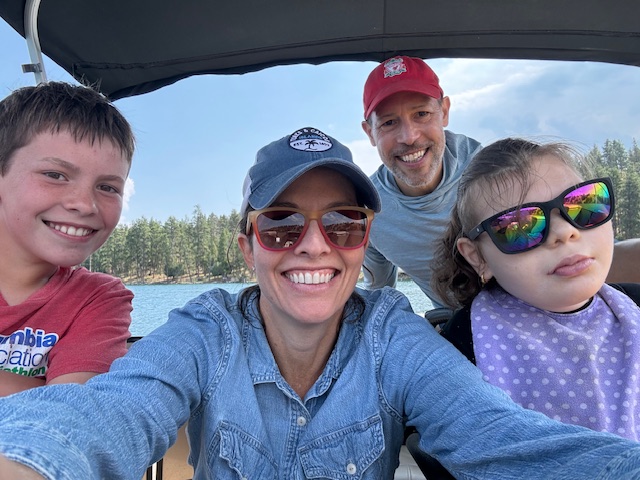
Jennifer Lewis and her family have built their lives around the uncertainty of their daughter’s school bus schedule.
Lewis and her husband, Josh, both 49, wake up at 4:30 every school morning, about three hours before the bus is scheduled to take 15-year-old Kate, who has multiple intellectual and physical disabilities, to St. Coletta of Greater Washington school in Southeast near RFK Stadium. Then, because of the bus’s unpredictable arrivals, they make sure at least one of them is home during a two-hour span every afternoon in case Kate arrives early, on time or late — all possibilities on any given day. Earlier this year, Josh quit his federal government job after a 27-year career in part to make that easier.
The Lewises are among the thousands of D.C. families who have a child with disabilities who takes a bus to and from school each day. Families say the trips are often made harder because of frequently erratic arrivals and undependable communication from the district.
This month, the Office of the State Superintendent of Education, the agency required by federal law to transport students with disabilities from home to school and back again, said it had agreed to a one-year, $2.1 million contract with Tyler Technologies to create a GPS system that will allow parents to track their students and automatically notify them about schedule changes. Since the contract exceeds $1 million, the D.C. Council will have to approve it at a future meeting.
OSSE has struggled for decades to reliably transport disabled students, and generations of parents have tried to force D.C. officials to improve the service by complaining, imploring lawmakers to apply pressure and filing federal lawsuits. Most children in D.C. get to school on a local bus or the Metro, but about 3,600 students rely on OSSE’s fleet of 700 school buses because they have physical or intellectual disabilities that prevent them from using public transportation or require them to attend faraway campuses that offer special services.
Many parents and officials acknowledge that service has significantly improved in the 30 years since the filing of a landmark lawsuit in 1995 that would lead to the federal takeover of OSSE’s bus system. The U.S. district judge who presided over that class-action lawsuit, Paul L. Friedman, is also handling one filed by families last year.
Despite the progress, OSSE is not meeting its obligation under federal law to provide disabled students with safe, reliable transportation, critics say.
Raphael Park, OSSE’s interim transportation director, acknowledged the agency’s shortcomings as D.C. Council members grilled him at a Dec. 3 oversight meeting.
“What parents are asking for is not unreasonable,” Park said.
Over the past decade, OSSE has paid nearly $6 million to companies that were supposed to provide services that would use GPS to automatically track the agency’s buses. In 2016, it awarded a contract to Teletrac Navman, an agreement it extended four times for work that ended in 2021. It has since awarded two more contracts, one extending to Sept. 25, 2026, to Teletrac for maintenance and support. Together, the Teletrac contracts total $2.7 million.
Meanwhile, in 2020, OSSE gave another company, Seon Systems Sales, a contract to provide similar services. It extended the agreement three times for services that ended in 2023 after paying Seon a total of $3.2 million.
OSSE uses the Teletrac Navman system to monitor bus speeds, braking and location, which employees can relay to parents when they call in, the agency said in a statement, but Navman does not have public-facing features that meet student privacy requirements. OSSE contracted with Seon to create a tracking app parents could use, but that project did not meet “all necessary business requirements” and was killed, the agency said.
In the new contract with Tyler Technologies, city officials said, the planned tracking capabilities will replace two GPS systems that tracked the fleet and notified parents with one that can do both.
“We’ve learned what we need to do — and we’re dedicated to getting it right for the DC families we serve,” Park said this month in an email.
At the Dec. 3 oversight hearing of the D.C. Council’s Committee of the Whole, Park said that OSSE had installed a tracking system on buses last year but that it is not “family facing.”
Rosalyn Vann-Jackson, secretary of the National Association for Pupil Transportation, said more school districts have installed GPS tracking services on their buses over the past decade as the technology has become more reliable and affordable.
Broken Arrow Public Schools, the Oklahoma school district where Vann-Jackson works as the chief support services officer, made the switch about a decade ago to help parents track their children, she said. This year, the district added RFID chips to cards that students scan upon boarding. Automatic alerts are sent to parents through an app when their child boards the bus and when they arrive at school or back home — without drivers having to do anything.
“It takes the job out of the hands of drivers — and the guesswork out for officials and parents,” Vann-Jackson said.
Broken Arrow has about 20,000 students, roughly 5,000 of whom have disabilities, Vann-Jackson said. For those parents, the technology provides “an extra layer of comfort.”
The data from the GPS and RFID systems also saves money and improves service, Vann-Jackson said. Officials can use the information to tweak routes and schedules to increase efficiency, and it allows them to know the exact number of buses needed. By reducing drivers’ workload, the technology also helps the district cope with a national shortage of qualified drivers, she said.
In the District, OSSE said the driver shortage is making its service worse. About 17 percent of roughly 570 bus driver positions are open, State Superintendent of Education Antoinette Mitchell said in October. To expand the pool of drivers it can hire, the agency is transporting some students in vans, which don’t require a commercial driver’s license to operate, Park said at the oversight hearing, adding that officials may expand that effort.
Vann-Jackson lauded D.C. for starting the process of switching to a GPS system, because the one being used now is far inferior.
“Paper and pen routing methods unfortunately are not extinct,” she said in a text.
Fed up with delays, six parents of disabled students and a national disability rights organization filed a class-action lawsuit last year alleging that the city and OSSE fail on a daily basis to transport students with disabilities to and from school on time, as required by federal law.
OSSE’s buses often arrive hours after students’ scheduled pickup times and return them home long after school has ended, the suit states. The delays cause students to miss class time and families to scramble for backup transportation when buses don’t show, the suit says.
Parents across the city have called police because they could not find their children, while others use Apple AirTags to track their children after school. Some have bought cars they say they wouldn’t have purchased otherwise. Others have left jobs to ensure they can see children off to school, welcome them home and adapt to the unreliable bus schedule without having to juggle work.
Parents said that before filing the lawsuit, they complained to OSSE, the mayor’s office and lawmakers — to no avail.
Lewis, who is not a plaintiff in the lawsuit but filed a sworn declaration in support of it, said Kate has used OSSE’s bus system for about 12 years. When she and her daughter regularly started experiencing problems with transportation around 2021, she filed formal complaints to alert OSSE. She said she has never heard back.
When asked if she still files complaints, Lewis laughed.
“Filing a complaint became not a worthwhile use of my time,” she said.
Some D.C. lawmakers are growing frustrated by what they see as OSSE’s sluggish efforts to install a GPS system parents can use. Council Chairman Phil Mendelson (D) vowed to hold oversight hearings as often as every month until “this thing is underway” so he and other council members can grill OSSE officials on their progress.
Also, at a the Oct. 28 hearing, council member Matthew Frumin (D-Ward 3) told Park that he has asked OSSE “every year” about when GPS will be installed on buses, and that every year, an OSSE official tells him “this year.” He demanded that the agency stick to its plans of launching the system at the start of next school year.
The timetable “cannot move again,” he said. “You cannot disappoint families again by moving the goalposts. Figure it out.”
Calling herself an optimistic person, Lewis said she is hopeful OSSE’s new contract is the start of improvements and the end of a life of uncertainty and anxiety. The week before, she told lawmakers during public testimony about a conversation she had two years ago in which OSSE’s then-transportation-director said a GPS system was “imminent.” It never came.
“I hope it’s real this time,” she said.
The post No-show buses, long waits: Will GPS finally help D.C.’s disabled students? appeared first on Washington Post.