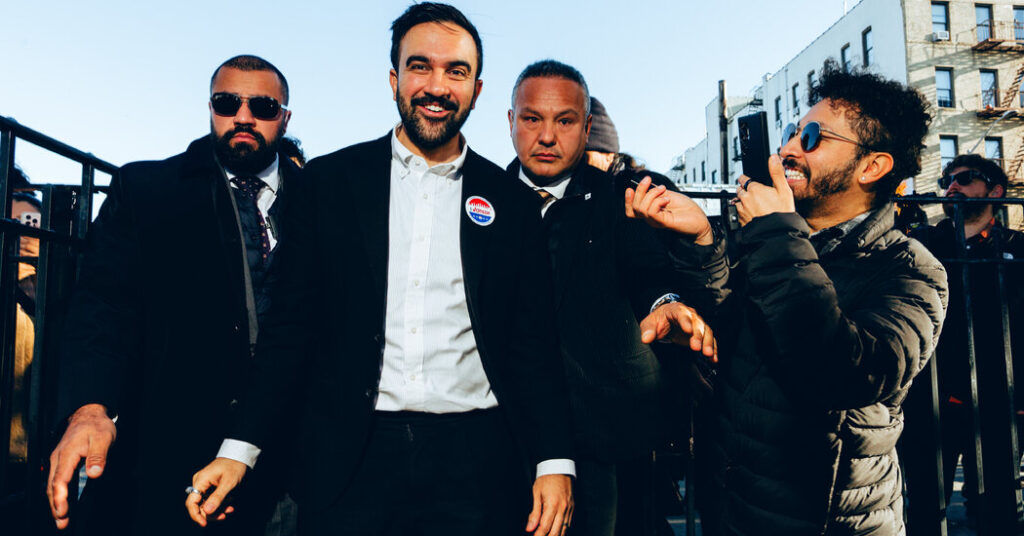
Mayor-elect Zohran Mamdani has built his political brand around being friendly and approachable, with videos showing him chatting with food vendors, ducking into bodegas to talk to workers and posing for countless selfies. On the morning before Election Day, he marched with hundreds of supporters across the Brooklyn Bridge.
But given the vitriol and threats that have been directed at Mr. Mamdani, 34, his outgoing nature could pose a challenge for the New York City police officers charged with protecting him around the clock.
Gregarious mayors are nothing new. But Mr. Mamdani, a Democrat who will take office on Thursday, has already become an international figure, drawing attention in part for his identity as a Muslim and an immigrant (he was born in Uganda). And attacks by his critics, particularly from the right, have raised concerns about his safety in one of America’s most high-profile jobs.
He has been called a “jihadist” and Hamas supporter not just by Republican lawmakers who object to his staunchly pro-Palestinian views, but also by right-wing leaders in Israel and India.
During the primary, his campaign hired private security after it received threats. In September, a Texas man was charged after the authorities said he sent Mr. Mamdani messages filled with anti-Muslim insults and warned him not to start his car, suggesting that it would explode.
Like other mayors, who have been reluctant to change their ways for the sake of security, Mr. Mamdani may not want to abandon the kind of interactions with the public that helped him get elected, according to security experts and former mayoral aides.
“I think the mayor is the one who dictates how it’s going to be,” said José Bayona, who helped run mayoral communications offices under Bill de Blasio and Eric Adams.
At least, he said, “until the security detail sees something and says, we need to change this.”
Mr. Mamdani’s spokeswoman, Dora Pekec, suggested that the mayor-elect would not change his approach to the public.
“Mayor-elect Zohran Mamdani will carry the spirit of the movement that elected him into City Hall, meeting New Yorkers where they are and experiencing firsthand all that the greatest city in the world has to offer,” she said in a statement.
Officers assigned to the mayor’s security detail have long had to adapt to the whims and habits of the politicians under their protection.
Michael R. Bloomberg insisted on taking the subway instead of being driven from his five-story townhouse on Manhattan’s Upper East Side to City Hall.
Mr. de Blasio’s police escort regularly drove him about 12 miles from Gracie Mansion to Park Slope, his old Brooklyn neighborhood, to work out at the Y.M.C.A.
Mr. Adams gallivanted about the city, staying late at clubs and restaurants, his security detail watching from a separate table. Once, while being driven back to City Hall, he darted out of the car to buy a grapefruit from a street vendor, a former aide recalled.
Typically, officers will meet with a new mayor and explain any threats or risks and the steps they are taking to counteract them, said Jonathan Wackrow, a former Secret Service agent for President Barack Obama who has worked closely with the New York Police Department to provide security for dignitaries and political leaders.
Communication between the security detail and a mayor’s staff is critical, he said, so that officers can prepare for scheduled events and any developments that might attract a crowd or a crush of reporters.
Mr. Wackrow, who was assigned to protect Hillary Clinton when she was a New York senator, recalled how her staff, afraid of leaks, had decided not tell him of her plan to announce that she was running for the Democratic presidential nomination. He learned about it only after news trucks began pulling up to Mrs. Clinton’s house in Chappaqua.
“There was a lot of choice language coming out of my mouth for a few hours,” said Mr. Wackrow, who is now the managing director of the Sentinel Resource Group, a risk management firm based in Silicon Valley.
Chris Coffey, Mr. Bloomberg’s former communications strategist, recalled a time when the detail showed up to the mayor’s townhouse (he had chosen not to live at Gracie Mansion) at 6:30 a.m. to take him to an event early in his administration.
Mr. Bloomberg, who always liked to be at least 15 minutes early, had already left in a taxi, Mr. Coffey said. His only police protection was the startled officer outside who had jumped into the cab with him.
It was an important lesson, Mr. Coffey said: “He’s going to do what he wants to do.”
Watching over a politician like Mr. Mamdani, who is eager to mix with the public, can feel daunting, Mr. Wackrow said, especially “in a time of assassination culture.” Just in the past two years, gunmen have attacked President Trump and killed Charlie Kirk, a right-wing activist, and Melissa Hortman, a Democratic state lawmaker in Minnesota, and her husband.
Still, officers know they can only reduce risk, not eliminate it, Mr. Wackrow said.
“The job of a protector is not to dictate the behavior of a politician,” he said. “It’s to protect them no matter what they’re doing.”
Maria Cramer is a Times reporter covering the New York Police Department and crime in the city and surrounding areas.
The post Mamdani’s Man-of-the-People Style Could Present Security Challenges appeared first on New York Times.