In a major shift, Mayor-elect Zohran Mamdani on Wednesday said that he would no longer seek to end mayoral control of the New York City schools, a decision that came as he formally announced his choice to run the nation’s largest school system.
Mr. Mamdani’s reversal on mayoral control marked a significant change of heart. He argued often on the campaign trail that the system shuts out the voices of too many teachers, parents and students from crucial decisions, and maintained his opposition to the model during the final mayoral debates.
But on Wednesday, Mr. Mamdani said that while he disagreed with the way that the outgoing mayor, Eric Adams, wielded power over education, he understood the need for the mayor to be held accountable for public school outcomes.
The State Legislature typically renews mayoral control for two- or four-year terms, and Mr. Mamdani said that he would ask lawmakers this year for an extension of his authority over schools.
The ironclad grip that New York City’s mayor has on public schools contrasts sharply with many other school districts, which rely on elected school boards to shape policy. Mr. Mamdani’s shift will probably be welcomed by some veteran education leaders who worried about his calls to end mayoral control but could deeply frustrate some families who had hoped he would usher in a new model.
The mayor-elect promised on Wednesday to take a new approach to mayoral control.
“Though I held concerns about mayoral control, I also know that New Yorkers need to know where the buck stops: with me,” Mr. Mamdani said. “My approach to mayoral control will ensure that community involvement is not ceremonial or procedural, but tangible and actionable.”
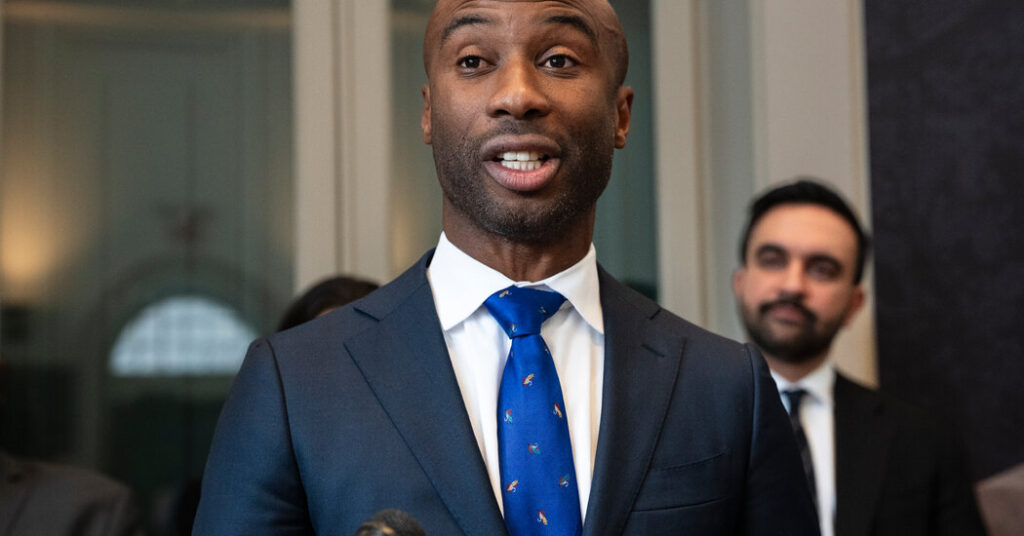
Mr. Mamdani’s shift came as he appointed Kamar Samuels as his chancellor, one of his final major decisions before his inauguration early Thursday. He formally announced the selection at an environmental center in Central Park and also named Emmy Liss, a well-regarded former top education official who helped launch universal prekindergarten under Mayor Bill de Blasio, as the executive director of the city’s child care office.
Mr. Samuels will take over a job that has historically been regarded as the second-most influential education job in the United States after the federal education secretary.
The New York City schools chancellor presides over a $40 billion operating budget and exercises broad authority over instruction at more than 1,500 schools across the five boroughs. (By comparison, the entire state of Maryland has roughly 1,400 public schools.)
“This moment demands a new generation of leadership that both understands our school system and has a transformative vision on how to remake it,” Mr. Mamdani said. “Kamar is that leader.”
Mr. Samuels, who most recently served as the superintendent of an Upper Manhattan district, offered a brief message that highlighted his work to expand rigorous academic options and access to them, and emphasized his shared priorities with the mayor-elect, including tackling student homelessness.
Mr. Samuels will start on Thursday, and Mr. Mamdani said that the departing chancellor, Melissa Aviles-Ramos, had agreed to stay on for a month to aid the transition.
The challenges facing the new chancellor are substantial: New York City is in its third year of a high-stakes effort to rethink how young children learn to read. More than 150,000 pupils were homeless during the last school year, sleeping in shelters or doubled up with other families. And one in three students was chronically absent, missing at least 10 percent of class time.
John C. Liu, the chair of the New York City education committee in the State Senate and a key partner for chancellors, said in a statement that at a moment of “looming threats to education and outright sabotage from the White House,” it will be crucial for Mr. Samuels to offer clear and steady leadership.
Troy Closson is a Times education reporter focusing on K-12 schools.
The post Mamdani Reverses Call to End Mayoral Control of Public Schools appeared first on New York Times.