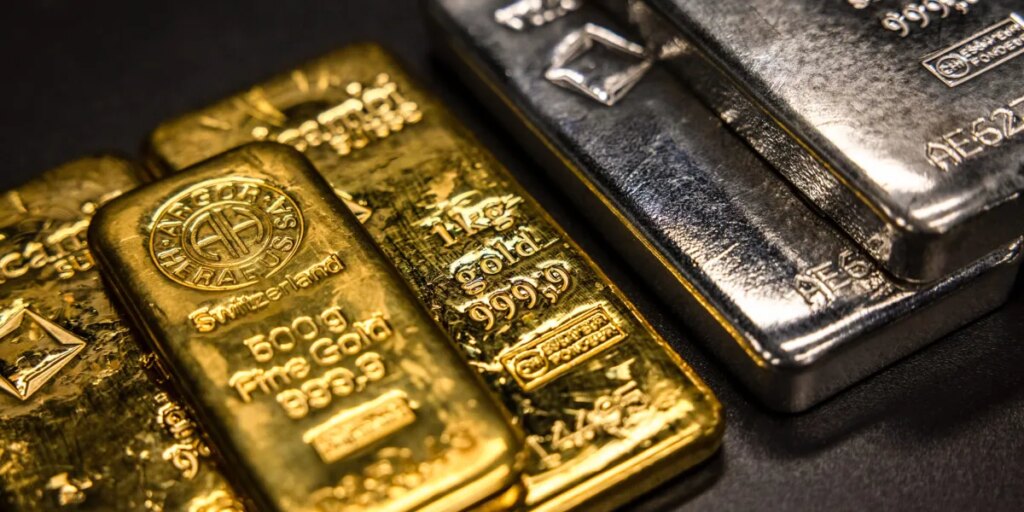
Gold and silver fell on the last trading day of 2025, though both remained on track for the biggest annual gain in more than four decades as a banner year for precious metals draws to a close.
Spot gold hovered around $4,320 an ounce, while silver slid toward $71. The two have seen exceptional volatility in thin post-holiday trading, plunging Monday before recovering Tuesday and dropping again Wednesday. The big swings prompted exchange operator CME Group to raise margin requirements twice.
Both metals are still on track for their best year since 1979, supported by strong demand for haven assets amid mounting geopolitical risks, and by interest-rate cuts by the US Federal Reserve. The so-called debasement trade — triggered by fears of inflation and swelling debt burdens in developed economies — has helped supercharge the scorching rally.
In gold, the bigger market by far, those factors spurred a rush by investors into bullion-backed exchange-traded funds, while central banks extended a years-long buying spree.
Gold is up about 63% this year. In September, it eclipsed an inflation-adjusted peak set 45 years ago — a time when US currency pressures, spiking inflation and an unfolding recession pushed prices to $850. This time around, the record run saw prices smash through $4,000 in early October.
“In my career, it’s unprecedented,” said John Reade, a market veteran and chief strategist at the World Gold Council. “Unprecedented by the number of new all-time highs, and unprecedented in the performance of gold exceeding the expectations of so many people by so much.”
Silver has notched up a gain of more than 140% during the year, driven by speculative buying but also by industrial demand, with the metal used extensively in electronics, solar panels and electric cars. In October, it soared to a record as tariff concerns drove imports into the US, tightening the London market and triggering a historic squeeze.
The new peak was then passed the following month as US rate cuts and speculative fervor drove prices higher, and the rally topped out above $80 earlier this week — in part reflecting elevated buying in China.
Yet the latest move swiftly reversed, with the market closing down 9% on Monday then swinging the following two days. In response to the extreme volatility, CME Group again raised margins on precious-metal futures, meaning traders must put up more cash to keep their positions open. Some speculators may be forced to shrink or exit their trades — weighing on prices.
“The key driver today is the CME raising margins for the second time in just a few days,” said Ross Norman, chief executive officer of Metals Daily, a pricing and analysis website. The higher collateral requirements are “cooling the markets off,” he said.
Platinum, Palladium
The enthusiasm for gold and silver has extended into the wider precious-metals complex in 2025, with platinum breaking out of a years-long holding pattern to hit a new high.
The metal is on course for a third annual deficit, following disruptions in major producer South Africa, and supply will likely remain tight until there’s clarity on whether the Trump administration will impose tariffs — as well as on silver.
Prices for silver, platinum and palladium all sagged on Wednesday, though there’s little sign of enthusiasm waning.
“2025’s surprise was how safe-haven metals turned into momentum trades — silver in particular,” said Charu Chanana, chief market strategist at Saxo Markets in Singapore.
Silver traded down 6% at $71.44 an ounce as of 12:28 p.m. in New York. Gold slipped 0.4% to $4,322.04 an ounce, while the Bloomberg Dollar Spot Index was up 0.1%.
The post Gold and silver stumble at the end of best year since the 1970s appeared first on Fortune.