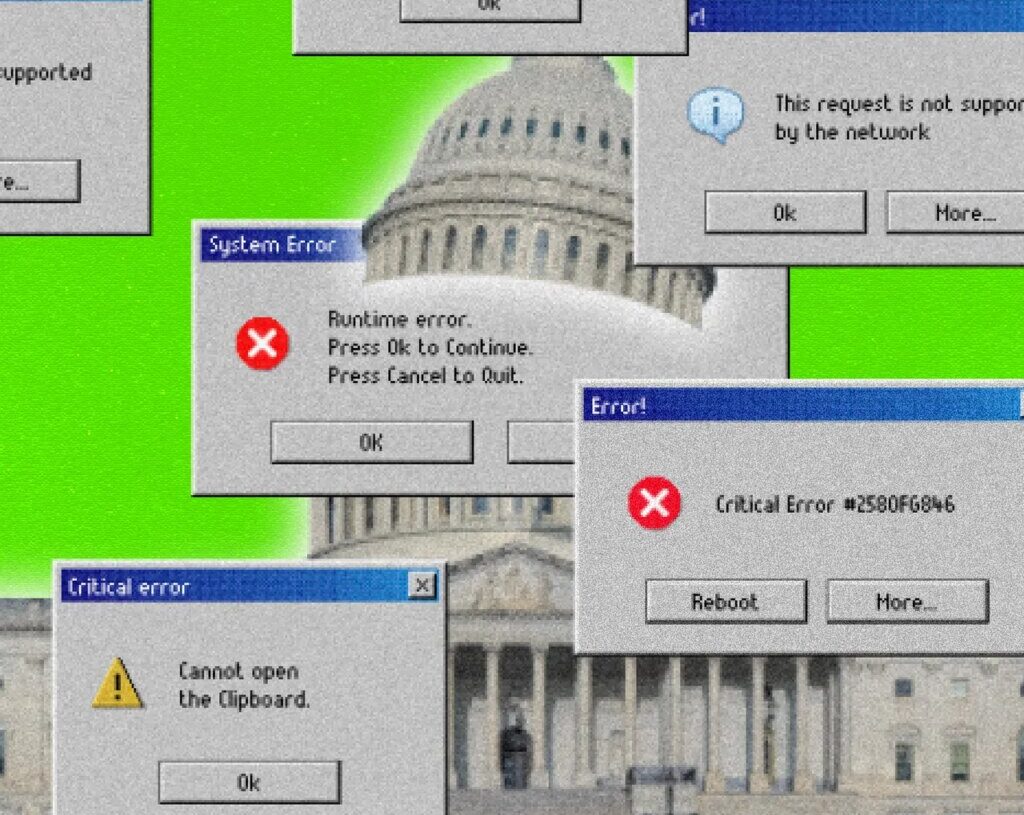
As the first year of the Trump administration approaches its end, government cybersecurity experts and even some United States government officials are warning that recent White House initiatives—including downsizing and restructuring of the US federal workforce—risk setting the government back on improving and expanding its digital defenses.
expired: US cybersecurity strugglingtired:US cybersecurity improvingwired: US cybersecurity backsliding
Read more Expired/Tired/WIRED 2025 stories here.
For years, the federal government was playing catch-up on cybersecurity, scrambling to replace ancient software, apply security patches to newer systems, and deploy other baseline protections across a massive and disparate population of PCs and other gadgets. With so many agencies and offices that needed upgrading, it was slow going. But as repeated government data breaches drew urgent attention to the issue, and as the Department of Homeland Security’s Cybersecurity and Infrastructure Security Agency—founded in 2018—established itself during the early 2020s, minimum standards seemed to be rising. Now, with major staffing cuts at CISA and in other key departments across the government, that incremental progress could quickly erode.
“We’ve spent a lot of time trying to encourage the government to do more, and CISA was doing, you know, a better job,” retiring comptroller general Gene Dodaro told the US Senate Committee on Homeland Security and Governmental Affairs on December 16. He added that the Government Accountability Office has “a lot of open recommendations still for them to do. But I’m concerned that we’re taking our foot off the gas at CISA, and I think we’ll live to regret it.”
CISA lost about 1,000 people, more than a third of its staff, as a result of cuts that seemed to be motivated by the Trump administration’s anger about the agency’s election security work. Cybersecurity Dive reported in mid-November that the agency is planning to rebuild in 2026.
“The recent reduction in personnel has limited CISA’s ability to fully support national security imperatives and administration priorities,” acting CISA director Madhu Gottumukkala wrote in a memo to staff at the beginning of November. He added that that agency has “reached a pivotal moment” but is “hampered by an approximately 40 percent vacancy rate across key mission areas.”
When asked for comment about staffing cuts at CISA and the administration’s plans for maintaining and improving federal cybersecurity and critical infrastructure defenses, the White House referred WIRED to the Department of Homeland Security.
CISA director of public affairs Marci McCarthy told WIRED in a statement that the agency is focused on executing its statutory mission. “Claims that staffing adjustments are weakening cybersecurity miss the truth,” she said in the statement. “We are accelerating innovation, deepening operational collaboration, and directing resources where they yield the greatest return.”
This fall’s weekslong government shutdown only added to concerns about the state of federal cybersecurity—creating the possibility of blind spots or gaps in monitoring while so many workers were furloughed and contributing in general to the already extensive IT backlog at agencies across the government.
“Federal IT workers, they are good jobs, there’s not enough resources for the issues that they have to deal with,” one former national security official, who requested anonymity because they are not authorized to speak to the press, told WIRED. “It’s always underfunded. They always have to catch up.”
Amélie Koran, a cybersecurity consultant and former chief enterprise security architect for the Department of Interior, notes that one of the most significant impacts of the shutdown likely involved disrupting, or in some cases potentially ending, relationships with specialized government contractors who may have needed to take other jobs in order to get paid but whose institutional knowledge is difficult to replace.
Koran adds, too, that given the limited scope of the continuing resolution Congress passed to reopen the government, “no new contracts and extensions or options are probably being done, which will cascade to next year and beyond.”
While it is unclear if the shutdown was a contributing factor, the United States Congressional Budget Office said more than five weeks into the ordeal that it had suffered a hack and had taken steps to contain the breach. The Washington Post reported at the time that the agency was infiltrated by a “suspected foreign actor.” And after years of incredibly consequential US government data breaches—including the 2015 Office of Personnel Management hack perpetrated by China and the sprawling, multi-agency breach launched by Russia in 2020 that is often called the SolarWinds hack—experts warn that inconsistent staffing and reduced hiring at key agencies like CISA could have disastrous consequences.
“When, not if, we have a major cybersecurity incident within the federal government, we can’t simply staff up with additional cybersecurity resources after the fact and expect the same outcomes we would get from long-tenured staff,” says Jake Williams, a former NSA hacker and current vice president of research and development at Hunter Strategy.
Brain drain, Williams says, and any loss of momentum on digital defense, is a serious concern for the US.
“On a daily basis I’m worrying that federal cybersecurity and critical infrastructure protection may be backsliding,” Williams says. “We must stay ahead of the curve.”
The post Fears Mount That US Federal Cybersecurity Is Stagnating—or Worse appeared first on Wired.