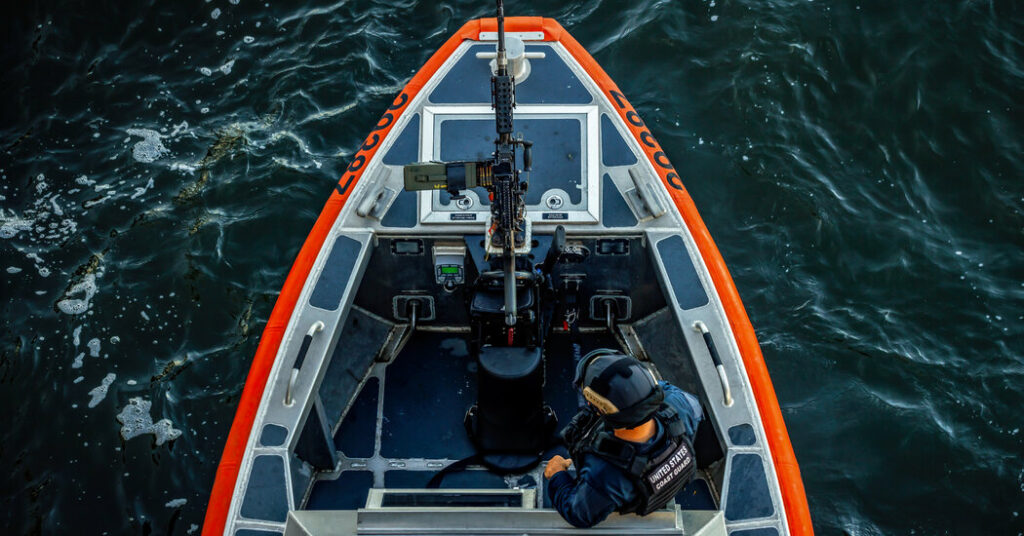
Long before the U.S. military began blowing up boats it suspected of smuggling drugs in strikes from the sky, the Coast Guard has pursued a very different campaign against drug smuggling on the water.
Cutters guided by an intelligence center in Key West, Fla., have intercepted go-fast boats in the Caribbean and Pacific Ocean and seized people suspected of smuggling, as well as bales of cocaine and marijuana. The Coast Guard has funneled cases to federal prosecutors, who leverage plea deals to persuade boat crews to flip in criminal cases that have in turn led to intelligence being fed back to the boat interdiction center.
Its goal then, as now, was to capture, not kill, them.
That is how the Coast Guard has traditionally sought to halt the flow of illicit drugs: as a law enforcement approach, in sharp contrast to the Pentagon’s use of deadly force since September against vessels it says are smuggling cocaine.
Those who have worked on the Coast Guard’s boat cases warn of the national security implications of downgrading the importance of such investigations by killing trafficking suspects rather than taking them into custody. They say the shift demonstrates inherent contradictions in the administration’s boat strikes, which so far have killed at least 107 people.
The Coast Guard missions continue, with seizures at the same rate as last year. Cutters still return from monthslong patrols to unload bales of cocaine or marijuana from their decks in events for the media.
But after Attorney General Pam Bondi directed prosecutors in February to mostly stop bringing charges against low-level offenders in favor of bigger investigations, the once steady stream of federal trafficking cases is drying up.
A few criminal cases, most from last year, are still in the pipeline in Tampa, Fla., the headquarters of a multiagency task force known as Operation Panama Express that was established in the ’90s to disrupt shipments of cocaine through prosecutions. But for the most part, people captured by the Coast Guard in the same smuggling routes the U.S. military is bombing are being repatriated — either directly, before reaching the United States, or through deportation after briefly being questioned near U.S. ports.
Some people who have been involved in the process caution that the strategy could erode the intelligence gathering operation that tracks the drug smuggling routes. It has helped the Coast Guard, by its own count, interdict 3,588 vessels and seize 3.26 million kilograms, or 7.19 million pounds, of cocaine and lesser amounts of marijuana since 2003.
“That’s how intel works: You climb the ladder from those types of cases. It feeds the big picture,” said Rebecca Castaneda, a criminal defense lawyer in Tampa who was previously a prosecutor working on drug smuggling cases.
The Justice Department and the office of the U.S. attorney for the Middle District of Florida, which is primarily where low-level smuggling suspects have been prosecuted, would not discuss the new approach and the drop-off in cases.
Operation Panama Express
Lawyers who have worked on the boat cases for decades describe the prosecutions stemming from the Coast Guard seizures as essentially feeding a plea bargain mill for people of similar profiles as those that the military has been killing.
These deals began decades before the strikes, which a wide range of experts in international and domestic law have condemned as unlawful. Even if the boats are carrying contraband, they are not legitimate targets, the experts say, because the civilians on board pose no imminent threat of violence.
President Trump contends they are lawful because he has “determined” that the United States is in a state of armed conflict with drug cartels and has declared people on the boats to be “combatants.”
The lawyers describe defendants in the boat cases as desperate, occupying the lowest rung of the narco-trafficking pipeline in Latin America and the Caribbean. Most do not speak English. Many do not read Spanish. They have been so impoverished, these lawyers said, that they have had no resources or cartel behind them to hire lawyers, so most are represented by federal defenders or through court appointments.
“We’re not talking about the Pablo Escobars,” said Ben Stechschulte, a criminal defense lawyer in Tampa, referring to the Colombian drug lord. “They really are just poor fishermen. They do a cost-benefit analysis, decide that they’re going to do it.”
He said he had represented about 50 men in the Panama Express boat cases, mostly Ecuadoreans and Colombians but a few Venezuelans. All have pleaded guilty in the hopes of shortening their sentences.
The defendants typically have had to explain in detail their narrow but crucial role on the boats to the Coast Guard Investigative Service, Drug Enforcement Administration, F.B.I. and Homeland Security, starting with how they were recruited and what they were promised or paid.
Cooperating with prosecutors has meant providing truthful information and being willing to testify in a trial, although the lawyers and a federal agent who worked on the cases say they rarely do.
The defendants have explained where they were put onto boats with drugs, or where they were driven to pick up their loads. Some had GPS data with drop-off locations, which can be helpful information.
Being the first on the boat to cooperate and providing useful information can get the mandatory 10-year sentence reduced, since a thrust of the Tampa prosecutions has long been intelligence gathering.
The intelligence was fed into a center in Key West housing the Joint Interagency Task Force South, where analysts use a mosaic of information, including electronic surveillance, to guide Coast Guard cutters to smuggling routes — and more interdictions.
Today’s Coast Guard
Even as the military has blown up some boats, killing those onboard, the pace of interdictions has not changed.
Between Sept. 1 and Nov. 30, when the U.S. military blew up 22 vessels, killing 83 people in the Caribbean and Pacific Ocean, the Coast Guard interdicted 38 vessels suspected of smuggling drugs — three more than it had intercepted during the same period in 2024.
As a law enforcement mission, the Coast Guard stops suspicious vessels, mostly those defined as “stateless boats” that fly no flag. At times the Coast Guard has had to use helicopter-borne sharpshooters to disable a fleeing boat’s engines and send a crew onboard to inspect it.
But in the past five years, the Coast Guard says, there has been just one instance of a smuggling suspect being shot and killed during an interdiction. Lt. Cmdr. Steven Roth, the Coast Guard’s chief of media relations, described that instance as a ramming episode during a boarding operation that put members of the Guard at risk.
More typical have been the nonlethal encounters that have predominantly delivered suspects to the federal courthouse in Tampa, and drugs to showy offload events from docks in South Florida.
That is what happened at Port Everglades on Nov. 19 for the return of the Coast Guard cutter Stone from the Pacific with what it called the largest cocaine seizure in a single patrol: 49,010 pounds from 15 interdiction episodes, estimated to value $362 million.
Sealed bundles of narcotics were stacked on the deck. Tulsi Gabbard, the director of national intelligence, was there, as were Terry Cole, the D.E.A. administrator, and the U.S. attorney from Tampa, Gregory Kehoe.
What of the boat crews? The cutter took custody of 36 smuggling suspects during the mission, repatriated 29 to Ecuador for prosecution and referred the others to the Justice Department, the Coast Guard said in a statement. The transfer reflects the fundamental shift in policy that those who have worked on the low-level boat cases predict will disrupt the stream of intelligence.
On Feb. 5, the Justice Department released a policy memo advising against prosecutions of “low-level narcotics offenders” pursuant to the law used against smugglers interdicted at sea — so those resources could be used to investigate and prosecute top cartel targets.
Now, those who are not repatriated or turned over to other countries from the sea mostly undergo one-day debriefings by law enforcement authorities before they are handed over to the Department of Homeland Security for deportation, according to the former agent, who spoke on condition of anonymity to discuss a sensitive topic of intelligence gathering. The Coast Guard statement described the process this way: When the Justice Department “declines prosecution, the Coast Guard coordinates either the direct repatriation to the detainee’s country of nationality or transfer ashore to Department of Homeland Security custody for additional investigation and expedited removal.”
Turning over such witnesses disrupts the intelligence pipeline and leads to “a drop-off of good intelligence,” the former agent said.
Low-level smugglers no longer have an incentive to cooperate if they know they face deportation rather than incarceration, the agent said.
Moreover, the experts who have tracked the boat cases for years say the strategy lacks coherence.
On the one hand, the people are deemed “so dangerous and so horrible” that the government has resorted to killing them, the agent said. On the other, capturing them would lead to their deportation because they are considered “so minor.”
Misunderstood Boat Crews
The lawyers in Tampa who have handled these cases say some of the people the U.S. military has killed in the boat bombings, without charge or trial, probably match the profile of the people they have represented — men so poor they get their lawyers through court appointment.
But, they say, the administration distorts the roles of the smuggling suspects. They don’t own the boats and may not know where they are going until they reach a boat and are handed a GPS device with preprogrammed coordinates, they say.
Mr. Stechschulte called the strikes “just plain Whac-a-Mole,” given the endless supply of poor fishermen and farmers willing to risk their lives on the drug boats. “As long as there’s a demand for cocaine, it’s just going to come in.”
To the drug dealers, Ms. Castaneda said, “those people are like toilet paper.”
Incoherent Strategy
Stephen M. Crawford, another Tampa-based lawyer who was assigned by the court to defend those accused of drug smuggling, has been representing defendants captured by the Coast Guard for about 30 years.
Most of his clients, mostly poor, uneducated farmers or fishermen, would reach cooperation agreements that offered details of their engagement at the bottom rung of the drug-smuggling business in exchange for possible leniency on mandatory 10-year sentences, he said.
Killing them without prosecution amounts to disturbing “political theater,” he said. “We just don’t have the death penalty for drug runners in this country.”
A letter from the head of the Coast Guard released in December by Senator Rand Paul, Republican of Kentucky, reported that more than one-fifth of suspicious boats that were stopped by Guard forces from Sept. 1, 2024 to Oct. 7 of this year had no drugs.
There are other contradictions. Those who have worked on the cases say the administration has dishonestly linked its campaign of killing to the fentanyl crisis in the United States. Coast Guard statistics show the interdictions mostly seized cocaine.
Fentanyl, which comes from China, appears in only three years of Caribbean and Eastern Pacific Ocean seizures since 2003, and insignificantly so: about 38 pounds in the fiscal year 2021, 12 pounds the year before and a quarter-pound in 2023.
Also puzzling to people who have worked on these cases was the administration’s claim that its first airstrike in the Caribbean killed 11 members of the Venezuelan gang Tren de Aragua. In announcing it, Mr. Trump called them “terrorists” transporting illegal narcotics, heading to the United States.
Experience has taught the lawyers and investigators that drug smugglers do not waste fuel carrying 11 people on a boat transporting narcotics. Nor do such boats carry enough fuel to make it all the way to U.S. shores.
Carol Rosenberg reports on the wartime prison and court at Guantánamo Bay. She has been covering the topic since the first detainees were brought to the U.S. base in 2002.
The post Even as U.S. Blows Up Boats, Coast Guard Captures Others at Sea appeared first on New York Times.