For a certain France, Brigitte Bardot incarnated the lost idyll of the country’s supposed golden years after World War II when its president supped as an equal at the table of world leaders, French-made Citroëns rolled down its new superhighways, and white people of French ancestry filled its cities.
For that France, Ms. Bardot — blond and slim, a child of the most privileged neighborhood in Paris — seemed the perfect symbol of this booming era of liberation from postwar gloom. Indeed, at the time, France was happy to export Ms. Bardot — a superstar of 1960s cinema who died on Sunday at 91 — as the quintessence of the country’s seductive charm. She was “incredibly French,” Marine Le Pen, leader of the far-right National Rally party, with whose family Ms. Bardot had ties dating back over 60 years, said after her death.
But the idyll had shaky underpinnings from the start, both in its conception of France and of Ms. Bardot herself. When reality caught up with the pure white dream — the reality of a France that even in the 1960s depended for its prosperity in substantial part on immigrants from its former empire, many of them Muslim — the blond goddess soured.
Her post-cinema career, after her early retirement in 1973, was punctuated by a series of hair-raising racist and Islamophobic declarations targeting Muslims and immigrants, along with gay people, feminists and anybody else who didn’t fit into her vision of the “France of before” when “everything was less screwed up,” as she put it in one of her last interviews, with the far-right magazine Valeurs Actuelles (“Today’s Values”) in September 2024.
Six times convicted of uttering racist statements under France’s strict hate-speech laws, Ms. Bardot was a precious ally for the anti-immigrant party the National Front, which was founded by Ms. Le Pen’s father, Jean-Marie, an old friend of Ms. Bardot. She was a popular icon who expressed, crudely and in charged images, the anti-immigrant ideology at the party’s core.
She was the only major French star who took up squarely for both the National Front and its rebranded offspring, the National Rally party, French media pointed out this weekend.
In one of the first of her anti-immigrant outbursts she wrote, in Le Figaro in 1996: “And so it is that my country, France, my homeland, has once again been invaded, with the blessings of successive governments, by an overpopulation of foreigners, especially Muslims, to whom we are supposed to swear allegiance. To this Islamic flood we are supposed to submit, against our will, all of our traditions.”
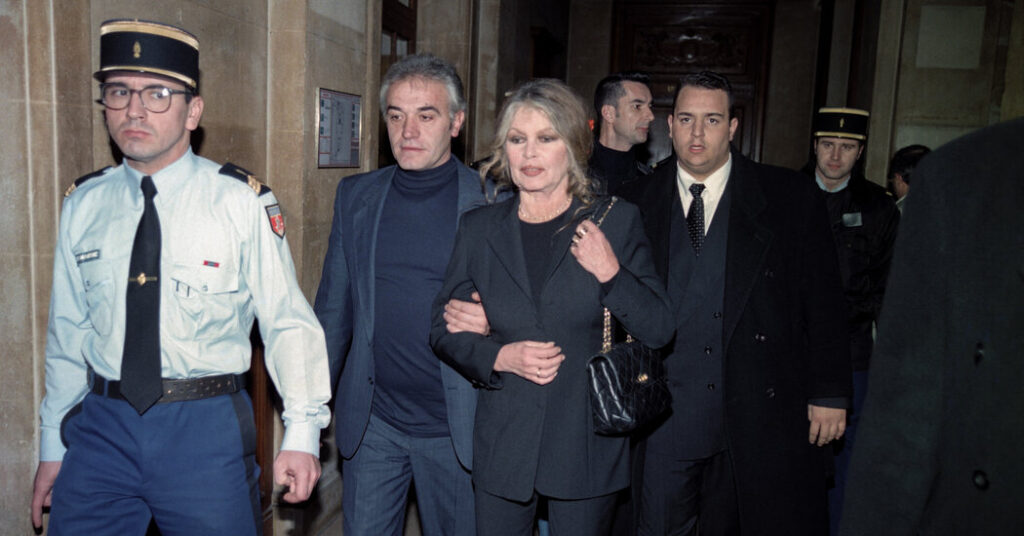
She was convicted in a Paris court the following year of inciting racial hatred.
“We no longer have the right to be outraged when illegal immigrants or thugs profane and conquer our churches, in order to transform them into human pigsties, defecating behind the altar, pissing against the columns, spreading their nauseating smells beneath the sacred vaults of our choirs,” she wrote in her book “Un cri dans le Silence” (“A Cry Amid Silence”) in 2003. She was convicted, again of inciting racial hatred, the following year. The court ruled that some comments in Ms. Bardot’s book would lead her readers “to reject members of the Muslim community through hatred and violence,” according to a report in Le Monde.
After the fifth such anti-Muslim diatribe, in 2008, the prosecutor Anne de Fontette expressed weariness at seeing her so often in court on the same charges.
Ms. Bardot was also a passionate animal rights activist whose Brigitte Bardot Foundation worked on behalf of that cause. In 2021 she was fined thousands of euros for writing in an open letter that inhabitants of the French territory of La Réunion, in the Indian Ocean, were a “degenerate population” that had kept its “savage genes” and was nostalgic for “cannibalism.” The letter, which was published by her foundation and distributed to media on the island, denounced the ritual animal sacrifice practiced by the Tamil who lived there.
Her anti-immigrant rhetoric pushed a step beyond the common currency of National Rally meetings. After her death, tributes from party leaders poured in — Jordan Bardella, the party president, called her an “ardent patriot” — and there were calls for President Emmanuel Macron of France to organize an elaborate national homage of the sort the country puts on for its greatest heroes. He seems unlikely to comply: She had expressed her disdain for him more than once.
Though for the National Front’s late patriarch, Mr. Le Pen, who died almost a year ago after making a political career of denouncing immigrants and their supposed invasion of France, and whose early allies were World War II Nazi collaborators, her admiration was mostly unreserved. “Everything he predicted has happened,” she told Valeurs Actuelles last year. “He was right before everyone else.”
It was Mr. Le Pen who introduced her to her fourth and last husband, Bernard d’Ormale, a high National Front functionary, at a dinner party in St.-Tropez in 1992.
“She rowed with us in the ’90s,” Mr. Le Pen wrote in his 2019 memoir, “Tribun du Peuple” (“The People’s Tribune”). She publicly supported the National Front’s first mayoral candidates, in the southern towns of Vitrolles and Toulon. “We have more in common than it might seem,” Mr. Le Pen wrote. “She likes animals, and she’s nostalgic for a France that was clean.”
They had met long before, in the late 1950s. As an up-and-coming young member of the French Parliament recently returned from France’s bloody war to hold onto its colony in Algeria, Mr. Le Pen persuaded the movie star to visit some of the war wounded in hospitals. “Next to her, Marilyn Monroe seemed like a barmaid,” Mr. Le Pen wrote.
Ms. Bardot’s rightward drift gained momentum in the 1960s, when she was “shocked” by the student and worker protests of May 1968 and “understood nothing about them,” Le Monde wrote. In 1981, after she had quit the screen, she expressed bitterness, in an interview, about the movie industry in her country, saying “it had become the reflection of what France has become: mediocre, routine.”
Decades later, in the 2010s, she scorned the #MeToo movement, denouncing women who accused men in the film industry of sexual harassment, calling them “hypocritical, ridiculous, without interest.” And she defended Gérard Depardieu, an actor convicted of assaulting women on a film set. “Those who have talent and put their hands on a girl’s bottom are thrown in the gutter,” she said in one interview.
The sharply divided reactions in France to her death on Sunday symbolized an ambiguous legacy.
Rima Hassan, a French lawmaker in the European Parliament, condemned those who praised her cinematic career and animal rights activism while “trivializing, minimizing or even rendering invisible the racism and Islamophobia she helped spread.” By contrast, Mr. Bardella, the far-right leader, condemned Ms. Bardot’s critics, accusing them on social media of “dehumanizing those who dare to think differently, reducing them to caricatures.”
Olivier Faure, the head of the Socialists, a left-wing political party, captured the polarized response. “Radiant, she made her mark on French cinema,” Mr. Faure wrote on X. “But she also turned her back on republican values and was repeatedly convicted for racism.”
Ségolène Le Stradic contributed reporting from Paris.
Adam Nossiter has been bureau chief in Kabul, Paris, West Africa and New Orleans and is now a writer on the Obituaries desk.
The post Brigitte Bardot’s Legacy of Racist Rhetoric appeared first on New York Times.