BERLIN — In a country known for its rule-abiding ways — quiet Sundays, meticulous recycling, orderly lines and an aversion to jaywalking even in the wee hours of the morning — there is one night each year when restraint collapses into sanctioned mayhem.
On New Year’s Eve, known as “Silvester,” Germans of all ages flood the streets armed with fireworks. But for some, it’s not about lighting up the sky, but often firing rockets directly at friends and unsuspecting strangers.
What was long considered a raucous celebration has increasingly turned violent. In recent years, Silvester has left behind a trail of serious injuries, fires and assaults on police and emergency workers, fueling a ferocious national debate over whether private fireworks should be banned altogether.
Nowhere is the debate more intense than in the German capital.
Last New Year’s, five people were killed across the country in fireworks-related incidents, while in Berlin alone, more than 360 people sustained firework-related injuries, according to the city’s health administration. Among the injured were emergency services workers. More than 50 attacks on police officerswere recorded, leaving 17 officers injured through criminal acts and eight by fireworks. A paramedic was also targeted.
“We are attacked massively with firecrackers and rockets from a distance,” Jochen Kopelke, federal chairman of Germany’s Police Union, said in an interview. “[The perpetrators] stand 30 or 40 meters [100 feet] away and attack police officers from afar, which makes arrests almost impossible.”
Compared with most global capitals, New Year’s Eve in Berlin is unusually wild, with private fireworks taking center stage. Although a public event is scheduled to host 20,000 people at Berlin’s iconic Brandenburg Gate this year, that figure is tiny compared with London’s roughly 100,000, New York’s 1 million, or Sydney’s 1.5 million-plus at those cities’ main New Year’s Eve events.
The heated debate in Germany has since morphed into a broader political and cultural argument about citizen freedoms — on par with the country’s decades-long dispute over imposing a speed limit on the Autobahn.
In the wake of last year’s Silvester, Germany’s former justice minister Marco Buschmann said in January that a complete ban on private fireworks would equate to “collective punishment.”
“Once a year, people should be given the freedom to observe this tradition,” he told German media group RedaktionsNetzwerk Deutschland at the time.
Private fireworks are banned year-round in Germany, except for a short window around New Year’s Eve. By midafternoon on Dec. 31, the first explosions echo through Berlin neighborhoods. Dog owners unable to escape the city squeeze in a final long walk of the year. By dusk, firecrackers — known as “böller” — explode on sidewalks, forcing pedestrians to dodge stray sparks as they hurry home, or toward parties. The advice to newcomers and visitors is simple: If you don’t have to go out, don’t. Navigating parts of the city center becomes nearly impossible as midnight approaches.
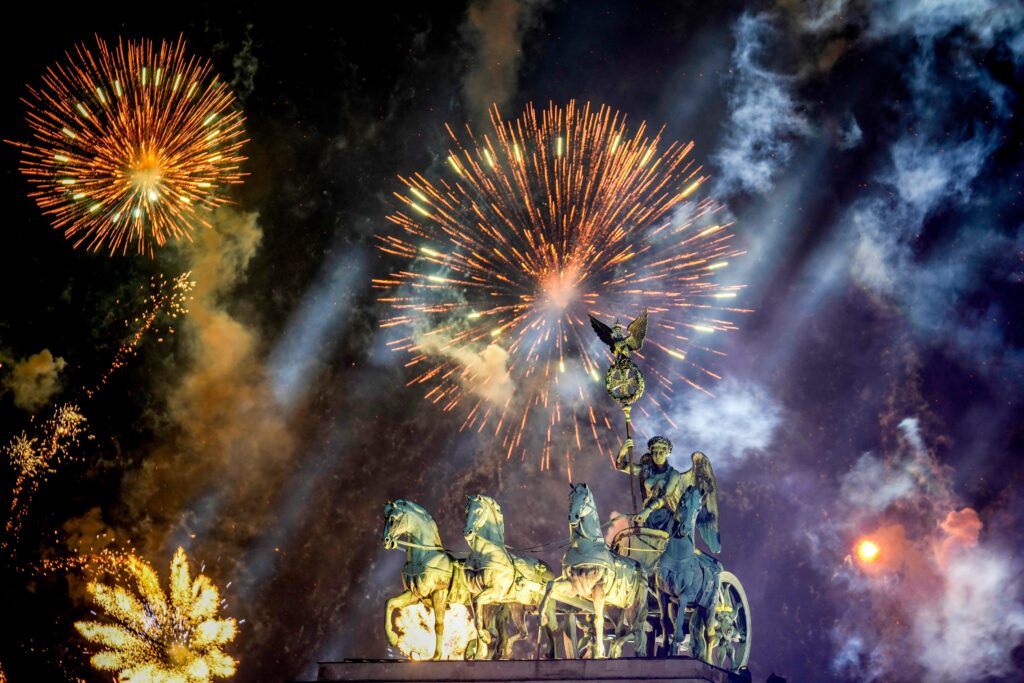
As the clock strikes 12, the sky erupts in cascades of color as rockets streak overhead. But beneath the spectacle, the oohs and aahs of onlookers are drowned out by sirens and the concussive booms of illegal pyrotechnics. What begins as celebration often curdles into what some residents describe as a night of terror. Even watching from a balcony can be a gamble, as stray fireworks whiz by, sometimes landing on terraces and even setting entire apartments ablaze.
To many Germans, the fireworks are a menace. To some newcomers, they can pose an even greater risk. In December 2015, months after hundreds of thousands of Syrian asylum seekers arrived in Germany, authorities warned that excessive fireworks could retraumatize refugees suffering from post-traumatic stress from the war they had just fled.
By early New Year’s Day, a gray smog hangs over Berlin, and streets are littered with spent shells and debris.
The debate over banning private pyrotechnics is as much a part of modern Silvester as the fireworks themselves. A recent Forsa poll found that about 60 percent of Germans would support a ban on private fireworks on New Year’s Eve. Now, two major petitions are pushing for that measure. One, from the “Böller Ciao” association — a nod to the Italian protest song “Bella Ciao” — is backed by nearly 60 organizations including environmental groups and animal welfare groups, and has gathered almost 800,000 signatures. A second, by the Berlin Police Union, has reached 2.4 million supporters.
“Germany … continues to allow thousands of people to be injured every year for the amusement of a very small minority, cities to be buried in particulate matter, and millions of animals to flee in panic,” Jürgen Resch, federal managing director of Environmental Action Germany, said in a statement.
Animal welfare advocates emphasize the toll on wildlife and pets. “Every year, New Year’s Eve fireworks cause stress and mortal fear for thousands of animals — pets, wild animals and farm animals experience days of extreme distress around the turn of the year due to the loud explosions, flashes of light and dense smoke,” said Volker Gaßner, managing director of Four Paws Germany.
“The number of firecrackers and rockets imported into Germany is at a record high this year, promising a particularly horrific and distressing night,” he added.
Both petitions were submitted to the state Interior Ministers’ Conference in early December to spur legislative change, but states less affected by firework-related violence have been reluctant to act. A nationwide ban would require changes to the federal Explosives Ordinance, and interior ministers have yet to agree. Critics say a blanket ban would be difficult to enforce, legally complicated, socially unpopular and ineffective at curbing violence.
But it’s what happens on hospital floors and city streets that has sharpened the debate. Berlin created several small firework-free zones after years of injuries, fires and attacks on emergency workers in densely built neighborhoods. The restrictions aim to protect residents, reduce risks from crowds and narrow streets, and limit extreme noise where celebrations have repeatedly spun out of control. But emergency services still find themselves in the line of fire, with 58 such cases recorded last Silvester. In total, Berlin police recorded 1,453 New Year’s Eve-related crimes a year ago — 125 more than the previous year.
The operation requires months of preparation. In 2024, roughly 3,000 police officers and 1,500 firefighters were deployed across the capital.
Despite calling for a blanket ban, German Police Union chief Kopelke acknowledged that many people want a peaceful firework celebration, especially in quieter suburbs.
“A calm New Year’s Eve with the neighborhood is something wonderful,” he said. “But for the police, New Year’s Eve is extremely difficult.”
He advocates rethinking the tradition: “We have to find a way to redesign New Year’s Eve with a firework ban — while creating legal alternatives so people can still celebrate safely.”
Hospitals like Berlin’s Accident Hospital are bracing for another busy night. Georg Osterhoff, director of trauma surgery and orthopedics, recalls his first Silvester shift nearly two decades ago. “The hand surgeon cried because she was simply overwhelmed by the number of patients who came and by some of the images you see,” he said.
“Even for us as experienced surgeons, a mangled hand or a shattered face, especially in children, is something that is very distressing,” Osterhoff said. The hospital reinforces staff by about 20 percent for the night.
Despite his frontline experience, Osterhoff is skeptical that a blanket ban would solve the problem. “Personally, I believe that a ban won’t change the fact that some people don’t follow the rules,” he said. “And the rule already exists, so the vast majority of blast injuries we see are a result of improper, rule-breaking behavior, and therefore I believe that a ban wouldn’t achieve much.”
Opponents of a ban argue that critics focus too narrowly on violence, ignoring the social value of Silvester fireworks. Germany’s Federal Association for Pyrotechnics and Artistic Fireworks rejects a blanket ban, instead calling for stricter enforcement against illegal devices and better safety education.
“We live in societies that are highly individualized, digitized, and where direct physical contact plays an increasingly smaller role,” said Felix Martens, head of the association. On New Year’s Eve, “we see our neighbors, greet them, wish them a happy new year and, above all, look together at this illuminated sky. And I think if that were to disappear, we would lose one of those very rare moments of social harmony.”
The post Berlin’s wild New Year’s Eve fuels constant debate over banning fireworks appeared first on Washington Post.