The police found him in his bedroom in Edmond, Okla., facedown, dead from a gunshot wound and still gripping the bloody kitchen knife he had used to try to defend himself.
His name was Wyan Wang, his job was in cannabis and he was a victim, investigators would say, of a robbery, one of many targeting the cash-heavy marijuana industry in Oklahoma in recent years.
But his web of connections extended far from the prairies of suburban Oklahoma City — to the boardrooms of Manhattan, where he was a protégé of a real estate mogul named John Lam.
Mr. Lam had developed at least 50 projects in New York and had recently teamed up with the British billionaire Richard Branson to open a trendy hotel in Midtown Manhattan. He was a prominent fund-raiser for Mayor Eric Adams.
And he had served as a top leader of a New York City Chinese heritage organization, known among the diaspora as a hometown association. It was one of a number of such groups that have maintained close ties to Beijing — and have become useful tools of China’s government to undermine politicians who oppose its authoritarian policies.
A New York Times examination of the groups’ dealings found that nearly a dozen people connected with the hometown associations have tried to carve out lucrative sidelines on marijuana farms in America’s heartland, where immigrant workers have often been treated like indentured servants and the true ownership of the operations has been obscured.
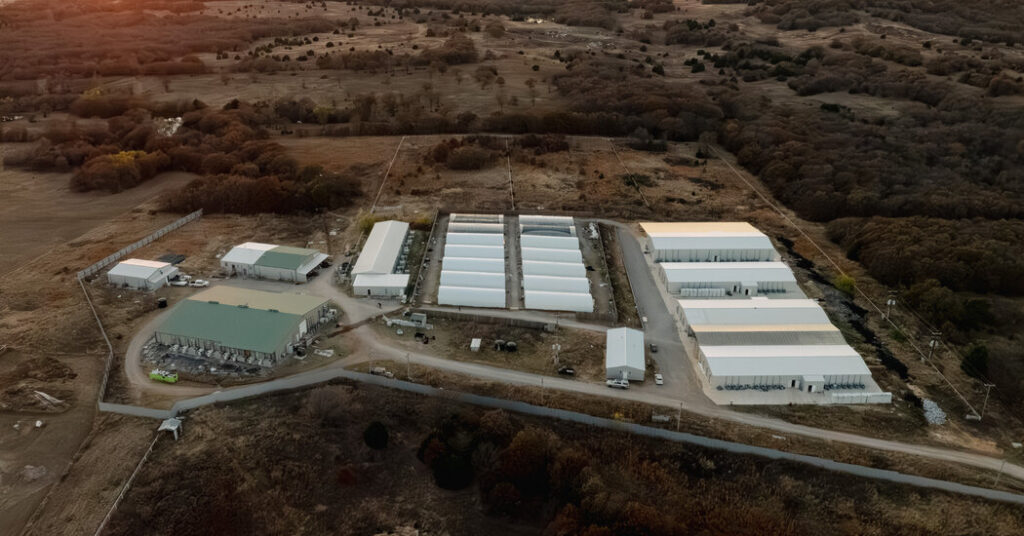
Court records show that Mr. Lam purchased the land and structures for Mr. Wang to operate a marijuana farm near Oklahoma City in 2021, although Mr. Lam denied any involvement in its day-to-day operations.
The Times also identified four other leaders of New York City hometown associations who have financed or otherwise have connections to cannabis farms in Oklahoma.
Those included Mr. Wang, who had helmed the pro-Beijing Taishan Du Hu Association of America and whose killing in January 2025, along with court proceedings that followed it, offered a rare look at how the groups’ officials have sought to gain a foothold in a booming industry far from their New York headquarters.
No law bars such investors from taking stakes in Oklahoma cannabis farms, but all operations must be 75 percent owned by Oklahoma residents and operators must obtain a state license and local permits and fully disclose all ownership stakes in each farm.
None of the marijuana produced on Oklahoma farms can legally be sold outside the state. Even so, in 2023, Oklahoma’s attorney general estimated that 40 percent of the cannabis consumed in New York came from his state.
All of the farms linked to the hometown associations are under investigation by the authorities in Oklahoma; Mr. Wang’s operation was shut down in 2022 for operating without a license, but Mr. Wang continued to work in the business after that, records show.
The leaders of the hometown associations were among thousands of Chinese-born businessmen and workers who have flocked to the state to take advantage of cheap land and an industry-written law — unique in the United States — that allows growers to plant unlimited amounts of marijuana.
Instead of revitalizing Oklahoma’s rural economy as many had hoped, though, the law has fed a thriving market for bootleg cannabis, where suppliers ignore laws banning marijuana trafficking, undercut legitimate sellers and skirt taxes and safety testing, officials said.
Whether some of the Chinese-born businessmen have acted with the tacit approval of the Chinese government remains an open question. The Times found no evidence that Chinese officials were involved in operating or supporting the marijuana farms, but, as The Times reported in August, the Chinese government has treated the hometown association leaders as favorite sons of the motherland.
At a hearing held by the House Homeland Security Committee in September, lawmakers from both parties suggested China is benefiting from marijuana industry investments by Chinese-born entrepreneurs, and they cast the farms as components of a broader criminal enterprise involving human smuggling, forced labor and money laundering.
Donnie Anderson, director of the Oklahoma Bureau of Narcotics and Dangerous Drugs Control, which has shut down hundreds of illegal marijuana farms, said in an interview that ethnic Chinese businessmen had been “providing staggering amounts of cash to build industrial-sized farms all over the state.” Mr. Anderson said most of the farms he had shut down were run by people of Chinese descent.
One undeniable element of the boom has been the influx in recent years of Chinese immigrants from New York who are helping to power it, sometimes while working in appalling conditions.
Of the nearly 2,500 active marijuana cultivation licenses issued by the state, at least 10 percent list addresses or phone numbers in one of New York City’s five boroughs, primarily the neighborhoods of Sunset Park in Brooklyn and Flushing in Queens, a Times analysis showed.
In interviews, marijuana industry entrepreneurs of Chinese descent said they abide by all state and federal laws, and some said they believed the authorities were targeting them out of racism.
“They want all the Asian guys out,” said one operator, Chen Xiang, 35, who said he owns 20 farms across the state.
An Illegal Operation
By any measure, John Lam is a powerful figure in New York’s Chinese diaspora, the largest outside East Asia.
He served as president of the Guangdong Association of America, one of the biggest and most pro-Beijing hometown associations in the city, as well as an adviser to an affiliate of the United Front, an organ of the Chinese Communist Party that seeks to expand the party’s influence at home and abroad.
Mr. Wang, who worked for Mr. Lam’s company, Lam Group, as head of the division that recruited investors in China, had also founded a hometown association representing people from his native Guangdong Province. That group supports Chinese government policies such as the crackdown on Hong Kong’s civil liberties. It also backed Mr. Adams’s mayoral campaign in 2021.
In summer 2021, Mr. Wang approached a marijuana grower in Del City, Okla., Chelsey Davis, and offered to take over his business for payments totaling about $1.5 million.
Mr. Davis, 51, said the Chinese laborers who started at the farm after he sold it often endured harsh conditions and long hours; some were even forced to urinate in five-gallon fertilizer containers rather than step away from the processing line.
“You could go at midnight — they were working,” Mr. Davis said. “You could go at 5 o’clock in the morning — they were working.”
In August 2022, firefighters in Del City received calls about black smoke billowing from the farm.
Inside, they saw that the Chinese workers were living on-site in cramped quarters. The smoke was coming from a fire near an outdoor kitchen, complete with a wok, where firefighters found burning wood and construction materials, according to the fire chief, Z. Williams.
Chief Williams said he had been startled to see what the workers were relying on for food: geese and turtles caught from a city-owned lake near the property. Photos taken by the firefighters show the geese in a makeshift coop fashioned out of road construction netting and discarded trays for growing marijuana. The turtles were paddling inside water-filled containers near the kitchen.
Although Mr. Davis had obtained the proper paperwork during his ownership of the farm, Mr. Wang’s operation had failed to do the same. The firefighters found no valid marijuana cultivation licenses, or even a certificate of occupancy, that would allow Mr. Wang to grow and sell cannabis legally. The department promptly shut the operation down.
Mr. Wang looked on as the firefighters inspected the grounds, photos of the scene show.
A few weeks later, city records show, Mr. Lam’s name appeared on an application for a permit to reopen the business, which city planners quickly rejected, citing the owner’s failure to obtain a marijuana license and meet safety guidelines.
In an interview in Manhattan’s Chinatown, Mr. Lam denied signing that paperwork, saying he had legally empowered Mr. Wang to transact business in his name and had not kept up with the day-to-day details of the operation.
.css-1mxer6r{max-width:600px;width:calc(100% – 40px);margin:1.5rem auto 1.75rem;height:auto;margin-left:auto;margin-right:auto;font-family:nyt-franklin;color:var(–color-content-secondary,#363636);border-top:1px solid var(–color-stroke-quaternary,#DFDFDF);border-bottom:1px solid var(–color-stroke-quaternary,#DFDFDF);padding-top:20px;padding-bottom:20px;}@media only screen and (min-width:1024px){.css-1mxer6r{width:600px;}}.css-1medn6k{font-family:nyt-franklin,helvetica,arial,sans-serif;font-weight:500;font-size:1.0625rem;line-height:1.5rem;}@media only screen and (max-width:480px){.css-1medn6k{font-size:1rem;line-height:1.375rem;}}.css-1f84s5v{font-weight:700;font-size:1.0625rem;}@media only screen and (max-width:480px){.css-1f84s5v{font-size:1rem;}}.css-1f84s5v a{color:var(–color-signal-editorial,#326891);-webkit-text-decoration:underline;text-decoration:underline;}.css-1f84s5v a:hover{-webkit-text-decoration:none;text-decoration:none;}.css-1hvpcve{font-size:17px;font-weight:300;line-height:25px;}.css-1hvpcve em{font-style:italic;}.css-1hvpcve strong{font-weight:bold;}.css-1hvpcve a{font-weight:500;color:var(–color-content-secondary,#363636);}.css-214jt4{margin-top:15px;margin-bottom:9px;}@media only screen and (max-width:480px){.css-214jt4{font-size:14px;margin-top:15px;margin-bottom:10px;}}.css-214jt4 a{color:var(–color-signal-editorial,#326891);-webkit-text-decoration:underline;text-decoration:underline;font-weight:500;font-size:16px;}@media only screen and (max-width:480px){.css-214jt4 a{font-size:13px;}}.css-214jt4 a:hover{-webkit-text-decoration:none;text-decoration:none;}.css-1mxer6r{max-width:600px;width:calc(100% – 40px);margin:1.5rem auto 1.75rem;height:auto;margin-left:auto;margin-right:auto;font-family:nyt-franklin;color:var(–color-content-secondary,#363636);border-top:1px solid var(–color-stroke-quaternary,#DFDFDF);border-bottom:1px solid var(–color-stroke-quaternary,#DFDFDF);padding-top:20px;padding-bottom:20px;}@media only screen and (min-width:1024px){.css-1mxer6r{width:600px;}}.css-1medn6k{font-family:nyt-franklin,helvetica,arial,sans-serif;font-weight:500;font-size:1.0625rem;line-height:1.5rem;}@media only screen and (max-width:480px){.css-1medn6k{font-size:1rem;line-height:1.375rem;}}.css-1f84s5v{font-weight:700;font-size:1.0625rem;}@media only screen and (max-width:480px){.css-1f84s5v{font-size:1rem;}}.css-1f84s5v a{color:var(–color-signal-editorial,#326891);-webkit-text-decoration:underline;text-decoration:underline;}.css-1f84s5v a:hover{-webkit-text-decoration:none;text-decoration:none;}.css-1hvpcve{font-size:17px;font-weight:300;line-height:25px;}.css-1hvpcve em{font-style:italic;}.css-1hvpcve strong{font-weight:bold;}.css-1hvpcve a{font-weight:500;color:var(–color-content-secondary,#363636);}.css-214jt4{margin-top:15px;margin-bottom:9px;}@media only screen and (max-width:480px){.css-214jt4{font-size:14px;margin-top:15px;margin-bottom:10px;}}.css-214jt4 a{color:var(–color-signal-editorial,#326891);-webkit-text-decoration:underline;text-decoration:underline;font-weight:500;font-size:16px;}@media only screen and (max-width:480px){.css-214jt4 a{font-size:13px;}}.css-214jt4 a:hover{-webkit-text-decoration:none;text-decoration:none;}
Got a confidential news tip? The New York Times would like to hear from readers who want to share messages and materials with our journalists.
See how to send a secure message at nytimes.com/tips
He acknowledged buying the farm for Mr. Wang’s use but described his role in the marijuana business as little more than that of a landlord — and an unpaid one at that. He also blamed Mr. Wang, who had been trying to drum up Chinese investors for the Lam Group, for Mr. Lam’s participation in three organizations under the Communist Party’s United Front.
“He may have mentioned them to me, but I did not understand them,” Mr. Lam said. “I did not know what kind of organizations they were.”
Still, it was Mr. Lam who paid for the lawyers representing his interests, and those of Mr. Wang’s family, in a breach-of-contract lawsuit later filed by Mr. Davis, Mr. Lam said.
But instead of dwelling on the Oklahoma operation, he said, his focus has been on New York, where, in September, he was a guest of honor at a lavish party at a cavernous restaurant in Flushing. He sat at one of the head tables, along with a Chinese diplomat and local politicians.
The host was a fast-rising and powerful hometown association leader in New York: Jason Lin.
Ties to New York
Mr. Lin, too, has served as president of a prominent hometown association in New York City — and had recently visited two marijuana farms in Oklahoma.
The swaggering operator of karaoke parlors, buffet restaurants and a Miami nightclub, Mr. Lin was elected president of the American Fujianese General Business Association in February 2024.
At a dinner in Flushing to celebrate his victory, the guest of honor, sitting next to Mr. Lin, was Mr. Adams, whose liaison to the Asian community at the time, Winnie Greco, was under scrutiny amid an investigation into possible Chinese interference in the 2021 mayoral race. (Mr. Lin had supported the mayor during his campaign.)
Also present were several people from the cannabis industry.
Soon after, Mr. Lin traveled to Oklahoma City with two non-Chinese businessmen to visit two cannabis farms run by people from Mr. Lin’s native province.
Mr. Lin gave conflicting accounts about the reason for his visit.
At first, during an hourlong interview at his office building in Flushing, he said he had traveled to Oklahoma — with a marijuana-growing expert — to help friends from his native Fujian Province whose farms were struggling.
“I have friends with farms” in Oklahoma, he said.
But during follow-up interviews, Mr. Lin gave a different account, saying he had been simply making introductions for two non-Chinese people looking to invest in Oklahoma farms. He declined to provide names of the people with whom he had met and said he did not know the owners of the farms he had visited.
Mr. Lin said neither he nor his business association had any financial ties whatsoever to the marijuana industry, and The Times found no evidence that any such ties exist.
Other prominent members of New York hometown associations have had tangled relationships with Oklahoma growing operations.
Sin Tung Chan, 76, was a member of the American Fuzhou Langqi Alumni Association before buying into two large marijuana farms in Meeker and Cleveland, Okla., in 2021, state records show.
In a past life, Mr. Chan had served prison time in New York over threats he made to business rivals, one of whom was assaulted during an attempted kidnapping in 1995.
Now, he said in an interview, the crackdown by Oklahoma officials is souring business.
“You can’t sell this stuff now,” he said. “With all this investment, it would be a shame to just abandon it.”
And Chen Bichao, 61, the president of Chuan Shi USA Association in New York, ran a sprawling marijuana farm west of Tulsa that was ordered shut down in November for lacking a permit. In August, he appeared at an event in Flushing, flanked by two Chinese diplomats.
He, too, has a criminal record, having pleaded guilty to assault in 2015 after being accused of threatening a man with a knife and taking his wallet.
In a phone interview, Mr. Chen said that he was in New York and that he was not the owner of the marijuana farm, only one of many small investors. (State records list him as the sole owner; Mr. Chen said the farm was simply registered under his name.)
“The farm isn’t mine; I’m just a worker helping out,” Mr. Chen said.
He also said he believed the farm was still in operation. He had not heard about the shutdown order, he said.
A Cannabis Bonanza
The medical marijuana industry now rivals the state’s oil and gas business in revenue generated per year. From March 2024 to March 2025, Oklahoma growers produced about 50 times more marijuana than was sold at dispensaries to the state’s registered medical marijuana patients, according to figures shared by Mr. Anderson of the narcotics bureau at the September hearing in Washington.
Law enforcement officials said that most of the excess was destined for illegal markets outside the state, despite their efforts to stop it.
While dozens of states have made it legal to possess marijuana for medical or recreational use, it remains a federal crime to transport it across state lines. The U.S. Drug Enforcement Administration estimated that two-thirds of the illegal marijuana confiscated by the agency in 2024 was seized in Oklahoma.
Court records suggest that many companies are evading Oklahoma’s licensing rules through fraudulent paperwork, failure to obtain permits and the use of straw owners. In one case, a single Oklahoma resident falsely claimed to own more than 300 farms.
It was not clear how many of the unlicensed operations were owned by Chinese-born investors, or whether the Chinese government, or its politically connected elites, might be somehow benefiting from the tens of billions of dollars per year the farms generate.
But current and former state and federal law enforcement officials said that Beijing has certainly been aware, because much of the business has been conducted through WeChat, the Chinese social media platform that is closely monitored by the government.
Chris Urben, a former senior agent with the D.E.A. in New York, said he became increasingly focused on marijuana toward the end of his career because it had become central to money laundering and organized crime.
“You’re talking billions of dollars,” he told a congressional panel in September. “It essentially put on steroids Chinese organized crime within the United States.”
And the marijuana industry is far from under control, he said.
Operations like Botanical Green Farms LLC in Wynnewood, Okla. — which Mr. Lin visited last year — offer hints as to why.
Despite state rules requiring disclosure of all shareholders, trying to untangle the farm’s true ownership is a daunting task.
On paper, the 48-acre property about an hour south of Oklahoma City is 100 percent owned by a 66-year-old Oklahoma woman named Kimberly Hannah.
But in an interview outside her home, Ms. Hannah’s husband, Terry D. Hannah, 79, said he and his wife were merely minority shareholders in the company.
When state regulators visit, “we have to talk to them to get the permits renewed,” Mr. Hannah said, but he added, “That’s about all our involvement.”
State records show that he previously owned three marijuana businesses, now defunct, registered under the name of He Hui, a Chinese national with ties to Flushing who formerly owned the Wynnewood site. Earlier this year Mr. He was sentenced to eight years in federal prison for marijuana trafficking.
Mr. Hannah said he did not know who the current controlling shareholders of the Wynnewood farm were. Just that they were Chinese — and lived in New York City.
Yi Liu and Shuran Huang contributed reporting. Kirsten Noyes contributed research.
Jay Root is an investigative reporter for The Times based in Albany, N.Y., covering the people and events influencing — and influenced by — state and local government.
The post Behind Oklahoma Cannabis Farms, New Yorkers With Ties to Beijing appeared first on New York Times.