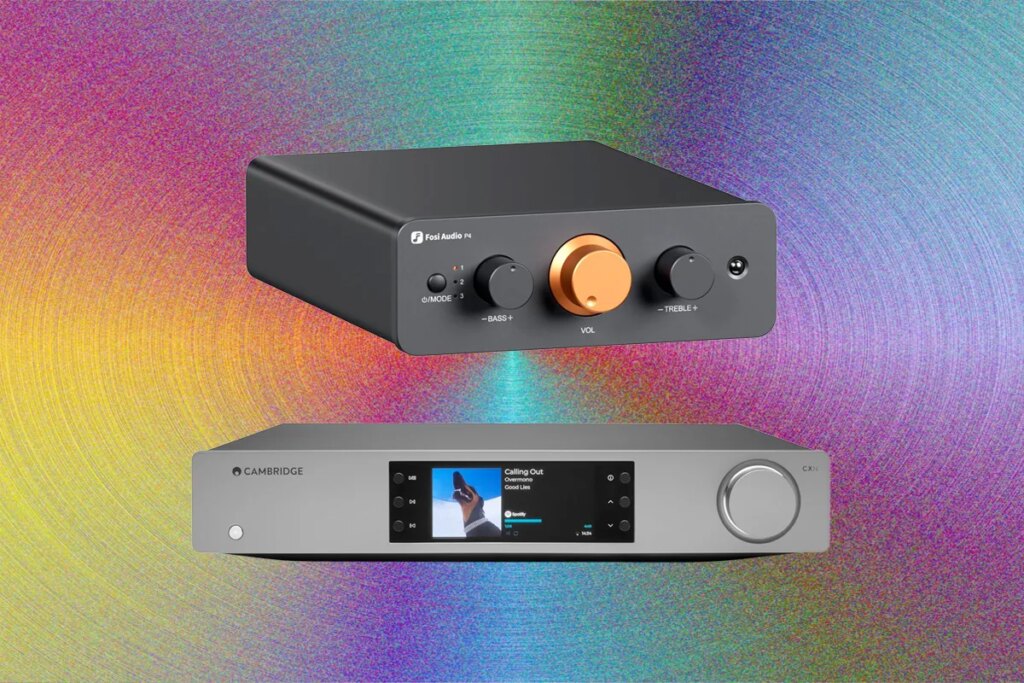
Every audio system requires amplification. In a traditional hi-fi set-up, the loudspeakers are always “passive”—which is to say, they don’t produce their own power. Instead, they must receive an amplified audio signal from an external source, aptly called an amplifier, in order to do their thing. Even in a more modern, self-contained audio system (like the Sonos Era 100, for example), the drivers that produce the sound must be amplified in order to function—this just all happens in a singular box rather than across hi-fi separates.
But if you’ve heard about amplifiers, you may have also heard about preamplifiers (often referred to as “preamps”) and wondered where they fit into an audio system, and whether you need one. Let’s answer those questions, shall we?
What Does a Preamp Do?
An audio signal needs plenty of attention before it’s ready to be amplified—so ultimately the question “what does a preamp do?” broadly contains its own answer. A preamplifier takes care of everything that needs to be done before the audio signal (sent from the music source) is amplified and sent onwards to the system’s speakers.
In a self-contained audio system like the Sonos speaker, the preamplifier and the amplifier are in the same enclosure, along with the speaker drivers that actually deliver the sound. Even in a more sophisticated hi-fi separates setup, the preamplifier part of proceedings is still often handled out of sight, within the amplifier. These types of amps are known as “integrated amplifiers” and contain both preamp and amplifier functionality.
However, some people prefer to separate out this functionality, which is when you may come across a preamplifier as its own piece of equipment, paired with a power amplifier. In these cases, the preamplifier allows you to select the source of music you’d like to hear (the majority have a selection of input options in order to support a system with multiple sources), and also set and adjust the volume.
The preamp also ensures the audio signal is at “line level”—that is, the standard voltage strength of an audio signal transmitted between components—and sends it on to be amplified, ready to be moved onwards, finally, to the speakers.
Does an External Preamp Improve Sound Quality?
Hi-fi orthodoxy says that individual functions in any system should be kept as separate as possible if the best results are to be achieved. The thinking goes that, by keeping electrical activity as shielded and self-contained as possible, the audio signal has the best shot at remaining as pure and uncolored as possible.
By dividing the preamplifier and the amplifier functions into separate boxes, there should be a reduction in electrical noise and interference around the signal compared to having it all crammed into a single box.
This two-box arrangement is commonly known as “pre/power”—the previously mentioned pre-amplification and power amplification—and can safely be interpreted as a sign of a listener who takes things very seriously indeed. A system that also separates out digital-to-analogue conversion into a self-contained enclosure is more serious still—and by this point you’re looking at a system that occupies a lot of space, not to mention requires quite a few mains sockets too.
Different Types of Preamp
Phono Stages
There are always exceptions, though, and in this instance they concern record players, or turntables. Turntable technology, of course, is quite elderly—and the audio signal that a record player produces is so feeble it’s virtually non-existent. This means it requires an awful lot of amplification even to get your vinyl sound to the point that it’s at that required “line level”—so if you want to use a turntable, it will require a whole lot of preamplification of its own.
Confusingly, the dedicated turntable amplifiers that help make this happen are sometimes also called preamplifiers—but they’re much more commonly known as “phono stages.” These are a very specific type of preamp, which only work to amplify a turntable’s audio signal and nothing else.
Naturally, the very serious listener buys a standalone phono stage to amplify the signal from a record player to line level before it reaches the next part of a system. But you will also find phono stages built into other pieces of equipment, including the turntable itself, or an integrated amplifier.
Solid State vs. Tube Preamps
The differences between solid state and tube preamps are, broadly speaking, the same as the differences between any solid state audio component and its tube (or valve) equivalent. Fundamentally, they concern cost, performance and longevity.
Where “cost” and “longevity” are concerned, solid state wins every time. A solid state preamp should really require no maintenance whatsoever beyond the occasional dusting, and certainly has no consumable parts. A tube pre-amplifier, on the other hand, needs real care taking of it, not to mention it will exhaust its tubes at some point, meaning they will have to be replaced.
Performance, though, is a rather more subjective topic. The stereotype that says solid state preamps sound clean and detailed, while tube preamps sound warm and lush is a stereotype for a reason, which means you’ll have to consider the sort of sonic signature you prefer, as well as your outlay, when it comes to choosing a preamp.
Do I Need a Preamp?
If we are being entirely accurate, the answer is yes, every audio system requires a preamplifier within it, in order to do all of the work we’ve spoken about—namely in helping every audio signal that goes through it to the necessary line level. So if you have any form of working audio setup, be that a Bluetooth speaker or full hi-fi system, you will actually already have one.
Whether you need a separate preamplifier in your system really depends on how serious you want to get about your system. Hi-fi enthusiasts and audiophiles would say that it’s a worthy investment, but upgrading your system’s integrated amplifier (or indeed, upgrading from a wireless speaker to an entry-level hi-fi separates system), could be a good start, if your budget won’t stretch to a full system of individual components just yet.
What Should I Buy If I’m Starting, or Upgrading?
The audio industry being what it is, it’s possible to pay anything from “not very much at all” to “fast German saloon car” money for a pre-amplifier. Here are four of the best—two pre-amplifiers, two phono stages—at different price points that all offer excellent performance at the money.
The post What Is a Preamp, and Do I Really Need One? appeared first on Wired.