On the first morning without rain after I moved to Switzerland, I woke up, still jet-lagged, and walked outside to look at any part of my new home that wasn’t cluttered with half-unpacked boxes.
I saw a snail.
It was huge. Its light brown shell stood taller than the tip of my shoe. Its yellowish-green body stretched about an inch ahead and behind. Its eyestalks probed the air in small circles. I pointed it out to my mother-in-law, who lives two floors down and was working in the garden.
“Careful,” she said. “They’re protected.”
I knew moving from the United States, where I had lived my entire life, to the village outside Basel where my wife was born would bring some confusion. But protection for snails? We were two blocks from the border with France, where snails are served in garlicky butter sauce. On the Swiss side, snails seemed about as common as squirrels back home. They were under trees, on fence posts and stuck to the sides of houses. I even saw a few tiny shells in the mailbox, hiding behind my immigration forms.
The snails and their apparent protected status sent me into a spiral of anxiety. I walked with my head down, afraid that one smushed shell would cost me my visa, or result in what I was learning were the two most common Swiss punishments: a lecture (delivered for, say, not cleaning the lint trap) or a fine (for just about anything else). The snails, meanwhile, were indifferent to my presence, much like the locals when I ungrammatically asked for water in restaurants or peanut butter in the grocery store. Even the word for snail — Schnecke — taunted me. I knew it because it’s also the name of the hazelnut-filled pastry spirals I saw in bakeries. Slugs are Nacktschnecken — “naked snails.” Why did snails get their own word (and snack) but not slugs? Lost in the logic of the language, I felt like a Faultier — a sloth, literally a “lazy animal.”
In spring, the snails arrived in abundance, but they didn’t seem protected. On walks, I saw shattered shells and trails of smeared goo. I wrote to a Swiss conservation group to check my mother-in-law’s claim, and they sent me a PDF listing hundreds of animals with protections from either the national or cantonal government. I counted seven snails, recognizing one as the brown snail from the front steps. (It’s also the one on menus.) The protections, I learned, were meant to prevent overharvesting.
If the government could stop snails from being hunted, I could stop them from being crushed. I lifted snails out of the street and carried them to safety. Often, I set one on a patch of grass and noticed three or four more just inches away. I got lost in the beauty of their shells and sat on the ground, watching as they moved with no apparent urgency or goal, gliding on curtains of flesh that waved like earthbound magic carpets.
For these minutes, I forgot that I didn’t have steady work or friends in my new country. Instead of finding either, I kept a notebook to log snail sightings. I studied scans of medieval manuscripts where scribes drew knights fighting giant snails. Walking in Basel, I took a photo of a painted snail on a centuries-old building with words meaning “to the red snail” written below it, believed to be a way of identifying houses in the years before street numbers.
Snails can start on an adventure and not realize what they’ve gotten themselves into until it’s too late.
There are more than 200 species of snails in Switzerland, living high in mountains and underwater in lakes. I called the Natural History Museum in Bern to ask about the snails’ importance to environments they had seemingly conquered. “That’s always such a mean question,” Estée Bochud, who manages the museum’s malacology collection, said, laughing — nobody asks what humans contribute. She told me snails replenish the soil and eat decaying plants. They’re also a food source for small animals, and when they die, their shells can become a home to insects or spiders. Humans don’t return the favor. Instead we destroy snails’ habitats and occasionally harvest their mucus for anti-aging beauty products.
I asked Bochud if moving snails like I was doing might cause them stress. She said it seemed fine, since snails can start on an adventure and not realize what they’ve gotten themselves into until it’s too late.
I understood the feeling.
Over time, snails became my connection to a new country. I practiced saying “This is good for the soil” in German, in case anyone asked what I was doing. While following slime trails, I learned how to get around. Reading Elisabeth Tova Bailey’s “The Sound of a Wild Snail Eating” taught me that a snail can repair a damaged shell using minerals from its diet, and as I squeegeed hard-water streaks from our shower tile, I had a new appreciation for calcium.
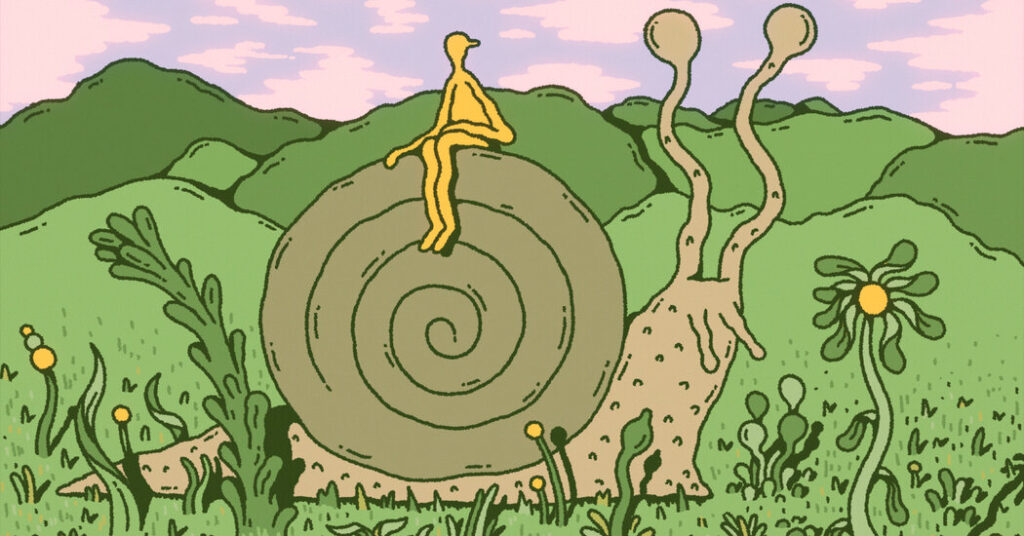
The cliché about the shell being a snail’s home — that all you need is what’s on your back — was a comfortable metaphor after my move, but the more I observed the snails, the less I believed it. The shell is protection, but so is a snail’s ability to blend in with its surroundings. Snails helped me love my new town and learn a new language. But crouching in lawns is no way for a human to adapt. When winter came and the snails went into hiding, I explored places that weren’t shady and damp, putting my verb conjugation to use in conversations about topics other than mollusks.
The next spring, I still helped snails across the street, but I didn’t record sightings or stare for minutes on end. I gave them their privacy. Snails are my neighbors, and now I know a few more of my human ones too.
Gabe Bullard is a journalist and a radio producer who lives in Switzerland.
The post To Feel at Home in a New Place, It Helps to Think Like a Snail appeared first on New York Times.