As a lifelong resident of Yonaguni, a remote island that is Japan’s westernmost point, Himeyo Ukemasu remembers the distant days when life was measured by the bright stars, the tides and the ripening of mulberry trees.
Today, the stars have been obscured by radar towers, and Ms. Ukemasu, a 70-year-old volunteer at a tourist site, has other concerns. Yonaguni, a Japanese military outpost about 70 miles east of Taiwan, sits along the so-called “first island chain,” a strategic arc of islands used to hem in Chinese naval expansion. As China fumes over Japan’s recent expression of support for Taiwan, Ms. Ukemasu and the island’s roughly 1,600 other residents have found themselves on the front lines of a rapidly escalating dispute.
“I don’t want the people to be sacrificed,” she said. “I want to see the mulberries turn red and the lilies bloom. All I want is an ordinary life.”
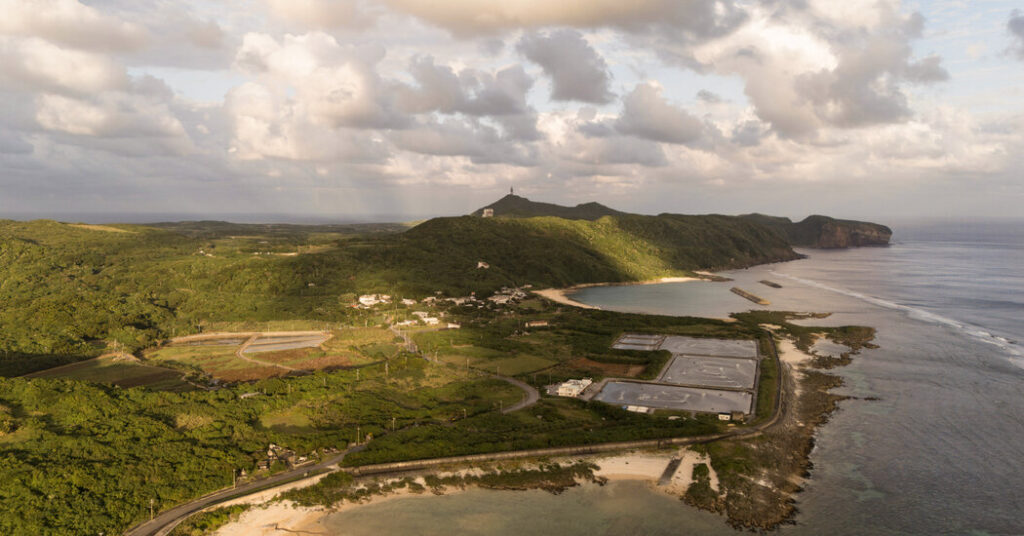
For decades, Yonaguni, part of Okinawa Prefecture, has been an enchanting oasis in the East China Sea with wild horses, hammerhead sharks and an offshore rock formation that some believe to be the ruins of a lost civilization. The island was perhaps best known in Japan as the backdrop for “Dr. Koto’s Clinic,” a 2000s medical drama about a Tokyo surgeon banished to a remote Okinawan clinic.
But over the past decade, the Japanese government has invested tens of millions of dollars to make Yonaguni a bulwark in its efforts to counter Chinese military aggression, with troops, radar towers and ammunition storage sites. Japanese and American military assets there could prevent Chinese warships from getting into the open Pacific waters farther east if conflict were to break out. The island has three tiny settlements, a small airport and a garrison of about 230 soldiers.
China has led an all-out effort to punish Japan since early November, when Japan’s prime minister, Sanae Takaichi, said her country could intervene militarily if China were to attack Taiwan, a self-governed democracy that Beijing claims is part of its territory. The Chinese government unleashed a wave of reprisals, discouraging tourism to Japan and ramping up air and sea patrols, including around Okinawa. China plans to hold live-fire military drills around Taiwan on Tuesday — a show of strength by its navy and air force — including some activities near Yonaguni.
Yonaguni is a reminder that Japan’s own security is linked to Taiwan’s. A Chinese attack on Taiwan could threaten Japan’s access to vital sea lanes and leave far-flung Okinawan islands vulnerable. (Chinese commentators have in recent years sought to raise doubts about Japan’s sovereignty over Okinawa.)
Japan’s defense minister, Shinjiro Koizumi, recently visited the island, where he detailed plans to station medium-range antiaircraft missiles there to deter an “armed attack on our country.” The move is part of broader effort by the Japanese military, known as the Self-Defense Forces, to fortify islands across Okinawa as a counterweight to China. Prime Minister Takaichi, a China hawk, has said she will accelerate Japan’s military spending to 2 percent of gross domestic product by next spring, two years ahead of schedule.
China has called the plan to put missiles on Yonaguni “extremely dangerous” and accused Japan of “provoking military confrontation.” The Chinese military recently flew drones near the island to express its displeasure.
Residents said that they have tried to tune out the tensions, though the subject sometimes arises at local izakayas, or pubs, after long days of work in the sugar-cane fields or at the garrison. In interviews, some people were defiant, saying they would not evacuate the island even if there were a Chinese attack on Taiwan.
Many residents rejected the idea that a crisis is imminent, blaming the news media for stoking fears of conflict. But they acknowledged that island’s identity has changed since the garrison was established in 2016; at the time, there were 632 votes in favor of hosting the military, and 445 against. Now, apartment buildings have been built for the troops, and military families mingle with Yonaguni natives at restaurants and shrines.
The island’s mayor, Tsuneo Uechi, won election this year promising to take a more cautious approach to defense expansion. He has expressed concern about hosting the American military on the island for joint drills with Japan. The United States has deployed radar systems to Yonaguni and held medical visits there as part of training in recent years.
In an interview, Mr. Uechi said most residents were just trying to go about their lives. While he is wary of turning the island into a fortress, he acknowledged that some level of preparation is inevitable.
“It will be too late once something happens,” he said, “so we’re preparing for the worst.”
In recent years, Yonaguni’s proximity to Taiwan has placed it increasingly at the center of regional tensions. In 2022, after Nancy Pelosi, then the speaker of the U.S. House of Representatives, visited Taiwan, China fired at least 11 missiles in response, including one that landed about 50 miles northeast of Yonaguni.
China’s increasingly bold threats against Taiwan have raised new alarms. The Japanese government plans to build underground shelters across remote Okinawan islands over the next several years, including one on Yonaguni that can hold more than 200 people. And officials are holding evacuation drills and preparing residents for a possible influx of Taiwanese refugees.
Japan also plans to deploy about 30 troops to Yonaguni over the next year to form an electronic warfare unit.
Many residents are skeptical of the Japanese government’s intentions, saying the presence of more troops makes the island even more of a target. A pacifist streak runs through Okinawa, in part because of a legacy of U.S. colonialism, World War II and the abundance of American military bases in Japan.
Takashi Tomitori, 56, an amateur diver, moved to Yonaguni several years ago from Chiba Prefecture near Tokyo, drawn by its stunning oceans. He said he felt the decision to station missiles there would make the island more dangerous.
“A war would seriously damage the island,” said Mr. Tomitori, who is also an auto mechanic. “Wouldn’t it be better not to have any missiles? Wouldn’t it be better not to retaliate?”
Still, more hawkish voices say the island needs to protect itself.
Shigenori Takenishi, chairman of the Yonaguni fishery association, said he was increasingly concerned by China’s movements in the seas around Japan.
“We never know what China might do,” he said.
Beyond security, Mr. Takenishi said troops were helping keep Yonaguni vibrant, at a time when the local population is aging and declining. The island lacks a major port, a high school and a hospital. Many young people have left in recent years for Japanese cities in search of better opportunities.
“Yonaguni won’t survive without the military,” Mr. Takenishi said.
Then there is the stress of being caught between geopolitical rivals. Some people joke that life might be better if Yonaguni could be moved farther to the east, perhaps closer to Hawaii.
On a recent evening, a group of young fathers gathered in a garage to build floats for a Christmas Day light parade, a Yonaguni tradition. They spent hours hammering together set pieces and stringing lights as Christmas music blared in the background. The aim was to give residents, especially children, something light and fun to think about for a change.
“Seeing their smiling faces is very rewarding,” said Takanobu Sugimoto, a 37-year-old father of four children, as he measured a piece of plywood. “That’s what this parade is all about.”
With tensions flaring in the region yet again, Mr. Sugimoto said the people of Yonaguni had come to accept there was little they could do to change the situation.
“That’s the only way it can be,” he said. “That’s the way we’ve become.”
Javier C. Hernández is the Tokyo bureau chief for The Times, leading coverage of Japan and the region. He has reported from Asia for much of the past decade, previously serving as China correspondent in Beijing.
The post The Tiny Japanese Island on the Front Lines of China’s Feud appeared first on New York Times.