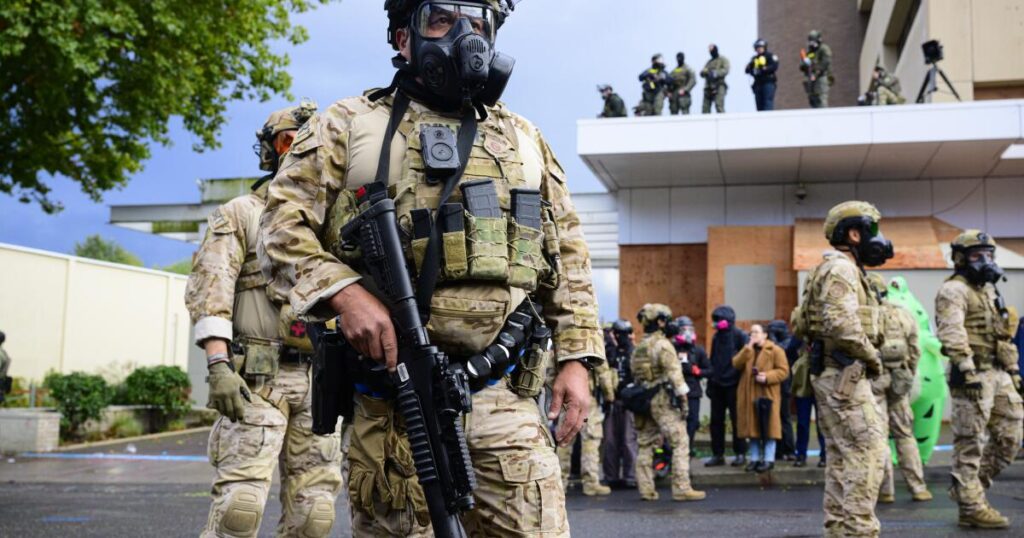
In one of its most consequential rulings of the year, just before breaking for the holidays last week the Supreme Court held that President Trump acted improperly in federalizing the National Guard in Illinois and in activating troops across the state. Although the case centered on the administration’s deployments in Chicago, the court’s ruling suggests that Trump’s actions in Los Angeles and Portland were likewise illegal.
Trump has said that his deployments of troops to these metro areas were just the beginning and that his administration planned to use military force in more cities across the country. The specter of U.S. troops being deployed against its citizens is inconsistent with a long history of not mobilizing the military for purposes of domestic law enforcement. Images of troops patrolling city streets are more often seen under authoritarian regimes, not in the United States. The Supreme Court’s ruling will immediately put a stop to this.
In coming to this conclusion, the Supreme Court interpreted two federal statutes: The first, 10 U. S. C. §12406(3), empowers the president to federalize members of a state’s National Guard only if he is “unable with the regular forces to execute the laws of the United States.” The Trump administration claimed that it needed to federalize the Illinois National Guard, and similarly troops in California and Oregon, because local police were unable to adequately protect U.S. Immigration and Customs Enforcement agents, especially during protests and other demonstrations.
Whether this level of protection was actually called for is still much disputed, and in three separate rulings this year federal courts found that there was no such need in Chicago, Los Angeles and Portland. However, the Supreme Court avoided that issue by explaining that the statutory provision means a president can federalize a state’s guard only if it can be shown that U.S. armed forces cannot provide adequate protection for the activities of the federal government.
In a 6-3 ruling, the court concluded that “the term ‘regular forces’ in §12406(3) likely refers to the regular forces of the U.S. military. This interpretation means that to call the Guard into active federal service under §12406(3), the President must be ‘unable’ with the regular military ‘to execute the laws of the United States.’”
This, in itself, is obviously a major limit on the ability of the president to federalize a state’s National Guard.
But the Supreme Court went even further, adding that to federalize a state’s guard would first require the state to be in a situation where the U.S. military could legally be deployed against its citizens, but that its use would be insufficient. Here, a second federal statute is critical. The Posse Comitatus Act, 18 U. S. C. §1385, adopted in 1868, prohibits the U.S. military from being deployed for use in domestic law enforcement except in very limited circumstances, such as when there is an insurrection in a state. Adopted soon after the end of Reconstruction, the act makes it a federal crime to deploy the military within U.S. borders except as expressly authorized by the Constitution or by a federal statute.
In plain English, the Supreme Court ruled that a president can federalize a state’s National Guard only in the rare circumstances where the Posse Comitatus Act allows the military to be used for domestic law enforcement, and then only if the U.S. military would be deemed inadequate to quell the unrest. The Court ultimately declared that “before the President can federalize the Guard under §12406(3), he likely must have statutory or constitutional authority to execute the laws with the regular military and must be ‘unable’ with those forces to perform that function.”
It is hard to imagine, except in the most dire of circumstances, how these requirements could be met. This is exactly as it should be. The U.S. military is not trained to police its citizens and it is not instructed as to the use of force to protect civil liberties. And removing policing from the control of state and local governments would dramatically expand the president’s power. The Supreme Court’s approach is precisely what Congress had in mind in 1878 in prohibiting the use of the military for domestic law enforcement.
I, and many others, have criticized the Supreme Court for seeming to operate as a rubber stamp approving the Trump administration’s actions. But here the court served its essential role of enforcing the law and of enforcing checks on presidential power. And it did so in a way that will matter enormously in the months and years ahead in keeping this president from using the military to serve his political agenda within the United States.
Erwin Chemerinsky is the dean of the UC Berkeley Law School.
The post The Supreme Court finally pushed back against Trump appeared first on Los Angeles Times.