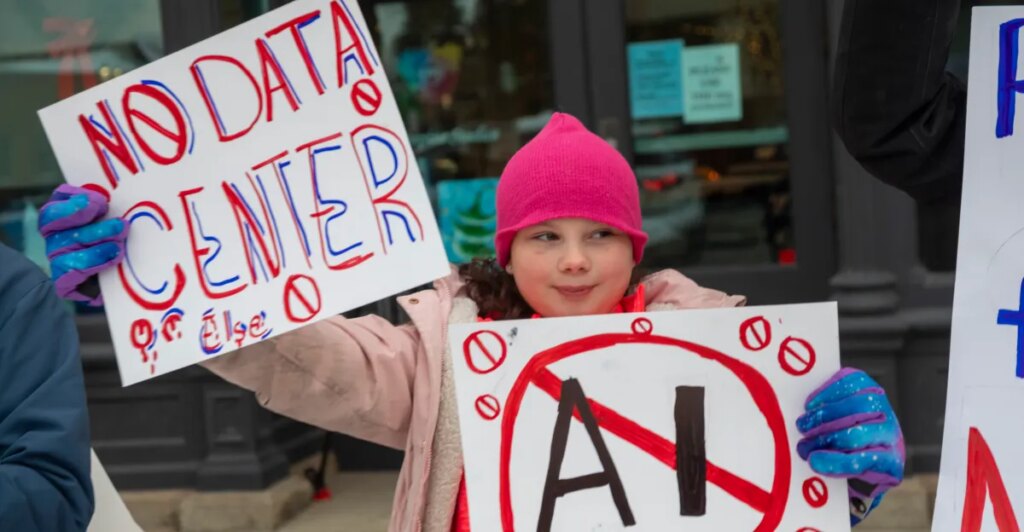
A widely despised industry is slurping up Americans’ water — and driving up their electricity bills — as part of a nefarious plot to take their jobs. Voters are begging for their political leaders to take a stand against these accursed corporations. Yet the Democratic Party can’t decide whose side it’s on.
Or so some Democratic operatives and commentators suggest.
This week, Politico published a report titled, “Americans hate AI. Which party will benefit?” In it, a diverse array of Democratic lawmakers and political professionals call on their party to be, in Politico’s words, “proudly, loudly, without reservations, anti-AI.”
Their case is simple: AI development is deeply unpopular. Voters are alarmed by the data center construction spree, fearing that it’s driving up energy costs and despoiling the environment. And they’re worried that AI is going to put them out of work.
The Trump administration is too wedded to the tech industry to speak to this anti-chatbot fervor, the operatives reason. Democrats therefore have an opportunity to claim ownership of a winning issue — one that unites a broad, populist coalition of both blue-collar and white-collar workers.
To effectively do so, however, it’s not enough to “minimally regulate” artificial intelligence while signaling a “a friendly stance toward tech companies building AI.” Rather, the party must define itself in opposition to the technology itself.
This may prove to be sound political advice. But it is nonetheless premised on a skewed reading of public opinion data. In reality, Americans’ feelings toward AI are more complicated than progressive consultants and pundits tend to suggest.
Americans are increasingly afraid of their computers
There is no question that US voters are anxious about AI in general and increasingly of the data center buildout in particular. To name a few recent poll results that illustrate this unease:
- 50 percent of Americans told Pew Research Center in June that they were “more concerned than excited” about “the increased use of artificial intelligence in daily life,” compared to only 10 percent who were “more excited than concerned.”
- 71 percent of voters are worried that AI will “put too many people out of work permanently,” according to a Reuters/Ipsos poll from August.
- By a margin of 41 to 37 percent, voters support banning data center construction near where they live, according to a November Morning Consult poll, while 58 percent say “AI data centers” are partly responsible for rising electricity prices.
As one would expect in light of these figures, Americans support the general concept of more heavily regulating the AI industry:
- 61 percent told Ipsos that the government should regulate AI to ensure economic stability.
- By an 80 percent to 9 percent margin, voters told Gallup that the government should prioritize “maintaining rules for AI safety and data security” over “developing AI capabilities as quickly as possible.”
Voters aren’t quite raging against the machines
All this said, Americans don’t seem to feel “hate” for AI, so much as unease and ambivalence about it.
In a recent poll from the Democratic data firm Blue Rose Research, 40.1 percent said they were “optimistic” about artificial intelligence compared to just 35.6 percent who said they were pessimistic (with the rest unsure).
A December survey from the left-leaning pollster Navigator produced similar results, with 49 percent of voters saying they had a favorable view of AI, while only 41 percent said they had an unfavorable one.
Meanwhile, in Gallup’s polling, 79 percent of Americans say that it is “important” for the United States to have the world’s most advanced AI technology, while 56 percent favored increasing government spending on artificial intelligence research. It is hard to see how a political party could be anti-AI “without reservations,” while still advancing these preferences.
In any case, for the moment, AI still isn’t a top concern for the typical American. This month, an Associated Press-Norc poll asked voters to name five problems they wanted the government to prioritize in 2026 — only 3 percent mentioned anything to do with technology, AI, or social media.
Likewise, in Navigator’s survey, only 7 percent of voters named AI as a top-five issue. Meanwhile, 75 percent of voters said they had heard “little” or “nothing” about new data centers being built in their communities.
Notably, some surveys cited by anti-AI populists are actually consistent with these findings. Politico’s piece referenced a Pew study showing that “only 17 percent of Americans think AI will have a positive impact on the US over the next 20 years.” The liberal commentator Josh Marshall cast this as evidence that “AI is running only slightly ahead of child molesters in the public imagination.”
Yet in Pew’s poll, only 35 percent said that AI would have a negative impact on the United States. In other words, two-thirds of the public said the technology would have either positive or neutral implications for American life. The share of voters who would say the same about child molesters is, presumably, quite a bit lower.
The robot apocalypse could change things
Democrats might still be wise to take a more adversarial posture toward AI. Voters are worried about the technology and support greater regulation of it. And they are increasingly sympathetic to the argument that data centers are driving up their electric bills.
Further, the public could plausibly become more opposed to artificial intelligence in the near future. If overinvestment in data centers triggers a financial crash — and/or, if AI actually generates mass unemployment — backlash to the technology would surely grow.
For the moment, however, it’s far from clear that either party can dramatically increase its popular support by declaring itself, unreservedly, “anti-AI.”
The post The political backlash to AI is overstated appeared first on Vox.