The heads of the security agencies arrived in convoys of black S.U.V.s to Bashar al-Assad’s presidential palace, a maze of marble and stone on a hillside overlooking Damascus.
Leaks about his regime’s mass graves and torture facilities were mounting — and top Syrian leaders wanted them to stop. So in the fall of 2018, they summoned Mr. al-Assad’s feared security chiefs to discuss how to cover their tracks better, according to two people briefed on the meeting.
One of the security officials proposed scrubbing the identities of Syrians who died in secret prisons from their records, the two people said, recalling what participants in the meeting had told them. That way there would be no paper trail, said the official, Kamal Hassan, who ran an infamous arm of Syria’s secret police, the Palestine Branch. Mr. al-Assad’s top security chief, Ali Mamlouk, agreed to consider the suggestion.
Months after that meeting, security agencies began interfering with evidence of the regime’s crimes, an investigation by The New York Times found.
Some security officials doctored paperwork so deaths of detainees could not be traced back to the security branch in which they were imprisoned and died. Some omitted details like the number of the branch and the detainee’s identification number. And top government officials ordered security agencies to forge confessions of prisoners who had died in their custody. Written confessions, they reasoned, would give the government some legal cover for the mass deaths of detainees.
The Times reviewed thousands of pages of internal Syrian documents, including memos marked “Top Secret,” many of which we photographed inside Syria’s most notorious security branches after rebels toppled the Assad government last year. Many of those security branches — which were known by their numbers — housed prisons inside their facilities.
We also interviewed more than 50 security and political officials, interrogators, prison guards, forensic doctors, mass-grave workers and others government employees, many of whom helped verify the documents.
Taken collectively, the documents and accounts provide the most comprehensive picture to date of the regime’s efforts to evade accountability for its industrial-scale system of repression. They also offer a rare look at how a secretive dictatorship responded in real time to growing international isolation and pressure.
Under Mr. al-Assad’s rule, more than 100,000 people disappeared, according to the United Nations, more than in any other regime since the Nazis. The documents show that the government went to elaborate, sometimes tedious lengths to cover it up. Officials held meetings to discuss public-relations messaging. They strategized about how to handle families whose loved ones had been imprisoned. They worried about paperwork that might be used against them if they ever faced prosecution.
Even so, extensive evidence of the atrocities came to light before its collapse, including thousands of records and photos of inmates. Though the most senior officials have yet to be held accountable for their role in the brutality, a handful of lower-ranking officials have been brought to justice. Two officials were arrested and sentenced to life in prison in Germany, and there are arrest warrants for others.
The muddied forensic evidence and the forged documents are among the many factors complicating efforts to prosecute senior officials, particularly for crimes committed in the later years of Syria’s long civil war.
Most of the people we interviewed spoke on the condition of anonymity because they feared retribution or arrest. Many of them are in hiding in Syria and elsewhere.
The most powerful Syrian security agencies in Damascus did not always agree on the cover-up measures, and it is unclear whether such practices were uniform across security branches.
Early in the war, the agencies kept meticulous records of their activities, and the Syrians who vanished in their custody. Every interrogation was transcribed, every death noted, every corpse photographed.
The detailed archiving eventually caught up with them. As documents leaked out, the United States threatened to impose especially punitive sanctions that imperiled the flow of ill-gotten gains to regime leaders. European courts began bringing charges against Mr. al-Assad and his allies.
The cover-up effort that followed continues to reverberate. And it has frustrated Syrians searching for answers about the fate of loved ones who were imprisoned, an open wound for a country trying to recover from the brutality of the decades-long dictatorship.
“How can I find peace?” asked Abulhadi al-Ali, 47, whose brother, Muneim al-Abdullah, disappeared in Syria in 2013.
For years, Mr. al-Ali and his relatives paid thousands of dollars to intermediaries with connections to the regime who promised to get information about his brother.
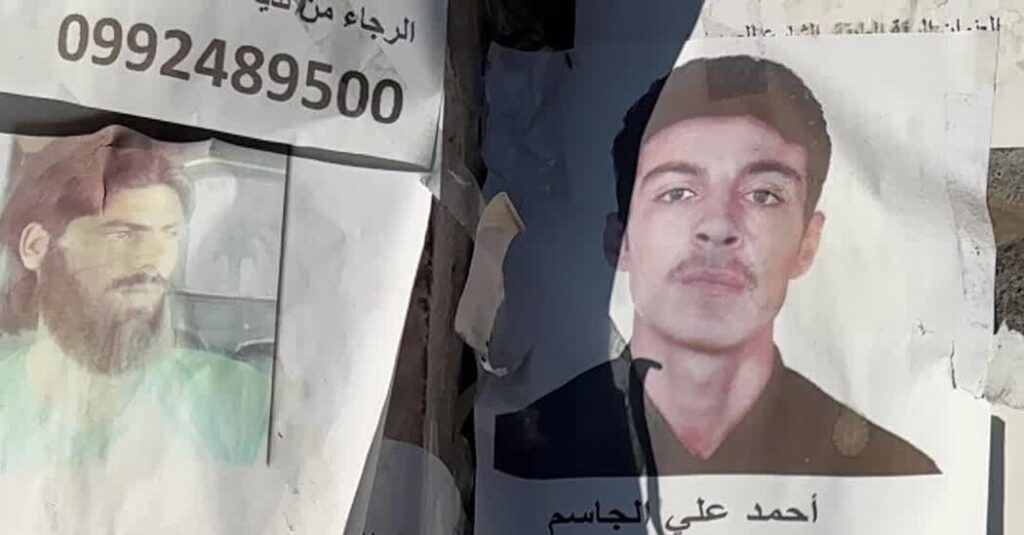
All his family could piece together was that he had been arrested at a government checkpoint near the Syrian-Lebanese border, accused of being a rebel and eventually taken to a security agency in Damascus.
“I still have this gnawing inside me,” Mr. al-Ali said. “Where was he taken? How was he killed? The questions haunt me.”
The Disappearances
After a popular revolt in 2011 spiraled into a civil war, the role of the secret police — long a menacing presence in Mr. al-Assad’s Syria — transformed. Legal constraints were tossed aside as security agencies worked to crush the rebellion and break Syrians’ resistance.
Prisons became overcrowded with detainees. Interrogators administered electric shocks to prisoners’ genitals, threw corpses and open gas canisters into their cells and deprived them of sleep, according to eight former interrogators who spoke to The Times.
They kept meticulous records of every prisoner.
At the start of the war, Russian and Tunisian allies had advised Mr. al-Assad to do so, saying that prisoner confessions and other information could provide the regime legal cover, according to Ismail Keewan, a former senior official in the military’s medical branch.
Then the records became a liability. In January 2014, images of more than 6,000 bodies from secret prisons, some bearing signs of torture, were smuggled out of the country by a Syrian military photographer, code-named Caesar.
The photos were the first detailed evidence of torture and executions by the Assad government since the war began. Months later, France submitted the images to the United Nations Security Council, which lent them greater legitimacy and raised the prospect that the regime would be charged with war crimes.
The security apparatus decided to mount a defense.
In August 2014, senior military, political and intelligence officials met with Syrian legal scholars to discuss their strategy, according to a memo viewed by The Times that described a meeting of the National Security Bureau, the coordinating hub for Syria’s intelligence and security agencies. The Times verified the deliberations laid out in the memo with two former officials who were briefed on the discussions.
Over two days, according to the memo, the senior officials plotted to discredit the images. Because there were no names connected to the photos, they could argue that only a handful were of political prisoners and that many were rebels killed in battle or petty criminals, the memo said.
The officials also advised others in the government to “avoid going into detail and avoid attempts to prove or deny any facts,” the memo said. They urged them instead to “undermine the credibility” of the leaker, Caesar, whose real name, Farid al-Madhhan, they had already determined.
The Paper Trails
The tide had turned in the civil war by 2018, after government forces retook many major cities. With Mr. al-Assad widely seen as the victor, Russian allies pressed him to rebuild Syria’s relations with other countries after years in which it was treated as a pariah state.
But if diplomatic relations were re-established, some in the government worried, international investigators might come to Syria and find evidence of atrocities, according to two former officials.
At the same time, new reports from human rights groups revealed more gruesome details about the violence against Syrians at the hands of the regime. This led to greater pressure from families demanding answers about the fate of their loved ones, one of those officials and another former official said.
After the directors of the security agencies met at the palace in the fall of 2018, Mr. Mamlouk, the head of the National Security Bureau, laid out a strategy to erase evidence of past crimes and better hide future brutality, according to a former official and documents, including memos with minutes of meetings and of discussions between security agencies.
Leaders at some agencies quickly began changing how they recorded prisoners’ deaths.
Typically, bodies of political prisoners who died in custody in Damascus had been transferred to three military hospitals in the capital with two figures scrawled across their foreheads in permanent marker or written onto a piece of tape. One number showed the security agency involved, and the other was a prisoner-identification number, according to documents and interviews with former military hospital officials.
.
In 2019, at least two security agencies — Branch 248 and the Palestine Branch — began omitting some or all of that identifying information when they transferred bodies to the military hospitals, officials at both of them said.
Government leaders also sought ways to justify the deaths of Syrians who had died in custody.
In memos marked “Top Secret” from 2020, officers in the Air Force Intelligence Directorate suggested recording the deaths of detainees with Syria’s civil registry. Doing so, the officers argued, would serve as a notification and offer closure to relatives, thereby reducing public pressure for answers about those who had disappeared.
But other officials worried it would make families angrier and perhaps even lead to protests, the memos showed.
“We see no need to share the details of the bodies with the families,” Maj. Gen. Mohammad Kanjo al-Hassan, the chief of the Military Justice Department, responded to the officers in a memo. “It could be unsafe,” he said.
Defense ministry officials also pushed back given “the pressures facing the country” as a result of the Caesar Act, new U.S. sanctions that were imposed in late 2019 and named for the photographer who had leaked the photos. They had concerns that if security agencies created lists of detainees who died in custody, they could be leaked and exploited to pressure the regime, according to the 2020 memos and one of the former officials who was involved in the discussions.
In late June 2020, Mr. Mamlouk formed a committee within the National Security Bureau to consider options, according to that former official and another one.
After the group’s discussions, Mr. Mamlouk ordered security agencies to forge confessions for anyone who had died in their custody and to backdate them, the two former officials said. Some included admissions of belonging to an international terrorist group, the officials said, though it is unclear how many agencies adopted this approach.
The only issue was the signatures. Legal protocol called for prisoners to sign confessions using a fingerprint. If security personnel used their own prints numerous times on the faked documents, some feared, it could give away the forgeries, according to one of the former officialsand another official.
Some involved found a workaround.
They signed the original confessions with their own fingerprints in very light ink and made a photocopy so the marks were barely visible, those two former security officials said. Then they destroyed the original and kept only the copy in their archives, the officials said. The Times viewed a copy of confessions that a former official verified as forged.
The Mass Grave
Some of the most damning evidence of the regime’s crimes were the mass graves where it dumped prisoners’ bodies during the civil war.
The mass-grave operation in the capital was overseen by Col. Mazen Ismandar, who organized teams to pick up bodies from military hospitals in Damascus and then bury them in sites around the city, according to three of his former colleagues. The Times reached out to Colonel Ismandar via an intermediary, who said he would not speak with journalists.
In early 2019, Colonel Ismandar found out from a superior that someone had tipped off opposition activists and journalists about a mass grave in Qutayfa, an area just north of Damascus, according to two of the colleagues. The activists subsequently posted online about the grave, the existence of which was verified using satellite imagery.
Colonel Ismandar was ordered to move all of the bodies to a new site, the two colleagues said.
That operation, which Reuters first reported in October, was carried out over the next two years. The team used excavators to dig up bodies, piled them into dump trucks and drove them to a site in the Dhumair desert, northeast of Damascus.
Colonel Ismandar became concerned that residents might see bodies piled on the truck beds, so he asked an aide to procure tarps, the two colleagues said. Then his team proposed dumping a layer of earth on top of the bodies in the trucks to hide them further, the colleagues said.
“There were civilians, people in military clothes, old people with white beards, people who were naked,” said Ahmad Ghazal, a mechanic in Dhumair city who frequently repaired the trucks and eventually got to know the drivers.
He often tried to get a look at the bodies, he said, in the hope of finding the remains of two cousins who disappeared in 2015. He never found them.
One night, Mr. Ghazal was called to the new gravesite to help fix a broken excavator, he said. Colonel Ismandar was standing to the side of the pit, his hands clasped behind his back.
Mr. Ghazal saw the driver sink the excavator’s teeth into one of the corpses and then fling it around before dropping it into a ditch.
Colonel Ismandar looked at Mr. Ghazal.
“He said, ‘Ahmad, have you seen anything?’” Mr. Ghazal recalled. “I said, ‘No, I haven’t.’ Then he said, ‘If you say you saw anything, you will join the bodies in the ditch.’”
The Downfall
When the United States passed the Caesar Act in late 2019, many hailed the sanctions as a step toward justice for the victims of war crimes by the Assad government.
“We have to make sure now that Assad, who is mainly responsible for a lot of the suffering of his own people, is held accountable,” Representative Eliot L. Engel of New York, who helped arrange for Caesar to testify before Congress, said at the time.
But the sanctions appeared to have little deterrent effect.
Interrogators in two agencies, Branch 248 and the Air Force Intelligence Directorate, said that they and their colleagues had become still more ruthless with prisoners, because they were angry about the plummeting value of their salaries as the economy weakened, in part from sanctions.
The interrogators and others security officials interviewed by The Times said they had never received instructions to stop or limit the use of torture because of the new sanctions.
After the Caesar Act, concerns also emerged that released prisoners would one day testify about the torture. In prior years, some prisoners had spoken with human rights groups, and officials worried that more damaging testimony would spur harsher sanctions, according to interrogators in three security agencies, Branch 248, Palestine Branch and the Air Force Intelligence Directorate.
One interrogator, who worked in Branch 248 for two years until 2020, said that after the sanctions came into effect, some prison officials wanted to keep Syrians imprisoned until they died.
Despite the cover-up efforts, by 2023 the regime’s crimes were catching up with it.
In April 2023, French criminal investigative judges issued arrest warrants for three senior Assad officials, including Mr. Mamlouk, for the torture, enforced disappearance and death of two Syrian French nationals. Months later, French magistrates issued arrest warrants for Mr. al-Assad; his brother, Maher al-Assad, who commanded the feared Fourth Division of the Syrian Army; and two other officials over the use of chemical weapons against civilians in 2013.
The legal action provoked debate inside the regime, the documents show.
“We believe it is necessary to abandon the traditional approach to dealing with such accusations, which is based on simply dismissing them as politically motivated and ignoring them,” an October 2023 memo from the Military Judiciary said.
The “thorny” issue of the disappeared, “with its resulting national, regional and international complexities, needs to be resolved,” the memo said.
To make it seem as if they were taking action, government officials pushed to form a committee that ostensibly would investigate the allegations of human rights abuses, documents show. Another group would convene Syrian international law experts to mount a legal defense against the French court cases.
Then, in December 2024, the regime quickly came crashing down.
The rebel coalition led by Ahmad al-Sharaa, now the Syrian president, swept into Damascus in a lightning advance. Mr. al-Assad, Mr. Mamlouk, Mr. Hassan and other top officials fled to Russia.
Colonel Ismandar, the official in charge of the mass-grave operations, also fled. The night the rebels arrived, he pulled a wooden box from the locked cabinet behind his desk in his office, according to one of his aides.
Inside were the identification cards of Syrian civilians who had died in custody or been executed. He handed out the IDs to some of his staff, believing they might help them escape, the aide said.
Colonel Ismandar remains at large.
Reham Mourshed and Hwaida Saad contributed reporting.
Christina Goldbaum is The Times’s bureau chief in Beirut, leading coverage of Lebanon and Syria.
The post The Cover-Up: Inside the Plot to Conceal Assad’s Crimes appeared first on New York Times.