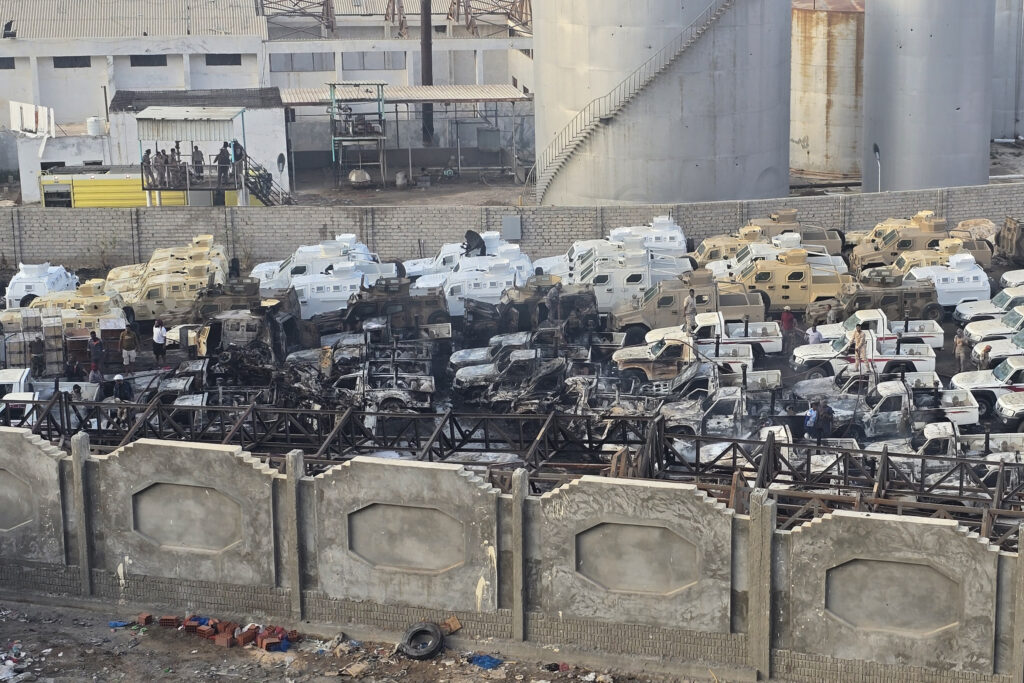
Saudi Arabia carried out an airstrike on the southern Yemen port city of Mukalla early Tuesday, targeting what it described as weapons shipments bound for a separatist force backed by the United Arab Emirates that has moved to consolidate further control of southern Yemen in recent weeks.
The strike marked an unprecedented escalation of tensions between Saudi Arabia and the UAE, two Persian Gulf heavyweights that are ostensibly aligned in the fight against the Iran-backed Houthis in Yemen but whose goals in that war-torn country, and the wider region, have increasingly diverged.
Saudi Arabia “stresses that any threat to its national security is a red line, and the Kingdom will not hesitate to take all necessary steps and measures to confront any such threat,” its Foreign Ministry said in a statement Tuesday in a sharp rebuke of its erstwhile ally.
Brig. Gen. Turki al-Malki, a spokesman for the Saudi-led coalition of forces backing Yemen’s internationally recognized government, said the strike was conducted after two ships that departed from the Emirati port of Fujairah arrived in Mukalla without permits over the weekend.
He accused its crew members of unloading “a large quantity of weapons and armored vehicles” to support the separatist Southern Transitional Council in the eastern provinces of Hadramawt and Mahra. At the request of the president of the Saudi-backed government in Yemen, “the Coalition Air Forces conducted a limited military operation this morning targeting weapons and combat vehicles unloaded from the two ships at the port of Al-Mukalla,” Malki said.
Videos circulating on social media and verified by Storyful show smoke rising from the blackened husks of several military vehicles at the port.
Updates from Mukalla: Several videos have emerged following the strikes. One features a local resident who is clearly an Independent Southern State supporter, filming from the roof of his house. He mocks the Saudi warplanes, saying they flew all that distance only to destroy his… pic.twitter.com/tW1lrHRcTY
— Basha باشا (@BashaReport) December 30, 2025
In a statement Tuesday, the UAE Foreign Ministry disputed Saudi Arabia’s characterization of its role in Yemen and rejected claims that it had pressured “any Yemeni party to carry out military operations” that threaten Saudi Arabia or its borders.
The statement expressed surprise at the strike and denied that the shipment to Yemen had contained weapons. It said the vehicles within were not destined for “any Yemeni party” but rather for UAE forces in Yemen.
Later, the Emirati Defense Ministry said it was planning to pull its remaining counterterrorism teams from Yemen. The UAE withdrew most of its troops from the country in 2019.
Secretary of State Marco Rubio spoke with his Saudi counterpart about developments in Yemen, the department’s deputy spokesman, Tommy Pigott, said in a statement Tuesday.
The Trump administration has mostly remained quiet as tensions between its gulf allies heated up in recent weeks. On Friday, Rubio said the United States was “concerned by recent events in southeastern Yemen.”
“We urge restraint and continued diplomacy, with a view to reaching a lasting solution,” he said in a statement.
The escalation comes after STC forces swept across Hadramawt and Mahra earlier this month, driving out Saudi-backed forces in a takeover of vast swaths of Yemen that border Saudi Arabia and Oman. The STC, established in 2017, is part of the Presidential Leadership Council, an uneasy alliance of political figures in southern Yemen that together form the executive body of the internationally recognized government.
Members of the council — and their Persian Gulf backers — share the aim of countering the Houthis, the Iran-backed rebel movement that took control of Yemen’s capital, Sanaa, in 2014, sparking a civil war. But Saudi Arabia supports a unified Yemen, while the Emirati-backed STC seeks to reestablish a separate state in southern Yemen that existed for about two decades before its dissolution in 1990. The Emirati government was rankled when Saudi Arabia excluded it from peace talks with the Houthis in recent years, analysts said.
The STC’s lightning offensive this month appeared to have caught Saudi Arabia by surprise, and tensions continued to simmer as Saudi Arabia weighed its response.
Late last week, Saudi Arabia hit an area of Hadramawt where STC forces were attempting to advance, in what Saudi-aligned media described as a “warning airstrike.” On Saturday, Malki threatened that the Saudi-led coalition would intervene unless the STC withdraws from the territory it seized.
Last-ditch diplomatic efforts to contain the crisis failed, Ahmed Nagi, a senior Yemen analyst for the International Crisis Group, said in a phone interview after meeting last week with Saudi and Yemeni officials in the Saudi capital of Riyadh.
The Saudi statement Tuesday, in which Riyadh directly accused the Emirati government of being behind the STC offensive, was the most strongly worded warning to the UAE from the kingdom to date.
“The steps taken by the UAE are considered highly dangerous, inconsistent with the principles upon which the Coalition to Restore Legitimacy in Yemen was established, and do not serve the coalition’s purpose of achieving security and stability for Yemen,” it said, referring to the Saudi-led military coalition.
The Saudi Foreign Ministry also endorsed Tuesday a call from Yemen’s internationally recognized government for Emirati forces to leave the country within 24 hours, demanding the UAE “halt any military or financial support to any party within Yemen.”
President Rashid al-Alimi, the Riyadh-backed head of the internationally recognized government, canceled a joint defense agreement with the UAE, declared a 90-day state of emergency in Yemen and announced an air, sea and land embargo on all ports and border crossings for 72 hours. He called on all forces in Hadramawt and Mahra to withdraw and hand over their positions to a Saudi-backed force.
Four members of the Presidential Leadership Council condemned Alimi’s moves to cancel the defense pact and expel Emirati forces from the country. Hisham al-Jabri, chief of staff for one of the council members, Faraj Salmin al-Bahsani, said in a text message that he expected Tuesday’s strike to accelerate efforts by the STC to declare an independent state in southern Yemen.
The emerging rift between Saudi Arabia and the UAE would be consequential for the region, according to Farea al-Muslimi, a research fellow at Chatham House, a London-based think tank.
“They are countries that are powerful,” he said. “They have weapons. They have no parliaments. There is no way to hold them accountable, and they have big egos. Saudi Arabia and the UAE have never gone after each other like this in the past. This is very dangerous.”
While Saudi Arabia and the UAE “share a close strategic alignment with the U.S.,” said Adam Baron, future security fellow at New America, a D.C.-based think tank, “their own regional strategies have increasingly clashed with each other.”
“We’ve seen this in Yemen, Sudan, Somalia,” he said in a phone interview. “We’ve seen this in the Red Sea, and now we’re seeing the — far from inevitable and, as of yet, still relatively limited — conflagration of these tensions.”
Those differing regional strategies have publicly come to a head in multiple fronts in recent weeks, Baron said, pointing to recent developments in Sudan and Somalia. President Donald Trump said last month that Saudi Crown Prince Mohamed bin Salman had requested that Washington work toward a solution to the conflict in Sudan, where Riyadh and the UAE government back opposing forces.
Israel’s formal recognition last week of Somaliland, a breakaway region that seceded from Somalia more than three decades ago, is also likely to have incentivized Riyadh to rebalance power dynamics, Baron said. The UAE maintains a military presence there and abstained from an Arab League statement condemning Israel’s move.
Arab states — and the broader international community — are likely to take Saudi Arabia’s side in Yemen, Muslimi said.
An early sign of support came in the form of a statement on Tuesday from Ahmed Aboul Gheit, secretary general of the League of Arab States. It expressed “profound concern over the rapidly escalating and dangerous developments” including the STC’s “failure to respond” to the Saudi-backed government’s demands.
Oman, which borders Mahra in southeastern Yemen, also called Tuesday for de-escalation and dialogue to resolve the crisis.
In Yemen, Muslimi said, ordinary citizens will pay the price as regional powers pursue their own aims.
“Yemenis will continue to be caught in the middle of enemies — and even worse, of friends,” he said.
Parker reported from Dublin and Cheeseman from Beirut. Suzan Haidamous in Beirut, Heba Farouk Mahfouz in Cairo and Adam Taylor in Washington contributed to this report.
The post Tensions between Saudi Arabia and UAE spike with bombing of port appeared first on Washington Post.