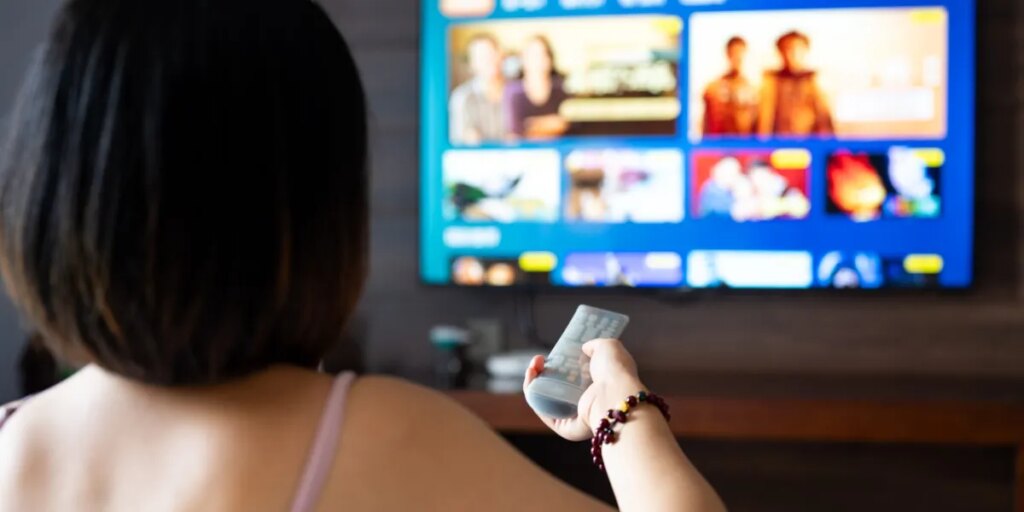
I struggle with the word television. Although we continue to use that term, recent market-definition debates – including in Netflix’s acquisition of Warner Bros. Discovery (WBD) assets – make it abundantly clear that what we call television is much more than a screen in a room where we lean back to watch professionally produced, long-form content delivered linearly at an appointed time.
What we now call television is an experience that adapts to the viewer. It’s about how, when, and where we connect to content across moments, moods, and devices. Television is the moment we decide to be carried by a story: comfort, curiosity, escape, connection. That moment can happen on a couch, in an Uber, in the kitchen, or between meetings—across any screen, any length, any format. Television has become a state of mind.
When Product Experience Becomes Strategy
Coming back to the U.S. after working in satellite television for News Corp. in India, I could see that digital streaming was the future. That feeling turned into a reality when I moved into the internet portfolio of News Corp./Fox during the MySpace era. My first big lesson was humbling: media companies don’t “go digital” by declaring a strategy. They go digital when the product experience is the strategy.
At MySpace, we signed what looked like a genius deal: Google guaranteed roughly $900 million over three years to serve ads on the Myspace platform. Wall Street applauded. Users did not. The interface and pages got cluttered, load times slowed, and the very vibe that made MySpace culturally dominant began to erode. When Facebook arrived with a cleaner, more intuitive design, people didn’t debate the switch. They simply left.
That moment clarified something the industry still struggles to accept: users vote with their behavior, not with their loyalty.
You Can’t Litigate Your Way to Relevance
MySpace also taught me you can’t litigate your way back to relevance. When music rights pressure intensified with Universal’s Music’s high stake litigation, a partnership was built in place of a war—structuring a Hulu-like joint venture with major labels that licensed catalogs and aligned incentives. The takeaway wasn’t “we won.” It was that the winners in disruption stop fighting the new behavior and start building an ecosystem around it. Disney’s recently announced partnership with OpenAI is a perfect example of this.
Engineers as Storytellers
Those lessons followed me into launching direct-to-consumer products for a major telecom platform and later for HBO Latin America. Inside big organizations, everyone understands technology matters. What’s harder is funding it, attracting talent to buy into the vision, and giving it the runway to pay off. Streaming “wars” are often narrated as content wars, but they’re increasingly product wars: discovery, personalization, and the quiet reduction of friction that keeps people in the experience.
To get closer to how that machine is built, I joined a PE-backed digital engineering services company as CLO and CPO and lived through the COVID era of forced digital transformation. I realized something that reshaped how I think about media: engineers are storytellers, like their counterparts on the content side. They don’t write the plot but they tell a story of how we live our lives online—how we find content, connect with others to share it, and return to continue engaging. The way we consume content becomes part of the content experience.
Future of TV
That’s the real power shift I wrote about recently: control is moving from whoever owns the most content to whoever delivers the best experience. YouTube is the clearest case study. It meets users in almost every “TV state of mind”—short bursts, deep dives, background listening, big-screen sessions—with a seamless product layer and a data flywheel that keeps audiences engaged. It also keeps creators engaged not by giving away equity, but by sharing advertising revenue at scale.
Netflix internalized the same idea early: one global product, one recommendation engine, one continuous engagement loop—and the willingness to invest heavily in technology so that the value of the company compounds. Now the industry is testing whether consolidation can accelerate that advantage. If Netflix’s pursuit of Warner Bros. Discovery’s studio and streaming assets signals anything, it’s that media deals should be judged less by “how much content did we buy” and more by whether the combined company can deliver a better experience, globally.
TV As a State of Mind
So what does the future look like when we treat television as a state of mind?
Theatrical doesn’t fade, It evolves from “watching a movie in an uninteresting venue” to showing up: a high-quality social ritual built on community and connection.
The winners will think like great hospitality brands and premium experience operators — designing nights people crave, delivering them consistently, and scaling them into repeatable, franchise-ready formats based on business models that create value and opportunity.
Home viewing becomes the default theater, but only if it’s designed, not delivered. “User-first” means personalization that recognizes mood, not just taste. Discovery that feels like curation, not an infinite shelf. Social layers and advertising opportunities are either optional or integrated in a seamless way into the user experience. Continuity that lets you start anywhere and finish anywhere.
The future of television is the feeling of being understood—and the platforms that earn that feeling will define what we call TV in the next decade ahead.
The opinions expressed in Fortune.com commentary pieces are solely the views of their authors and do not necessarily reflect the opinions and beliefs of Fortune.
The post Television is a state of mind: why user experience will define the next era of media appeared first on Fortune.