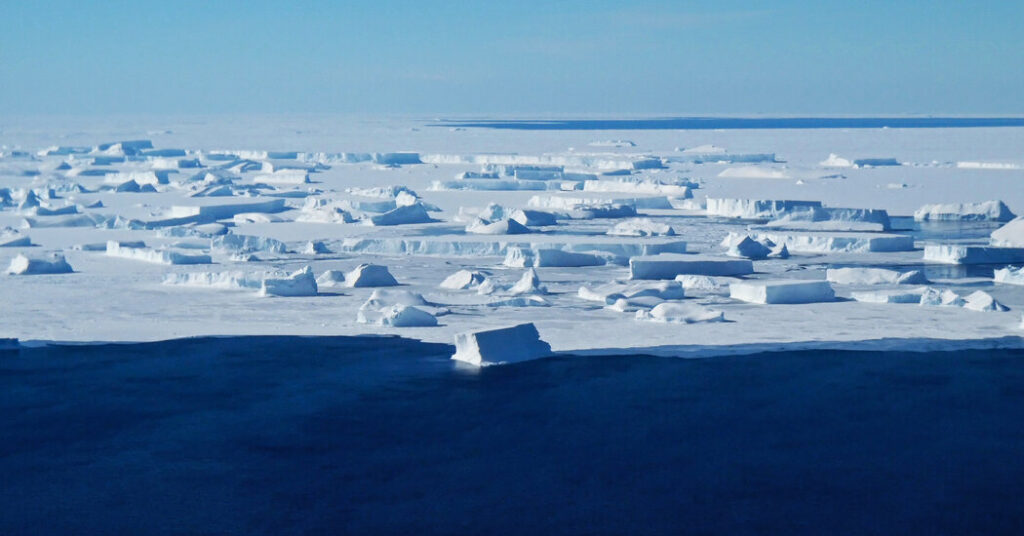
We often talk about climate change as a long, gradual process, with rising temperatures barely perceptible from one year to the next. But scientists also keep an eye on a handful of global tipping points, thresholds that, if crossed, could lead to sudden and cascading changes across the natural world.
Among the most mysterious of these potential tipping points is the breakup of ice sheets in West Antarctica.
On Dec. 27, our reporter Raymond Zhong began an eight-week journey on an icebreaker ship bound for a key glacier in Antarctica, the Thwaites. He and photographer Chang W. Lee are embedding with nearly 40 scientists who hope to answer big questions about climate change’s effects on one of the most remote corners of the globe.
The rate at which the region’s glaciers melt into the ocean will play a pivotal role in determining how much and how fast sea levels will rise in the future. But we know very little about exactly what’s happening on the ground: On a 2022 expedition to install measuring equipment beneath Thwaites, scientists were blocked from reaching it by thick sea ice.
You can follow along with this journey and find the latest updates from the team here. If you have questions about the trip, email us at [email protected] or reply to this email.
The ‘doomsday glacier’
As Zhong writes today, journalists have nicknamed the icebreaker’s destination the “Doomsday Glacier” because its complete collapse would cause sea levels to rise by two feet globally. (That would mark a serious acceleration: Since 1880, sea levels have risen by an estimated 8 to 9 inches.) Thwaites is the fastest-thinning glacier in Antarctica.
Scientists also worry that if Thwaites collapses, that could destabilize other glaciers around it, resulting in a breakup of the West Antarctic ice sheet and adding another 10 to 15 feet to global sea levels. Zhong likened Thwaites to a cork in a bottle.
One reason it’s so hard to understand what’s happening at Thwaites is that it’s melting from below as warming ocean waters wash up against its underside. Satellite images can’t capture the full extent of changes taking place thousands of feet below the surface.
Researchers on the expedition hope to drill through a half mile of glacial ice to install monitors in the seawater to gather data in the years to come. Another team plans to tag seals with sensors. Their deep dives could provide more information about hard-to-reach parts of the ocean.
An arduous journey
The ship has already departed from New Zealand, skipping through time zones in a head-spinning fashion (“At 9 p.m. that evening, our ship would become a time machine,” as Zhong put it.) as it makes its way to a region where the sun will shine all night long.
But the team’s preparation started months ago. You can watch some of the training Zhong did at an indoor pool for worst-case scenarios like iceberg collisions and helicopter crashes.
Zhong’s home for the next two months is the Araon, a 360-foot-long icebreaker operated by the Korea Polar Research Institute. He’s sharing a cabin with Lee.
The ship is expected to reach Antarctica sometime in early January. Then begins the careful process of setting up equipment, including finding a place to drill a foot-wide hole down to the ocean below using hot water.
The team is preparing for whatever the ice throws its way. “There will be a Plan A through F,” glaciologist Chris Pierce told Zhong.
Thousands of readers sent us environmental fixes from their states
This year, amid difficult climate news and the Trump administration’s attacks on clean energy and rollbacks of environmental protections, our readers helped guide us to a whole different set of stories. As part of our 50 States, 50 Fixes series on environmental success in every state, we asked for reader submissions.
Of the more 3,200 ideas that poured in, from all over the country and indeed the world, 14 made it into the series, including tales from Mississippi, Nebraska and Pennsylvania.
Perhaps not surprisingly, Times readers are not only plugged into things that are working in their neck of the woods, but they’re often doing the hard work themselves, helping to make their homes and communities friendlier to native flora and fauna and the planet.
This week, we featured some of the reader submissions that jumped out to us. That still leaves us with a trove of thousands of ideas sent in by readers, as well as an open question: What should we cover next?
Some of you already offered suggestions in your submissions. “I hope you can continue this series and do even more stories than just one per state per year,” wrote a reader from Kansas. Others asked that we expand the scope of the series to include Washington D.C., Puerto Rico and Guam, and perhaps even the world. “Can Ontario, Canada count?” asked a reader from Canada.
We won’t be repeating the series, which entailed the work of 13 reporters and 51 photographers and videographers, along with numerous editors. But still, we wanted to see what you thought. Should we expand the project to American territories and the world?
Email us at [email protected], or reply to this email, and send us your ideas.
Power moves
Cheap solar is transforming lives and economies across Africa
South Africans have found a remedy for the power cuts that have plagued people in the developing world for years. Thanks to swiftly falling prices of Chinese made solar panels and batteries, they now draw their power from the sun.
These aren’t the tiny, old-school solar lanterns that once powered a lightbulb or TV in rural communities. Today, solar and battery systems are deployed across a variety of businesses in South Africa — auto factories and wineries, gold mines and shopping malls. And they are changing everyday life, trade and industry in Africa’s biggest economy.
This has happened at startling speed. Solar has risen from almost nothing in 2019 to roughly 10 percent of South Africa’s electricity-generating capacity.
What’s happening in South Africa is repeating across the continent. Key to this shift: China’s ambition to lead the world in clean energy. — Somini Sengupta
And read more from our Power Moves series on the race between the United States and China to dominate the energy future.
More climate news from around the web:
-
“Studies have found that wolves in the Midwest and Canada not only keep deer populations in check,” the Washington Post reports, “but they also alter deer behavior in ways that help prevent car crashes and save human lives.”
-
Bloomberg reports that American automakers are betting big on hybrid vehicles as sales of electric vehicles slow.
Read past editions of the newsletter here.
If you’re enjoying what you’re reading, please consider recommending it to others. They can sign up here.
Follow The New York Times on Instagram, Threads, Facebook and TikTok at @nytimes.
Reach us at [email protected]. We read every message, and reply to many!
Claire Brown covers climate change for The Times and writes for the Climate Forward newsletter.
The post Studying the Melting Continent, if We Can Reach It appeared first on New York Times.