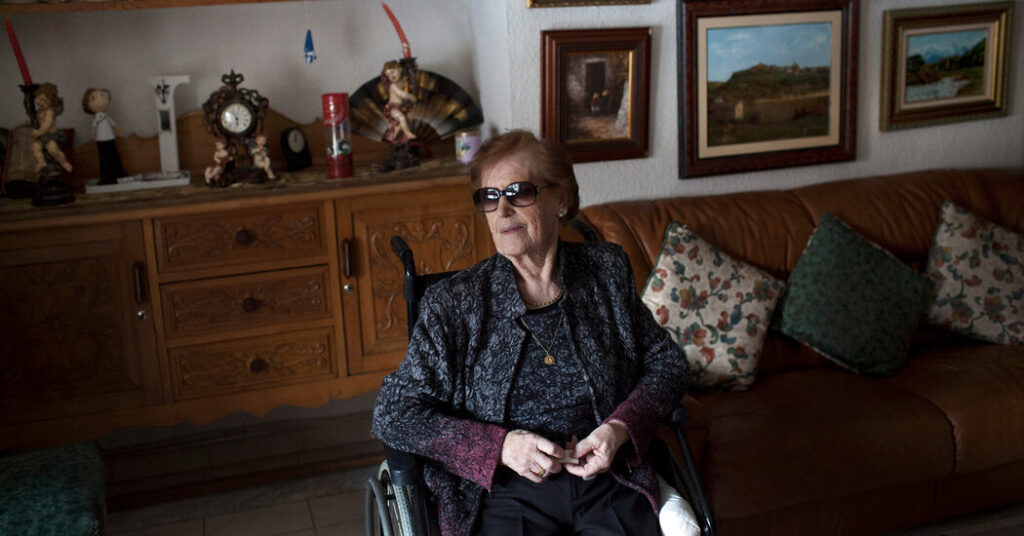
Cecilia Giménez, an amateur painter in Spain whose attempt to restore a church fresco of Jesus in 2012 ricocheted across social media, turning her town into a tourism hot spot, has died. She was 94.
The authorities in Borja — Mrs. Giménez’s hometown, in the Zaragoza region of northeastern Spain — said in an email that she died on Monday. Eduardo Arilla, the mayor of Borja, told Heraldo de Aragón, a local newspaper, that she had died in a local nursing home.
On social media, a group of fans who promote Mrs. Giménez’s restoration said that she was “one more star in the sky.”
The group called her “a great painting enthusiast” and acknowledged Mrs. Giménez’s efforts to restore the nearly century-old fresco of Jesus. “Because of the poor state of conservation, Cecilia, with the best intentions, decided to repaint over the work,” it said.
But when Mrs. Giménez’s handiwork came to light in August 2012, the authorities initially suspected that the church had suffered an act of vandalism. The delicate misery on the face of Christ en route to the crucifixion had been replaced by a misshapen head.
Mrs. Giménez, then already in her 80s, told Spanish television at the time that she had tried to restore the fresco, which she called her favorite depiction of Jesus in her area. The painting, “Ecce Homo,” or “Behold the Man,” was created in the 1930s by Elías Garcia Martínez, an art professor.
The fresco had started to flake, Mrs. Giménez said, most likely because of moisture in the 16th-century church in Borja.
“The priest knew it,” she added. “I’ve never tried to do anything hidden.”
But images of the botched restoration spread quickly online, where many parodied her work.
The local authorities considered legal action against Mrs. Giménez. Her relatives told The New York Times in 2014 that she had wept and refused to eat after her restoration attempt made global headlines.
“I felt devastated,” Mrs. Giménez told The Times. “They said it was a crazy, old woman who destroyed a portrait that was worth a lot of money.”
But her artistic mishap created an economic boon for Borja, a town of 5,000 inhabitants.
Tourists flocked to see her efforts. Less than three years later, more than 150,000 visitors from Japan, Brazil, the United States and elsewhere had made a trip to Borja, paying one euro, about $1.20, to view her work under a protective clear cover.
Local officials told The Times in 2014 that the tourism spike had stabilized the town’s restaurant industry and helped the area’s institutions. The nearby Museo de la Colegiata, which houses religious medieval art, experienced a rise in annual visits to 70,000, from 7,000. Vineyards in the region squabbled over the rights to put Mrs. Giménez’s Christ on their labels. In 2016, two Americans even staged an opera about the affair in the same church.
Mrs. Giménez, once ridiculed, became a beloved figure, even handing out prizes for a competition of young artists who had painted their own “Ecce Homo” portraits. She was also feted by her neighbors every year on Aug. 25, the day of the fresco’s transformation.
Amelia Nierenberg is a Times reporter covering international news from London.
The post Spanish Woman Scorned, Then Loved, for Botched Fresco Restoration Dies at 94 appeared first on New York Times.