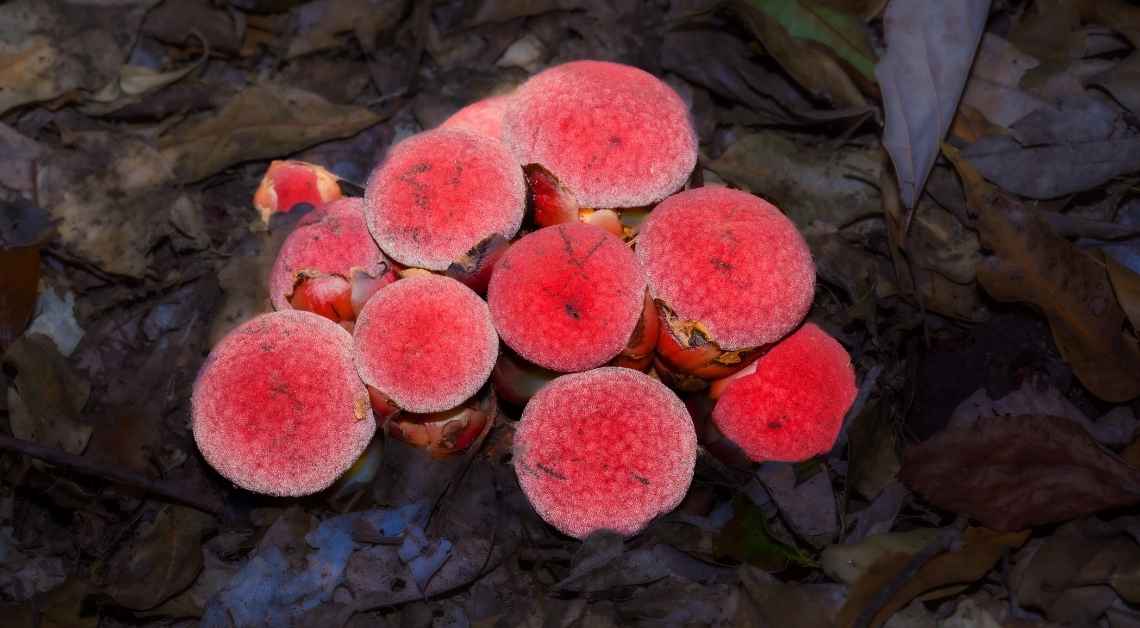
For most plants, there is no way to eat and live without photosynthesis. Sure, some, like the Venus flytrap, find more carnivorous ways of sustaining themselves. But there’s a weird group of parasitic plants out there called Balanophora that found a loophole in it all by thriving without the need for photosynthesis, instead relying on being parasitic little moochers.
A new genetic analysis of seven Balanophora species, published in New Phytologist, reveals that these plants have eliminated almost all the cellular processes normally used for photosynthesis.
Plastid genomes are the DNA inside plant cells that handles the light-to-energy conversion that we call photosynthesis. The ones in Balanophora have been shrunk by a factor of 10.
This Parasitic Plant Has Figured Out How to Live Without Photosynthesis
Plastome plants carry the complete DNA content of a plastid, the organelle in plants that is essential for photosynthesis. Plants usually have between 120,000 and 170,000 base pairs in their plastomes.
Balanophora has only 14,000 to 16,000, and those can’t photosynthesize at all. It’s like a plant version of an appendix: utterly useless, a remnant of a time when it actually needed it, now just hanging around because it doesn’t know what else to do with it.
So, instead of making its own food, Balanophora lives like a botanical parasite. It attaches itself to tree roots and siphons off nutrients, offering nothing in return. It is a parasite in the most accurate definition of the word. Funny, considering it looks like a mushroom, which famously provides a mutually beneficial relationship to whatever it’s attached to.
Balanophora still flowers and produces seeds, a pair of traditionally plantlike things for a very unplant-like plant. Researchers found that its remaining plastid genes are metabolically active, just not for photosynthesis.
This probably means the plant has stripped its genome down to the bare minimum needed to survive as a parasite, leaving it with no redundancies, just barely enough stuff to function. It even pared down sexuality, according to the researchers.
As the plants spread to islands in Taiwan and Japan, some evolved the ability to reproduce exclusively asexually, which is necessary to survive in inhospitable environments where others like them were scarce.
That all makes a lot of sense when you consider the plant that, at some point, considered photosynthesis entirely optional.
The post Scientists Found a Plant That Gave Up on Photosynthesis Entirely appeared first on VICE.