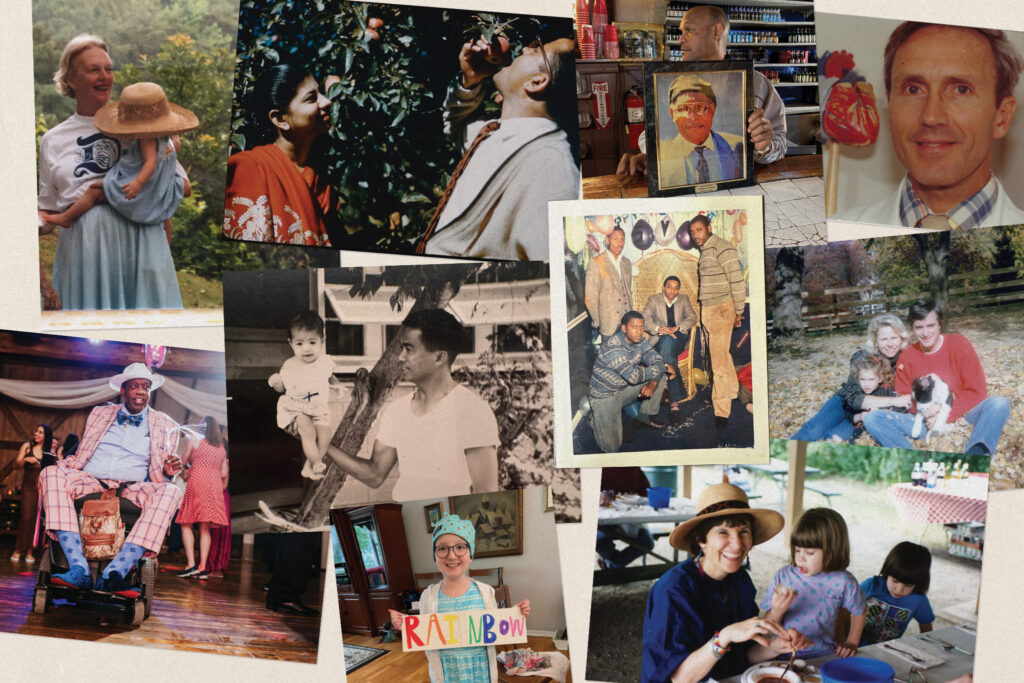
Beyond the artists and athletes who died this year, the departed lawmakers and officials who made the news each day, the world lost beloved parents, children, friends and mentors — people who were mainstays of their communities, even if their names were not well known.
In the Washington area, families are mourning the bar owner who turned his dive into a D.C. institution; the surgeon who patched up newborns’ hearts; and the plumber who moonlighted as a youth football coach, teaching his players to be the best version of themselves.
Like dozens of others in the region, they were ordinary people who had extraordinary impacts on those around them. Here are 10 who never received a Washington Post obituary, but who are far from forgotten.
L. Thomas Mangrum Jr. was not limited by his disability
On that late summer night when he was at the center of the dance floor, spinning in his wheelchair to pop music while decked out in a pink plaid suit, cobalt smoking slippers, red nail polish and a white fedora, it seemed impossible to picture where L. Thomas Mangrum Jr. had started out.
Because decades ago, Mangrum was very shy. And very wounded. And unsure about how to find his voice as a Black, gay, developmentally and physically disabled person growing up in Washington, at a time when people like him were often institutionalized.
But by the time he was dancing under the lights at a friend’s wedding in August 2024, Mangrum had blossomed. Slowly at first — then rapidly — he became a familiar and respected leader in the city’s disability rights community.
A little over a year later, Mangrum was gone at 61.
He had seemed to be everywhere. He testified before the D.C. Council, advocating for funding to support educational programs for people with disabilities. He trained law students at American University and medical students at Georgetown, discussing the needs of the disabled. He advised the Capital Pride Parade organizers, helping ensure the route was wheelchair-accessible. And as a leader of Project ACTION!, a self-advocacy coalition, he led letter-writing campaigns in the 2010s that got the “R-word” eliminated from D.C. government rules, policies and documents.
In his advocacy, he spoke in a way that was both “kind and demanding,” said Phyllis Holton, a longtime advocate for people with developmental disabilities. She befriended Mangrum when he was in his 20s, taking continuing-education classes and learning to live independently.
“He will hold your feet to the fire. He will tell you point blank: ‘You could be doing things better,’” said Susan Brooks, whose firm RCM provides services for people with disabilities. Brooks, who became his support person during covid, said Mangrum’s focus was always on making sure people were happy and getting the same opportunities, disabled or not. “Be more person-centered,” he would say. “More creative, more forceful.”
At 6-foot-4, 250 pounds, Mangrum didn’t roll into a room unnoticed. He had a broad, ever-present smile and dressed with splashes of color, like a chunky aqua necklace, or a string of burgundy and pink beads. His shirts went pow; his fedoras were festooned with birds. Feather boas wrapped around his chair. When he sang, as he did through Players Unlimited — a theater group featuring performers with disabilities — his voice boomed, especially on the Broadway show tune “The Impossible Dream (The Quest).”
Mangrum was still looking for a rambler, a one-story house good for accessibility, when he was diagnosed with Stage 4 stomach cancer earlier this year. A supreme planner, he had laid out his desires for his funeral long before. He got just what he wanted: “His hair dyed burgundy, his fingernails red and a baby blue hearse,” Holton said. “Nothing black. And music with an LGBTQ theme.”
“You have to learn to love yourself,” Mangrum had said earlier in the year, addressing others with disabilities. “And accept everything about you.”
Lucius Thomas Mangrum Jr. was born March 9, 1964. He lived in Washington and died Sept. 17. — Michelle Boorstein
Tony Tucker turned the football field into a classroom
Blake Pierce still remembers how brisk the air was as he ran onto the football field on a chilly fall day in 2004. As the quarterback for the Bowie Bulldogs in Maryland, he had reached the local youth league championship, where he was facing off against a Chantilly team known for its stellar defense. He was nervous, but he knew he could count on his coach, Tony Tucker, who kept the team cool and composed even as they trailed by six points in the fourth quarter.
Pierce threw the game-winning touchdown pass.
He would go on to play football and basketball in high school and in college. And like so many of his teammates, he remained close with Tucker, whose generosity, work ethic and commitment to his community inspired a whole generation of boys in Bowie.
“He was a big person for a lot of people my age,” Pierce said. “Coming up on 25 years later, people still talk about Coach Tony.”
Tucker, who died at 59 after a six-year battle with cancer, built a life defined by reliability, magnanimity and an unshakable, quietly radiant strength.
He grew up in the District, where his commitment to hard work started early. Long before most teenage boys were awake, Tony was already dressed and working, joining his father on the back of the garbage truck his dad owned. Those early mornings taught him discipline and responsibility — traits that never left him.
At Eastern High School, he was the kind of football player coaches remember, the kind who seems destined for college athletics. But after dropping out of high school, he found a new passion. Job Corps training led him into plumbing, a profession he saw as practical, steady and deeply necessary. Eventually he started his own business, Tony’s Drain Services. Always looking to serve others, after Hurricane Katrina, he traveled to New Orleans to help families rebuild.
Outside of work, Tucker loved spades, pool, dominoes, cookouts and the noisy, joyful gatherings that he hosted for his family and friends. He had a gift for forming bonds that lasted. “Even when he was in the hospital sick, he was cracking jokes with the nurse,” said his son, Tony Tucker Jr., a heavily recruited defensive end who played for the University of Pittsburgh. “Even in all that pain, you could just really see his spirit.”
The Bowie community knew him not just as a businessman and father, with five children in his blended family, but as Coach Tony — the man who transformed football fields into classrooms of character. Championships came, and players like Jelani Jenkins and A.J. Hendy went pro, but Tucker cared more about who they became than what they achieved.
Long after Pierce played in the youth league championship, when he launched a career flipping houses, he knew exactly the plumber he wanted to work with. “I didn’t understand it back then,” Pierce said, “but for him to be as successful as he was in his career, and then be at practice every night from six to eight, five days a week, really showed how much he cared about us.”
Tony Tucker was born June 22, 1965. He lived in Glenn Dale, Maryland, and died Feb. 9. — Emmanuel Felton
Frank Midgley ran a marathon in the morning and performed a heart transplant at night
To Frank Midgley, there were thousands of Melissa Greene Smiths. But to Smith, there was only one Dr. Midgley, the man who sewed a tiny piece of fabric over a hole in her heart when she was just 4 years old, the man who saved her life.
She barely remembers the day of the operation. But Midgley’s name became a fixture in her household, and the scar he left on her chest a symbol of survival. Smith is one of many who would have perished without Midgley’s intervention, and when the pediatric surgeon died in September at 86, she could feel his legacy in her heartbeat.
When Midgley first picked up his scalpel in the 1960s, performing open-heart surgery on children was a rare and risky undertaking. But by the time he placed his last suture, more than 40 years later, the survival rate had skyrocketed, and the operation had become commonplace. Midgley spent his career pioneering techniques to make such surgeries safer and more successful.
“He is forever a main character in my life, and he always will be,” said Smith, now 37 and married with a young son. “I feel honored to have a scar on my body that was cut and sewn by such an extraordinary man.”
Born and raised in Yonkers, New York, Midgley trained with surgeons in Michigan and London before coming to Washington in 1974, joining what is now Children’s National Hospital. Two years later, he was named chief of cardiovascular surgery, a title he would hold for nearly three decades.
Midgley had a cool head and an engineer’s brain — a knack for taking things apart and putting them back together. Colleagues remember him as one of the finest surgeons of his generation.
Yet when he heard such superlatives, he demurred.
“He said, ‘I’m just the plumber,’” his wife, Sally Brown, recalled.
He was always fixing things.
Brown met him when she was 43, a single mother of four coming off a difficult divorce. Midgley, who had two grown children from a previous marriage, helped raise Brown’s kids, teaching them how to drive and how to stitch up wounds, setting them up to practice on raw chicken breasts. Despite his occupation, he had a prodigious sweet tooth: doughnuts, ice cream, orange soda.
His work was intense, and sometimes tragic. Yet he rarely seemed stressed.
“His attitude was, ‘How can I not do this?’” Brown said. “‘I know how to fix this baby, so how could I not?’”
Some of his feats became hospital legend. Like the time he ran a marathon early one morning and then performed a complicated heart transplant late that night. He helped separate conjoined twins and operated on Quinn Bradlee, the son of Washington Post journalists Sally Quinn and Ben Bradlee, the paper’s longtime executive editor.
Some 25 years after Midgley patched the hole in Smith’s heart, she had a chance to meet him, thank him, hug him. “I was wide-eyed and starstruck,” she said.
What he told her still echoes: “Take good care of yourself.”
Frank Murray Midgley was born July 6, 1939. He lived in Potomac, Maryland, and died Sept. 6. — Reis Thebault
Penny Gentilly, severely injured in a car crash, helped make air bags mandatory
Driving down a rain-slicked road in Bethesda, Maryland, in June 1991, Penny Gentilly, a longtime Capitol Hill staffer on her way home to Potomac from an aerobics class, collided head-on with a van. The crash, in a vehicle without air bags, put her into a coma, derailing the life of the 45-year-old mother and D.C. political operator.
It also helped transform the future of automobile safety in America.
With encouragement from the consumer advocacy group Public Citizen, her husband Peter Peyser, a lobbyist, was soon walking the halls of Congress, pitching lawmakers on new safety standards proposed as part of a massive transportation bill.
“If there had been air bags in Penny’s car,” he would say, “she could be here talking about this.”
The blunt force of Gentilly’s story — delivered by a grieving partner whose wife was in the hospital with a traumatic brain injury, and whose 7-year-old daughter was devastated back at home — nudged reluctant lawmakers to include a measure requiring air bags for the driver and front-seat passenger in all new cars. The bill was signed into law that December, after previous air-bag proposals had been blocked in the House, rejected by lawmakers opposed to new federal regulations.
“She had such a good reputation on Capitol Hill,” Peyser recalled, “and hearing her story made it personal for the representatives.”
In the aftermath of the crash, Gentilly achieved what every idealistic young professional drawn to Washington politics hopes for — monumental change. But she never recovered enough to understand how her own injuries had impacted millions. For more than three decades, she lived in a nursing home in Rockville, Maryland, where she died in February at 78.
Raised in Northern California, Gentilly became interested in politics while studying at the University of California at Berkeley. She went on to campaign for George Moscone, a San Francisco progressive who was elected mayor in 1975, and moved to Washington to work as a congressional staffer, first for Leon Panetta and then for Peter A. Peyser, an independent-minded Republican from New York.
When Peyser launched a longshot Senate campaign in 1976, Gentilly pitched in to help. She soon met her future husband, the candidate’s son.
“She was very direct and didn’t hide what she thought,” the younger Peyser said, recalling that not long after they met, Gentilly told him, “You know your dad is going to lose, right?”
Peyser’s father lost in a landslide. But the bond he and Gentilly forged on the campaign trail led to a committed romance, and a quintessential D.C. love story: two ambitious, politically engaged young people, crowding their days with endless work.
“We both had demanding jobs,” Peyser said. “But we understood each other’s commitments.”
By the early 1990s, Gentilly was one of the highest-ranking female staffers on the Hill, serving as executive director of the House Democratic Caucus. The day before her car crash, she accepted a new job at the PR firm Hill & Knowlton.
Gentilly’s accident meant that she was not on hand as her daughter, Kim Peyser, grew, married and had a child of her own. But her example inspired Kim to go into politics herself, with appointments in the Obama and Biden administrations.
“Part of what drew me to this kind of work is my mother’s legacy,” she said. “There is something that pulls me about the real world impact that policy decisions can have.”
Penny Eileen Gentilly was born June 6, 1946. She lived in Rockville and died Feb. 9. — Kyle Swenson
Kasey Zachmann celebrated Christmas in June
It’s no secret that Kasey Zachmann loved Christmas. She loved the lights and the carols, the gift-giving and the trimming of the tree. She loved Santa Claus and “Home Alone” and baking with her family. She loved the way the holiday seemed to make things, and people, sparkle.
For a little girl who spent half her life in and out of hospitals and doctors’ offices, undergoing treatment for brain cancer, Christmas was transportive.
Kasey’s yuletide enthusiasm inspired hundreds of families near her Maryland home to organize an elaborate community Christmas this year, six months ahead of schedule, after doctors warned her cancer had spread and she was running out of time.
Kasey didn’t make it to December. She died Aug. 16, two months after the June celebration and about two weeks after her 10th birthday. Her story inspired friends, neighbors and strangers to donate hundreds of thousands of dollars to medical research and clinical trials, to raise awareness about pediatric cancer, to hang up holiday lights in the sweltering summer heat.
But Kasey was more than her diagnosis. An artist, a big sister and a natural performer, she lit up onstage and often requested to perform at her dance recitals solo. She loved rainbows and music and having pork chops for dinner. She refused to eat red gummy bears and didn’t like roller coasters. She never got used to being stuck by needles at the doctor’s office, hating it every time.
Diagnosed with medulloblastoma when she was 5, Kasey endured chemotherapy, surgeries, dozens of rounds of radiation and a rigorous medication regimen, including two experimental drugs she tested in clinical trials. Through it all, her parents held out hope that they might find a cure, a way to save their eldest daughter.
But earlier this year, the Zachmanns learned that the cancer in Kasey’s brain had made a rare and fatal progression. That’s when Alyssa, her mother, emailed their neighbors, asking for help bringing a little Christmas cheer to what they believed could be Kasey’s last few weeks.
Her parents said she packed as much joy into her final two months of life as any kid could — parties and presents and a vacation with her family.
“It was like she took whatever she had left, both energy wise and happiness wise, and spent it on that Christmas in June, the week at the beach, and her birthday,” said her dad, Joe Zachmann.
Before Kasey died, her parents preserved their daughter’s voice in a metallic green Christmas ornament bearing her photo. It’s been hard to listen to this year, they said. But they’re glad to have it — for Christmases to come, and for every holiday season they will mark without her. With the press of a button, her small voice rings out from the family’s tree: “Merry Christmas.”
Kasey Vivian Zachmann was born July 30, 2015. She lived in Chevy Chase, Maryland, and died Aug. 16. — Marissa J. Lang
‘Rad’ Radhakrishnan turned his morning commute into a community car service
Belur Krishna “Rad” Radhakrishnan knew what it meant to arrive in a new country with nothing.
Radhakrishnan moved to the United States from India in 1957 — a time when there were no Indian restaurants or temples or grocery stores in Ann Arbor, Michigan.
“He had no landing pad,” said his granddaughter, Anjali Belur.
So he made his own community, starting an Indian students association at the University of Michigan, where he studied engineering. That formative experience is what inspired him to make a home for everyone he met. While Radhakrishnan, who died in August at 98, did impressive things like participate in the March on Washington in 1963, it was his ability to serve as a landing pad for others that stuck with people the most.
“I can’t tell you how many people have said at the funeral or in the weeks afterward, ‘When I first moved to America, I stayed at Rad’s house,’” Belur recalled.
Radhakrishnan and his wife, Premalatha Radhakrishnan, settled in Bethesda, Maryland, in 1961. There, they were founding members of the Sri Siva Vishnu Temple, which began construction in 1988 in nearby Lanham. He and the group of founders sponsored visas so soapstone carvers could travel here and help shape the temple, which has grown to become one of the largest in the United States.
In the 1990s, on his way to work, Radhakrishnan noticed people standing, waiting, at bus stops. He started offering them daily rides at no charge from a set spot in his neighborhood to the Bethesda metro station about 3 miles away, sometimes picking up stragglers on the way if he had room. The service soon became known as the BK Express.
Over the years, Radhakrishnan picked up semi-famous figures, such as the ambassador to Egypt, but mostly his passengers were just ordinary people. In a video interview for a high school student’s class project, Radhakrishnan described why he did it: “I used to drive all by myself, which is boring to go all by myself. This is exciting because I spend a really enjoyable time with all my friends.”
Lawrence Soler, a passenger on the BK Express on-and-off since 2000, said Radhakrishnan “wasn’t always a huge talker. But he always had something interesting to say because he had an interesting life: He was just super caring about his community members.”
Radhakrishnan missed only one day, Belur said: the day his wife died 20 years ago. The rides continued until the covid pandemic, when he stopped due to his age.
Radhakrishnan remained energetic long after he stopped offering rides. He would wake up every morning at 4:30 a.m. to do yoga, well into his 90s. Then he’d sit down with the newspaper and read it cover-to-cover over a cup of coffee.
“Above all,” Belur said, “my grandfather was a very disciplined, reliable person.”
Belur Krishna Radhakrishnan was born June 24, 1927. He lived in Bethesda, Maryland, and died Aug. 27. — Rachel Hatzipanagos
James Ramirez flew planes, collected orchids and hoisted up his family
Buried inside a three-inch-tall stack of handwritten index cards is a reminder, “Be content with what you have.”
For years, the cards sat on a shelf in James Ramirez’s living room, next to his prayer books and Bible. Some of the cards have spiritual lessons. Others, the names of people. All of them guided Ramirez’s daily prayers. When age took away his ability to see, and with that his ability to write, he started asking family members to make the notes for him.
He wanted to remember people’s stories. He wanted to remember what he had learned.
Ramirez died in August at age 100, leaving custody of his beloved card stack to his daughter, Arleen Ramirez Borysiewicz. Now, the multicolored paper tower sits in her home, a reminder of her father’s dedication to his friends and family — his dedication to people.
“Relationships were important to him, and not perfunctory relationships,” Borysiewicz said. “He really wanted to know people and to serve them.”
Service permeated Ramirez’s life. Born in California to Filipino parents, Ramirez moved to the Philippines with his family when he was 11, as they sought a better life during the Depression. He endured the Japanese occupation during World War II, taking odd jobs like sailing a boat up and down the Pampanga River, bartering clay pots for rice.
To support his family, he enlisted in the Philippine Air Force, training as a fighter pilot and flight instructor. He later flew for a commercial airline and sold orchids, picking up seeds during stops in Bali and Singapore.
By the mid-1980s, an economic downturn led him to move his family to the Washington area, where he worked as a group-home parent, security guard and special-education assistant.
Though he gave pieces of himself to each job, friends said Ramirez will be remembered most of all for the way he loved his family. He often joked that he had fulfilled God’s calling to “be fruitful and multiply.” He had 12 kids, 10 of whom survive him, along with 30 grandchildren, 21 great-grandchildren and two great-great grandchildren.
There was hardly a weekend Ramirez spent alone. At times, he literally hoisted up his family. When his children were toddlers, Ramirez would coax them to settle in the palm of his hand, then raise them into the air so he could show them off.
At the center of it all was Ramirez’s wife, Angelina, a former elementary schoolteacher whom he married when he was 19. She was his source of peace, and remained by his side until she died of pancreatic cancer in 1996.
For 20 years, Ramirez visited Mount Comfort Cemetery each day to clean Angelina’s grave and light a candle so he could spot her from the road. When he could no longer walk or drive himself, his family loaded him in the car. Surrounded by their love, praying over his wife, Ramirez found tranquility. He was content.
James Montayre Ramirez was born Oct. 21, 1924. He lived in Alexandria, Virginia, and died Aug. 2. — Kendall Staton
Olivia Cadaval thrived on stories
When she was just starting out at the Smithsonian Institution, working as a curator at its Center for Folklife and Cultural Heritage, Olivia Cadaval could count the number of Latina staffers on one hand. Plenty of security guards were “puertorriqueños,” she later told a Smithsonian interviewer, but in the late 1980s and ’90s, there were few Latinos in senior positions.
“So we started pushing,” she said. “Pushing for curators being hired, pushing for directors to be Latinos.”
A fiercely independent scholar and activist, Cadaval spent years pushing and tangling with the powers that be, seeking to make room for marginalized voices in and out of the Smithsonian. She led El Centro de Arte, a D.C. cultural organization that promoted the work of Latino artists. She conducted oral history research on El Festival Latino, documenting the ways in which the festival — now Fiesta DC — fostered a sense of community. And for nearly three decades, she helped make the Smithsonian Folklife Festival a vibrant showcase for far-flung cultures and traditions, curating programs on the Mall that featured artists and craftspeople from Peru, Colombia, Mexico, the U.S. Virgin Islands and points in between.
“She did all of the work, from moving the chairs to setting up the tables to the actual scholarly research,” said her colleague Michelle Banks, a festival curator. “She treated everybody as an equal, as a contributor, as somebody who had something to say. She created space for people, for their stories to be part of these larger narratives.”
Cadaval liked to say that she thrived on stories. Her own began in Mexico City, where she was born. As a young girl, she was fascinated by its plazas and markets, by “the bantering between merchants and customers, the boys pushing produce carts.” She wanted to know who they were, where they lived. She maintained that curiosity about other lives long after she came to the United States, where she met David Bosserman, her future husband and collaborator, while in college in Illinois.
The couple had a son, Arnold, and settled in Washington, moving in 1985 to a Mount Pleasant rowhouse their friends dubbed La Orilla, the Edge. (Its name was in contrast to El Centro, the Center, where Cadaval once worked.) Decorated with maracas, harmonicas, drums and other wall-mounted instruments, the house became a music-filled hub for the community, home to fundraisers for the Green Party (their signature dish was a veggie-rich green soup) as well as an annual Tres Reyes celebration that drew artists, Smithsonian colleagues and anyone else the couple befriended on their strolls through the neighborhood.
While battling Parkinson’s disease near the end of her life, Cadaval spoke with her granddaughter Jaime Bosserman, who wanted to know how she had endured the loss of so many friends and family members: siblings, parents, her own husband, “Big Dave,” who died in 2020.
“She said that it’s OK to be sad for a little bit,” Bosserman recalled, “but to continue living your life — and to love your people well.”
Across her 81 years, it was a philosophy that served her well.
“How she lived her life,” said Bosserman, “was by loving her people, really well.”
Olivia Cadaval Bosserman was born Sept. 29, 1943. She lived in Washington and died April 9. — Harrison Smith
Cynthia Burress Dolvin made things beautiful
The daughter of one three-star general and the wife of another, Cynthia Burress Dolvin knew nothing but Army life. Her father, Withers “Pinky” Burress, was a courtly Virginian who served in both World Wars and received a Silver Star for valor. Her husband, Welborn G. Dolvin, was a tank commander and a farmer’s son, a Georgia native who fell in love with his commanding general’s daughter.
Mrs. Dolvin, as she became known, was elegant and cosmopolitan, with a private side that was gleefully silly. She spoke a smattering of French and German, memorized nonsense poems by Lewis Carroll and Edward Lear, and took to carrying a Hershey’s bar in her pocketbook. She loved linens and pearls, straw hats and red lipstick. She made ink-wash drawings and had once hoped to go to art school, only to be told off by her father, who worried that she would be “exposed to Bolsheviks.”
While her husband went on to have a decorated career, serving with distinction in Korea and Vietnam, Mrs. Dolvin provided crucial support, quietly facilitating his rise through the ranks. Before her death in April at 101, she was among the last of a generation of officers’ wives — women who aided their husbands while hosting coffees and teas, volunteering at wives’ clubs and altar guilds, serving as models of dignity and grace, all with unimpeachable etiquette.
“She was an ornament — a sparkling ornament, in contrast to my father, who was all business. And she was more than that,” said her daughter, Virginia Dolvin Peabody. Victoria Almquist, a family friend who lived with the Dolvins while in high school and whose own father was an Army general, described her as “the mother hen,” the “mentor to the wives.”
“There was an expectation that they would be excellent hostesses, so that when people thought about the Dolvin family, they would think not only that Gen. Dolvin was an amazing leader, but that Mrs. Dolvin was an amazing hostess,” she said. “That really helped his career.”
When the family lived in West Germany, Mrs. Dolvin served pickled shrimp at cocktail parties, a Southern dish that evoked her and her husband’s childhood in the United States. In Japan, where her husband served as a corps commander in the 1970s, she helped organize a lavish New Year’s reception, greeting guests in the receiving line and looking after the home with help from a “houseboy,” cook, gardener and driver.
“She cared very much about how things looked,” Peabody said. “When she gave people directions to wherever we lived, she routed them along the most attractive, not the shortest, path. The approach was as important as the destination.”
Her love of beauty, and her advocacy for her husband, continued well after his death in 1991. At Arlington National Cemetery, “she went to bat to get him the very best location she could,” Peabody said. He was ultimately buried near the Old Post Chapel, in a quiet section of the cemetery grounds. Mrs. Dolvin will join him there soon.
“She really wanted things to be beautiful,” her daughter said, “and she made them beautiful. She wanted the rest of us to be beautiful, too.”
Cynthia Kent Burress Dolvin was born Aug. 7, 1923. She lived in Falls Church, Virginia, and died April 23. — Harrison Smith
‘Dickie’ Dickens gave Dan’s Cafe its squirt-bottle signature
The bar’s regulars rarely use its proper name. To them, it’s not Dan’s Cafe. The Adams Morgan institution is known simply as Dickie’s, in honor of its longtime owner, Clinnie “Dickie” Dickens, who stood night after night behind its 14-seat bar. Dickens purchased the watering hole in 1965, from the man for whom Dan’s was named, and ran it until his death in February, at age 90.
By the time he bought the place, Dickens had already lived a full life. Raised on his family’s tobacco farm in North Carolina, he joined the Army at 18, served in the Korean War and took a job delivering mail for the U.S. Postal Service in Washington.
But the bar soon came to define him. One of its servers, Helen Martin, became his wife. Together they raised nine children, several of whom joined him in working at the dive. His son Tracy Dickens, 61, now runs the place, and said that for a Black man from the segregated South, owning a bar in the nation’s capital was a mark of success and independence.
“This bar was his whole life,” he said.
Dickens was a reserved father and an even-keeled bartender. Serious but not unfriendly, quiet unless you engaged him directly. On slow nights, he would pull out a deck of cards and play solitaire at the far end of the bar, out of view of customers.
The regulars still feel his presence: In the decades-old bartop covered in cracked and chipped tiles. In the wood-paneled walls, smoothed by time. In the tarp-covered pool table at the center of the room, long out of commission. And, of course, in the handwritten signs that Dickens made himself, alerting patrons to the house rules.
“Cash only.”
“$5.00 deposit on all squeeze bottles. Refunded when bottle is returned.”
His family said it was Dickens who came up with the bar’s signature: hard liquor served out of plastic squirt bottles. By the late 1980s, he was tired of pouring individual shots for his customers, a clientele that had grown younger and Whiter as the neighborhood gentrified, transforming into a nightlife destination for Washington professionals.
Jim Voye, 59, began frequenting Dan’s Cafe in the early 1990s. He never stopped coming. On a recent Saturday night, he sipped a beer nearly an hour before the place opened. Over the past 35 years, he’s come to regard the Dickens family as an extension of his own. When Dickens was placed in hospice care in the final days of his life, Voye went to visit him one last time. He held the bar owner’s hand and told him he loved him.
“I was 22 when I first met him,” Voye said. “These guys are family.”
As the night got going, customers lined up to order the squirt-bottle special: a 16-ounce, squeezable bottle of liquor shaken with ice, served with shot glasses and a mixer upon request.
Behind the bar hung a newly framed photo of Dickens, his lined face set in a thin smile. “In Loving Memory,” read a plaque at the bottom.
“It feels funny to me, now, to get to take over this place,” said his son Tracy. “Because it’s something I’ve wanted to do. But now that I’m here, I just want my father to still be around.”
Clinnie Mable Dickens was born Feb. 24, 1934. He lived in Washington and died Feb. 21. — Marissa J. Lang
The post Remembering 10 extraordinary D.C. locals who died in 2025 appeared first on Washington Post.