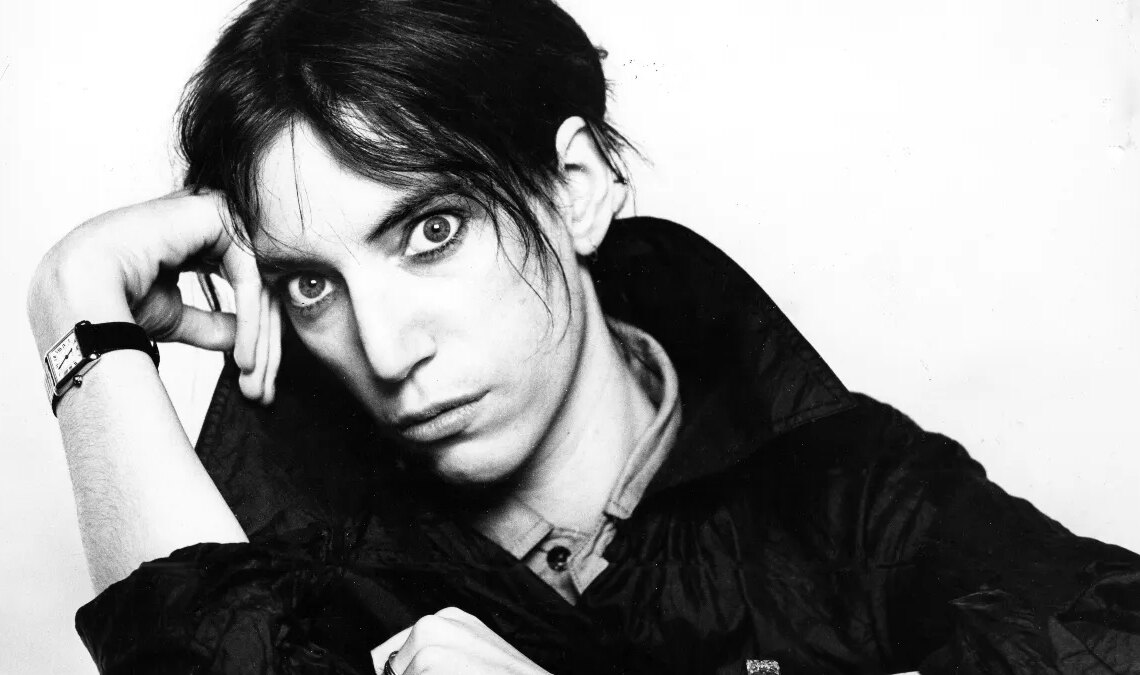
On December 30, 1946, Patti Smith was born, and she would go on to create a five-decade-long career that’s still going strong. She was at the forefront of NYC punk and new wave, but her work is rooted in poetry first and foremost. The people love Patti Smith for her raw, emotional approach to writing, her captivatingly human performances, and her dedication to art. So, let’s celebrate the punk poet laureate on her 79th birthday.
“Pissing In a River”
“Pissing in a River” served as the lead single for the Patti Smith Group’s debut album, Radio Ethiopia, released in 1976. Its painfully heartfelt speaker begs to be taken back by the object of her desire, but resigns herself to rejection and confusion anyway. “What more can I give you to make this thing grow?” she says. Pleading, “Everything I’ve done I’ve done for you / Oh, I give my life for you.” But still, a singular question remains: “What about it?” It hurts so deeply, the futility of pissing in a river.
“Gloria”
Patti Smith made her debut in 1975 with Horses, which had a 50th anniversary reissue this year. One of the most enduring songs on that album is “Gloria”, a Them cover which Smith reimagined with her own poetry. Her opening line, “Jesus died for somebody’s sins but not mine,” immediately grips listeners by the throat. Then, the ensuing verses shake us around like a dog with an old sock. This line not only opens the track, but it opens the entire album, setting the tone for the rest. “…My sins, my own / They belong to me / Me,” Smith says in the first verse. She is at once blasphemous and reverent in “Gloria”, indulging the sacred and profane in equal measure.
“Because The Night”
Smith’s second album with the Patti Smith Group, Easter from 1978, included her first big mainstream hit, “Because the Night”. Initially a Bruce Springsteen song that he then gave to her, Smith kept the chorus and added her own verses. Overall, “Because the Night” moves away from her early punk poetry roots, leaning more toward a heartland-rock type of sound. But it’s still very much Patti Smith in its darkly romantic yearning and minimalist hedonism. An oxymoron for sure, but Smith has an indescribable knack for being sparse and abundant at the same time. It’s the contradiction of having very little yet still enjoying all the richness and pleasures life has to offer. To me, that’s the essence of a Patti Smith song.
“Dancing Barefoot”
In 1979, the Patti Smith Group released Wave, which would be Smith’s last album under that name. “Dancing Barefoot” has been covered often, notably by U2, First Aid Kit, and even Pearl Jam at a 2010 benefit concert. But initially, the track was largely ignored because of the word “heroine.” The song features a female hero, a goddess-like figure, but radio stations and record execs assumed it was a drug reference. Instead, “Dancing Barefoot” is a dedication to creation, the cross-section of human and divine. It was also an homage to Jeanne Hébuterne, the mistress of artist Amedeo Modigliani. While eight months pregnant, she killed herself two days after his death in 1920. But the song doesn’t focus solely on the divine feminine; instead, it blends masculine and feminine to create this strikingly human portrait.
Photo by Gijsbert Hanekroot/Redferns
The post Patti Smith Turns 79: 4 Fan-Favorite Songs to Celebrate the Punk Poet Laureate on Her Birthday appeared first on VICE.