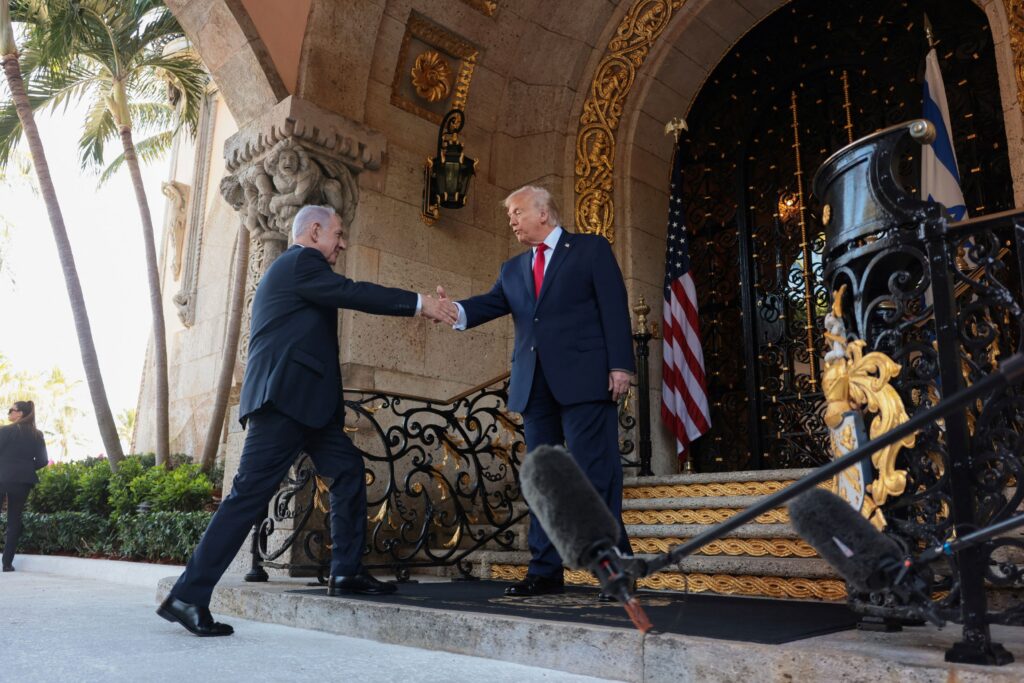
WEST PALM BEACH, Fla. — President Donald Trump presented a united front with Israeli Prime Minister Benjamin Netanyahu at his Mar-a-Lago estate on Monday, showcasing his friendship with the Israeli leader after tensions between Washington and Jerusalem threatened the fragile ceasefire that the United States brokered in Gaza earlier this year.
Netanyahu’s trip to Florida marked his fifth visit this year with the president and delivered a public reset as Israel’s approach to Gaza and Iran appeared at odds the Trump administration’s diplomatic efforts. Israel and Hamas have accused each other of not fully implementing the first phase of the peace plan, slowing Washington’s efforts to advance to the second phase focused on dismantling military and weapons infrastructure in Gaza.
After meeting with Netanyahu for several hours on Monday, Trump said that Israel had “lived up to the plan 100 percent.” He also warned Iran not to build up its weapons program. Ahead of the meeting, he signaled openness to Israel using force to prevent the Islamic republic from rebuilding its ballistic missile capabilities.
“Speaking of Iran, I hope they’re not trying to build up again,” Trump said during the news conference. “Because if they are, we’re going to have no choice but to very quickly to eradicate that buildup.”
Trump also said that Hamas would be provided “a very short time to disarm,” and asserted without evidence that countries other than Israel would “wipe them out” if they did not comply. The international force at the heart of Trump’s plan to demilitarize Gaza has struggled to get off the ground as some countries backpedaloffers to send troops.
Disarmament is among the most difficult unresolved issues in the implementation of Trump’s 20-point plan for postwar Gaza, which requires Gaza to demilitarize and place weapons “beyond use” through a process with independent monitors. None has been established to conduct that process.
Trump acknowledged he and Netanyahu were not yet aligned on the West Bank, but he declined to elaborate.
Trump sought to highlight the strength of his personal relationship with Netanyahu, calling him a “hero” as he arrived at Mar-a-Lago. Like other world leaders who have presented Trump with golden crowns and golf clubs, Netanyahu appealed to the president’s desires, announcing that Trump would be the first non-Israeli to receive the state’s highest cultural honor: the Israel Prize.
The meeting marked the second diplomatic engagement at Trump’s “Winter White House” in two days, after Trump met Sunday with Ukrainian President Volodymyr Zelensky. The leaders’ pilgrimages to Trump’s private Florida club during the holidays highlight how heavily Trump’s peace efforts rely on leader-to-leader diplomacy, even as key conflicts prove resistant to swift resolution.
Press secretary Karoline Leavitt said on X that Trump had a “positive call” with Russian President Vladimir Putin regarding Ukraine on Monday morning, after the pair spent more than two hours speaking Sunday.
The White House did not respond to a request for comment about its goals for the meeting with Netanyahu.
Secretary of State Marco Rubio convened with Netanyahu in Florida on Monday ahead of Trump’s meeting, as did Defense Secretary Pete Hegseth.
Earlier this month, policy differences surfaced publicly when Trump warned Israel against doing anything “that will interfere with Syria’s evolution into a prosperous state,” following actions by the Israeli military inside the country aimed at shaping the post-Bashar al-Assad landscape under Syria’s new president, Ahmed al-Sharaa. In Lebanon, Israel has repeatedly hit Hezbollah targets while demanding that the militant group disarm in accordance with a U.S.-brokered ceasefire, threatening to inflame regional conflict despite Trump’s promises of lasting peace.
Netanyahu said in a statement last week that the agenda with Trump would contain Iran and its regional proxies — an issue on which the Israeli and the American position “has not changed.”
Dan Diker, president of the Jerusalem Center for Security and Foreign Affairs who is in contact with members of the Netanyahu government and the Trump administration, said that Netanyahu’s meeting with Trump would seek to establish the path forward for U.S.-Israel military cooperation, ranging from expanded operational latitude against Iran to deeper coordination across Israel’s active fronts in Gaza, Lebanon and Syria.
“Israel is back again at this critical moment, where we have this security dilemma blocking Trump’s Saudi-partnered program” for a more stable Middle East, said Diker. “President Trump is a great friend of Israel. But he is impatient. Netanyahu will need to clear the air. He will need to impress upon the president that Israel and the U.S. are very much aligned in their goals, but the timelines differ.”
The meeting comes as harsh winter weather has added to despair in Gaza. Hamas has accused Israel of not fully implementing Phase 1 of the agreement by impeding the agreed surge of aid into the enclave. Israel has accused Hamas of launching attacks on its remaining troops and refusing to release the last deceased hostage being held in the enclave.
The initial phase of the peace deal brought the release of hostages and prisoners and an increase in humanitarian aid. Israel has continued frequent strikes against Hamas targets despite the ceasefire. After Israeli forces killed Hamas commander Raed Saad in Gaza on Dec. 13, Trump told reporters he was “looking into” whether Israel had violated the agreement.
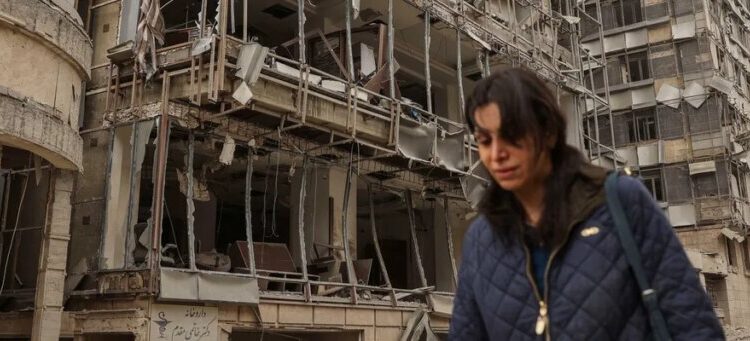
The United Nations says “significant restrictions and impediments” continue to hamper humanitarian operations in Gaza. Most Gazans have been displaced by the war and are sheltering in tents or makeshift structures. A harsh December storm damaged or destroyed 42,000 tents in the course of a week, said Philippe Lazzarini, the head of the United Nations Relief and Works Agency. Rainwater has mixed with sewage to flood the streets, heightening concerns about the spread of disease. Collapsing buildings have caused further deaths, while others have died because of the extreme weather. A 2-month-old died from exposure to the cold on Monday, the Gaza health ministry said.
Meanwhile, the body of one Israeli hostage — Ran Gvili, a 24-year-old policeman killed in the Oct. 7, 2023, attacks — is yet to be returned from Gaza. Netanyahu met with Gvili’s parents immediately after landing in the United States on Sunday, assuring them that “every effort is being made to return their heroic son for a Jewish burial,” his office said in a statement.
Trump said Gvili’s parents were inside Mar-a-Lago.
“We’re doing everything we can to get his body back,” Trump said. “And the parents just said, ‘Hopefully he’s alive.’ And I said, ‘I love you to think that way.’”
Egyptian Foreign Minister Badr Abdelatty said the body’s return should not hold up Phase 2 of the deal as “intensive efforts” were being made on the ground to locate it in rubble and thousands of tons of unexploded ordnance.
“There is no justification for delaying the announcement of, or entry into, the second phase of President Trump’s plan for peace in Gaza and the West Bank,” he said in an interview with Egyptian channel MBC Masr on Sunday evening. “The time has come.”
The key elements of a second phase include a supervising Board of Peace, a committee of Palestinian technocrats to govern Gaza’s internal affairs, and an International Stabilization Force to oversee in part the demilitarization of Hamas.
Abdelatty said that he hoped to see a “clear and firm” position from the White House in Monday’s meeting pressing for implementation. A meeting between American, Egyptian, Qatari and Turkish officials in Miami earlier this month showed a “high level of seriousness” from the U.S., he said, but on Israel’s side, momentum had lagged.
“There is a lack of willingness and a lack of seriousness in moving forward with the implementation of all obligations,” he added.
Rubin reported from Tel Aviv, and Morris reported from London.
The post Netanyahu, Trump project unity as Middle East tensions rise appeared first on Washington Post.