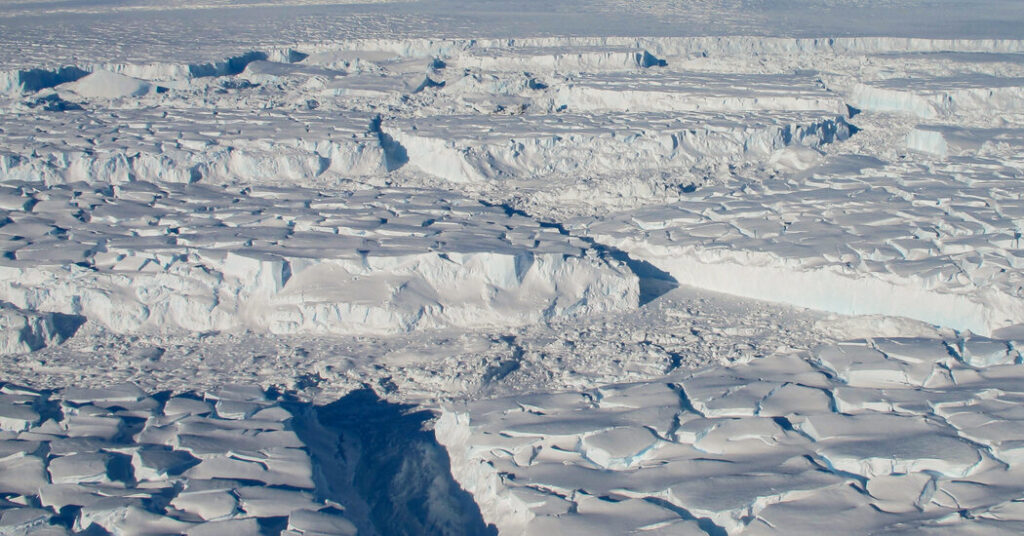
Scientists have never loved the scary nickname that journalists have given the glacier where the current Antarctic expedition is headed: the “Doomsday Glacier.”
Yes, the Thwaites Glacier is the size of Florida, and if it melted away completely, it would add two feet to global sea-level rise. The researchers aboard the icebreaker Araon are planning to study the ice of Thwaites and the seas around it to gauge how soon the glacier might collapse.
But Thwaites isn’t doomed to suffer such a fate, scientists say. They emphasize that by cutting the carbon emissions that are driving climate change, we might still protect the glacier from oblivion.
That said, nations are not exactly on track to make this happen. Globally, fossil fuel emissions soared to record levels in 2025 and show no signs of declining. One recent study found that it might already be too late to prevent the ice shelves in this part of the Antarctic coast from melting to some degree.
Other researchers say that although Thwaites is unlikely to collapse completely in the next few decades, they now have a clearer idea of what could bring about its unraveling in the latter half of the century or beyond.
To understand these predictions, it helps to know a bit about the glacier’s shape.
Like all glaciers, Thwaites is made of solid ice, but as gravity pulls it toward sea level, it moves like a thick, heavy liquid. (Think molasses.) Thwaites’s ice starts on the land of Antarctica but flows so far out to sea that the edge of the glacier juts past the bedrock, becoming a tongue of ice that floats upon the waves.
Now, warm ocean currents are washing up against the underside of this floating ice, causing it to melt and thin. These currents are also eating away at the base of the ice, or the part of the glacier that sits on bedrock. That causes the location of Thwaites’s base, which scientists call its grounding line, to retreat farther and farther inland until, scientists fear, the glacier could enter a dangerous cycle.
The bedrock beneath Thwaites is below sea level and slopes downward, becoming deeper inland than it is toward the ocean. Once the grounding line pulls back too much, this sloping shape will allow much more warm seawater to rush in, like floodwater entering a basement. This water will melt more of the floating ice and cause the grounding line to pull back further.
This self-reinforcing loop — retreat and melt, melt and retreat — could destabilize the glacier irreversibly, causing large swaths of its ice to slide into the ocean and melt away.
“The consequences of this unstable retreat will be felt worldwide in terms of sharply increased rates of sea-level rise,” said Hilmar Gudmundsson, a glaciologist at Northumbria University in England.
Thwaites doesn’t appear to have entered this cycle quite yet, according to a 2023 study by Dr. Gudmundsson and other researchers. But computer simulations have made him and his colleagues more confident that the glacier will someday collapse in this manner if the grounding line retreats too far.
“Basically, we have gone from thinking, ‘Yeah, it could happen, but we don’t really know,’ to an almost certainty,” Dr. Gudmundsson said. Still, he added, it’s very hard to predict how long from now such a cycle might be triggered.
Not all recent research on Thwaites is bad news. According to a recent study, a different kind of worst-case scenario for the glacier now looks less likely.
That one has to do with Thwaites’s ice cliffs, or the sheer, vertical edges that remain after chunks of ice have broken off and fallen into the sea. These cliffs are so tall and steep that they can be unstable. As more ice starts breaking away, even taller, even more-unstable cliffs are exposed. These start crumbling too, and before long you have runaway collapse.
Computer modeling published in 2024 suggests that Thwaites isn’t vulnerable to this particular fate, though other scientists say more work is still needed to rule out the possibility.
Catastrophic, doom-filled outcomes naturally grab a lot of attention. But scientists are also working on improving their forecasts of the ongoing sea-level rise caused by Antarctic ice flowing down to sea, being pulled apart and melting away, said Doug Benn, a glaciologist at the University of St. Andrews in Scotland.
These incremental changes might not make it into a Hollywood disaster movie. But they matter urgently to the world’s most low-lying nations and ecosystems.
“Authorities are not really going to be planning for the next century. They’re going to be planning the next decades,” Dr. Benn said. “So that’s where our focus has turned.”
Raymond Zhong reports on climate and environmental issues for The Times.
The post Is Thwaites Still the ‘Doomsday Glacier’? appeared first on New York Times.


