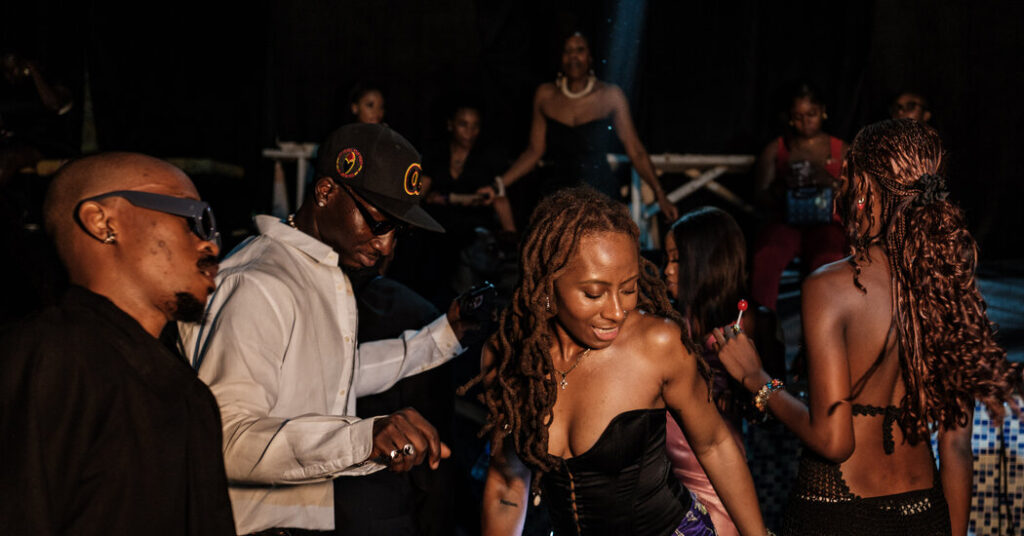
Just after midnight one weekend in December, in an empty swimming pool, a D.J. descended into the deep end and began mixing tracks with cool precision as a crowd of beautiful people danced before him, sucking strawberry mojito ice pops.
It was a well-known architect’s birthday party, and for the D.J., a rapidly rising star known as Yosa, it was only the first gig of what would be a long night in a month of long nights.
In Lagos, Nigeria, the festive season is hitting its peak. It’s Detty December, a monthlong fever dream of reunions, late nights and extravagance that demands as much stamina as it does a healthy bank balance.
Of course, weekend nights are prime party time. But so is every other day of the week.
“Detty December is back to back to back to back to back!” shouted Becky Ochulo, who programs experiences at raves, over the thumping bass of a 2 a.m. rave on a Monday.
Every year, the metropolis of about 20 million people (or maybe even more) transforms into a stage where the Nigerian diaspora and residents of the city meet to out-party the rest of the world — and in between, to sit in traffic. Lagos’s usual grit is lacquered over with giant Hennessy billboards and the neon glow of new clubs, as the city becomes a global magnet for those running from the cold abroad.
The musician Mr. Eazi says he coined the term Detty December in 2016, with the first word a variation on dirty, meaning “heavy” or “wild” in local slang. Of all the months in the calendar, December works best for the partying, not just because so many in the diaspora come home, but also because that’s when locals tend to have time off from work and the weather is at its best.
The month is a relentless calendar of weddings, street carnivals, champagne-drenched parties, fancy dinners, art shows, food festivals — including one starring pounded yam — and, toward Christmas, big-name Afrobeats concerts featuring Wizkid, Davido and Burna Boy.
To Yosa, the D.J., the city during Detty December is the “perfect balance of energy and opportunity.”
After his high-energy set at the birthday party — which featured sounds from the Nigerian legend Fela Kuti and newer tracks from the Nigerian highlife band The Cavemen — Yosa headed to his next gig at a swanky members’ club overlooking Lagos’s shimmering lagoon. By 4 a.m., some revelers began to peel off.
You have to pace yourself in Detty December: It was barely mid-month, and many would be up in a few hours for church. For Yosa, it helps that he was a former college athlete.
Yosa returned to Lagos from the United States three years ago, and as more Nigerians japa — the Yoruba term for seeking opportunities abroad — December has become the choice month for visits home. The year-end return of the “I.J.G.B.s” (“I Just Got Back”) means a month of their spending the money earned abroad; for many of the Lagosians who stayed behind, it’s the month that pays for the year.
For Tomiwa Ajayi, a wedding photographer, December is both his most lucrative month and “the month to dread,” he said outside a wedding venue in Ikeja, an upscale Lagos neighborhood, where his team was documenting every fake eyelash and glittery agbada, or flowing robe, of a purple extravaganza of a wedding. He was looking forward to spending January holed up at home.
Inside, the newlyweds slow-danced as fireworks wheeled around them. Clouds of ladies in head-to-toe lilac descended on waiters with trays held high of smoky jollof rice, corn on the cob and chicken.
Guests took bundles of banknotes — the largest denomination in Nigeria’s currency, the Naira, is worth about 70 cents — and headed to the dance floor to spray them on esteemed family members in appreciation, a tradition at Nigerian weddings. As the sun went down, older guests tried to leave but got infected by the groove on their way out.
For Taiwo Babatunde, one of the bride’s brothers who flies in annually from Scotland for Detty December, this was all pretty tame. “I’m just waiting for the actual party to start,” he said.
With everybody eager to party, Yosa, whose real name is Maghayevbosa Nosamiefan, has more than double the number of gigs as in other months.
“I’m taking gigs left and right and trying to make the most of it,” he said. “The volume this month is just — it’s insane.”
The volume was insane in another sense at a rave across town. Displays of wealth often characterize the traditional Detty December scene, but a rave counterculture has emerged, offering a much more accessible, less status-driven scene centered on Afro house music.
Music thunked down the elevator shafts as a dense crowd of ravers waited to be lifted up from a chandeliered lobby and deposited at the rave, where the outfits were far more varied than at other parties. Converse sneakers, towering heels, beach shorts, bejeweled berets, diamanté face jewelry and the full spectrum of cool sunglasses all turned neon green in the lights.
Presiding over the proceedings was its co-founder, Aniko, the female electronic music D.J. at the heart of Lagos’s rave culture. She has built a space that is welcoming to the L.G.B.T.Q. community and costs only $7-$10 to get in.
But there are many who can’t afford even that. As the ravers left, climbing into their S.U.V.s and Ubers, they were trailed by candy hawkers and beggars asking to be “blessed” with a few cents.
Seasonal blessings of the monetary kind were on Pastor Bolaji Idowu’s mind not long afterward at his 15,000-capacity megachurch, Harvesters.
“The person who turned paper into dollars, God bless you!” he said, referring to the inventor of banknotes, as he instructed everyone to video themselves singing during the worship service and post the clips on social media.
Whatever the season, Sundays for Lagos’s Christians are for church, and Harvesters was hosting its annual carol service, a high-octane stage production where the biblical met the bombastic and the Detty December spirit took a holy turn.
The Nativity was reimagined as a political thriller: Soldiers in uniform marched to a commander’s bark — “Soldiers of Christ, attention!” — while a terrified Herod stalked the stage, desperate to snuff out a “coup” by the newborn “Governor,” but frequently getting distracted by a love interest played by Nollywood actress Bimbo Ademoye. A mash-up of “The Lion Sleeps Tonight” and “Little Drummer Boy” dissolved into “O Come All Ye Faithful,” led by funky drummers in military hats with purple plumes.
The congregation, in tinsel reindeer horns and gorgeous gowns, hit a fever pitch when a magician set a silver plate alight, covered it and then uncovered it to reveal an awesome miracle: bread and fish. He took the fish, slapped it, and it began to flap. The congregation went wild.
“It’s a lie! Don’t tell me it’s real!” a young man gasped.
A different kind of congregation was gathering over at another “Sunday Service” at Federal Palace, a hotel and casino, on Sunday evening — one wearing roughly the same amount of sequins, but tiny shorts and tank tops in place of Harvesters’ gowns and reindeer horns.
Aniko was at the altar of the decks, playing a mesmerizing, almost reverent set with another D.J., Shamiso, to a crowd that had made modest “offerings” to get in. Her half-finished glass of champagne rippled to the music.
At 2:30 a.m., Yosa appeared behind the two women, preparing to take over.
Aniko’s champagne glass was cleared away. Yosa put on a faster track and the energy picked up. Hand fans were flapped. Afros bobbed. The crowd heaved. At the back, new plantains were thrown on the grill.
A new week in Detty December was just getting started.
Ruth Maclean is the West Africa bureau chief for The Times, covering 25 countries including Nigeria, Congo, the countries in the Sahel region as well as Central Africa.
The post In Lagos, December Is Time to Get Down and ‘Detty’ appeared first on New York Times.