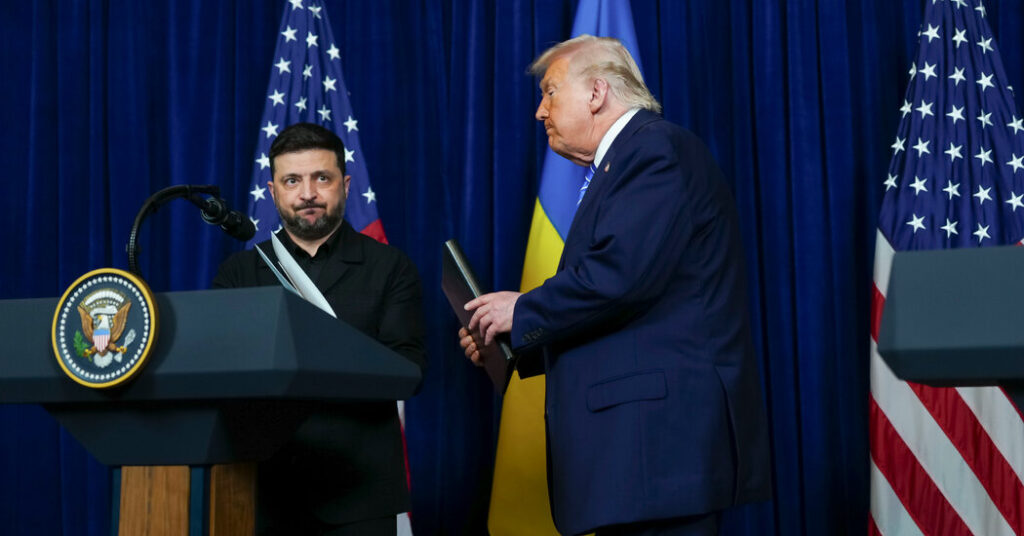
As President Volodymyr Zelensky of Ukraine traveled back from Florida on Monday, he could breathe a sigh of relief. His meeting with President Trump to discuss a peace plan seemed to have passed without drama — the American leader had neither berated him nor echoed Kremlin talking points, at least publicly. By the standards of past encounters, that counted as progress.
By while Mr. Zelensky was en route home, President Vladimir V. Putin was on the phone with Mr. Trump, introducing a new twist. Mr. Putin claimed that a Ukrainian drone attack had targeted one of his residences in Russia overnight. “I don’t like it,” Mr. Trump later told reporters, as he recounted the call. “It’s not the right time to do any of that. I was very angry about it.”
The accusation was just the sort that could derail Ukraine’s diplomatic effort. Mr. Zelensky swiftly denied it, describing the claim on social media as “a complete fabrication” designed “to undermine all achievements of our shared diplomatic efforts with President Trump’s team.” He reinforced the denial in a voice message to reporters in an online chat group, and his foreign minister also weighed in.
Meanwhile, several Russian officials relayed the accusation publicly, saying Moscow would toughen its stance in the negotiations as a response.
The flurry of statements from Ukraine and Russia over the claim, which so far lacks any clear-cut evidence, underscored an information war that has taken on outsized importance in the peace talks: the battle to shape Mr. Trump’s thinking.
Both sides in the war see the American president as their key leverage in negotiating a future peace settlement. For months, they have strived to shape his perception of the battlefield. That has included Russia claiming the capture of cities that have not yet been taken and Ukraine not immediately acknowledging when a city has fallen. Kyiv and Moscow have also accused each other of refusing to compromise to reach a peace deal and of trying to upend the talks.
Mr. Trump’s views on the war remain unclear after nearly a year of failed efforts to end it. Russia has held the upper hand in the battle to shape his perception, according to analysts. Mr. Trump has sided with Moscow several times this year, partly because of Russia’s advantage on the battlefield, which aligns with the president’s repeated belief that the strongest side would prevail.
Meanwhile, Mr. Zelensky has often been left scrambling to salvage diplomatic efforts by engaging frequently with the American side and rallying European allies to steer Mr. Trump toward a less pro-Russian position.
“Zelensky has this challenge in appealing to Trump that Putin doesn’t have,” said Harry Nedelcu, a senior director at Rasmussen Global, a research organization, noting that Mr. Putin has a closer relationship with Mr. Trump than the Ukrainian president does. Mr. Putin can typically talk to Mr. Trump shortly before the American leader meets with Mr. Zelensky — which is what happened on Sunday — to press his case directly and shape the negotiations.
Dmitri S. Peskov, the Kremlin spokesman, reiterated on Tuesday that Russia would toughen its negotiating stance, without specifying how Moscow would change its demands. He told reporters that Russia would “continue the negotiation process and dialogue primarily with the Americans.”
Local Russian authorities in the Novgorod region, where the residence that was allegedly attacked is located, reported a Ukrainian drone attack early on Monday morning. But the attack and its potential impact could not be independently verified.
With the negotiations at an impasse over territorial issues, much of the narrative battle in recent weeks has centered on which side is gaining ground on the battlefield.
In early December, Mr. Putin invited journalists to come and “see for themselves” that Russian forces had captured the northeastern city of Kupiansk. Instead, it was Mr. Zelensky who came about 10 days later and filmed himself by the entrance sign of the city to announce that it was mostly under Ukrainian control — a fact confirmed by battlefield maps made by independent groups.
On Monday, Mr. Putin met with senior commanders in the Kremlin and said that Russian troops were only about nine miles from the southern Ukrainian city of Zaporizhzhia, a major industrial center. He ordered his forces to capture the city “in the near future.” But Russia has not taken any major city since 2022 and military analysts say it lacks the forces to do so.
Still, Russian forces have made advances in recent weeks — a reality that Ukraine has sought to play down to avoid giving Mr. Trump the impression that it might be better off striking a deal on Moscow’s terms sooner rather than later.
Ukraine’s top military leaders, for example, was slow to acknowledge that the eastern town of Siversk had fallen to Russia last week.
On Monday, Ukraine’s top commander, Gen. Oleksandr Syrsky, offered a rather optimistic account of the situation in the strategically located eastern city of Pokrovsk, claiming that Russian forces controlled only half of it. But the battlefield maps compiled by the independent groups show that roughly two-thirds of Pokrovsk is under Russian control, and Ukrainian soldiers on the ground have acknowledged the city is nearly lost.
Ivan Nechepurenko contributed reporting.
Constant Méheut reports on the war in Ukraine, including battlefield developments, attacks on civilian centers and how the war is affecting its people.
The post How Russia and Ukraine Are Fighting to Shape President Trump’s View of the War appeared first on New York Times.