Faced with increasing pressure from much of the world over Israel’s bombardment of Gaza and the sprawling humanitarian disaster that resulted, Israeli Prime Minister Benjamin Netanyahu invoked a vision of a vanished Greek city-state.
With some Western governments restricting weapons transfers to Israel, the country must adopt a “super Sparta” mentality in the face of increasing isolation, summoning the famed self-reliance and martial resolve of ancient Sparta to boost the Israeli arms industry and hunker down, Netanyahu said in a September address.
But that was not the complete vision he set out: “We’re going to be Athens and super Sparta combined,” he said, unwilling to abandon entirely the more enlightened, democratic mythos of Sparta’s historical rival.
The emphasis on “super Sparta” stuck in the news cycle and provoked a backlash. Netanyahu was laying out a vision for a more militarized society that, like Sparta, would also be more closed to the outside world. His Israeli opponents despaired for what that would entail.
Even if Sparta’s autarky — its lack of a reliance on trade and economic ties to others — underlay its fierce reputation, that’s hardly a virtue in a globalized age, critics in Israel argued. Instead, they viewed it as a recipe for decline. Their contention, like Netanyahu’s own reach for Sparta’s legacy, has a long lineage. Writing in the Federalist Papers in 1787, as U.S. Founding Fathers debated the shape of their new republic against precedents in classical antiquity, Alexander Hamilton scoffed at the example of Sparta as “little better than a well-regulated camp,” addicted to war and lacking the economic vigor needed for a successful, sovereign republic.
Heading into 2026, there’s still something curiously potent about the allusion to Sparta. In many countries, the steady advance of illiberal, right-wing nationalist politics has come with border walls and military budgets to match. The waning of the postwar “rules-based” order and the apparent retreat of globalization — sped, in part, by President Donald Trump’s trade wars — has returned us to a kind of “Spartan” moment, some analysts say.
Swedish economic historian Johan Norberg’s new book, “Peak Human: What We Can Learn From the Rise and Fall of Golden Ages,” points to the eternal clash of Spartan and Athenian ideals. “The Greek historians talked about the Athenians always going out to explore, to acquire something new, to trade,” he said of the city-state remembered for seeding trade routes and amassing maritime power across the eastern Mediterranean. “The opposite is the Spartan ideal that you stay at home to try to protect what you already have.” The latter, he argued, is “a very appealing idea in times of trouble, when the world seems like a dangerous place.”
A sense of peril stalks the political discourse in the West and elsewhere. The White House and ideological fellow travelers in Europe cast migrants and the feckless liberal establishments that welcomed them as the drivers of a “civilizational” crisis. Myths of Sparta shadow that rhetoric.
Some rioters who stormed the Capitol on Jan. 6, 2021, wore Sparta-themed helmets. They also flew flags emblazoned with the Spartan idiom “Molon Labe” — the laconic phrase that means “come and take it,” popularized through generations of Hollywood films that tell the story of Spartan defiance of a Persian emperor who would have them surrender their weapons. Almost 25 centuries after 300 Spartan hoplites and their allies tried to thwart the advance of the Persians at the Battle of Thermopylae, their sacrifice is still a canonical event in the Western imagination — and a constant font of memes for the West’s far right.
U.S. gun rights activists invoke “Molon Labe” as a slogan, a rejection of anyone who would contravene their Second Amendment freedoms. Martin Sellner, the Austrian neofascist who helped popularize the concept of “remigration” — that is, the mass removal or deportation of non-White migrants, whatever their status, echoed by Trump and other right-wing leaders — adopted a “Spartan shield” as the image of his movement. In 2022, Don Bolduc, a Republican senatorial candidate in New Hampshire, carried around a similar version of the shield (stuck full of arrows, for further dramatic effect) during his failed campaign.
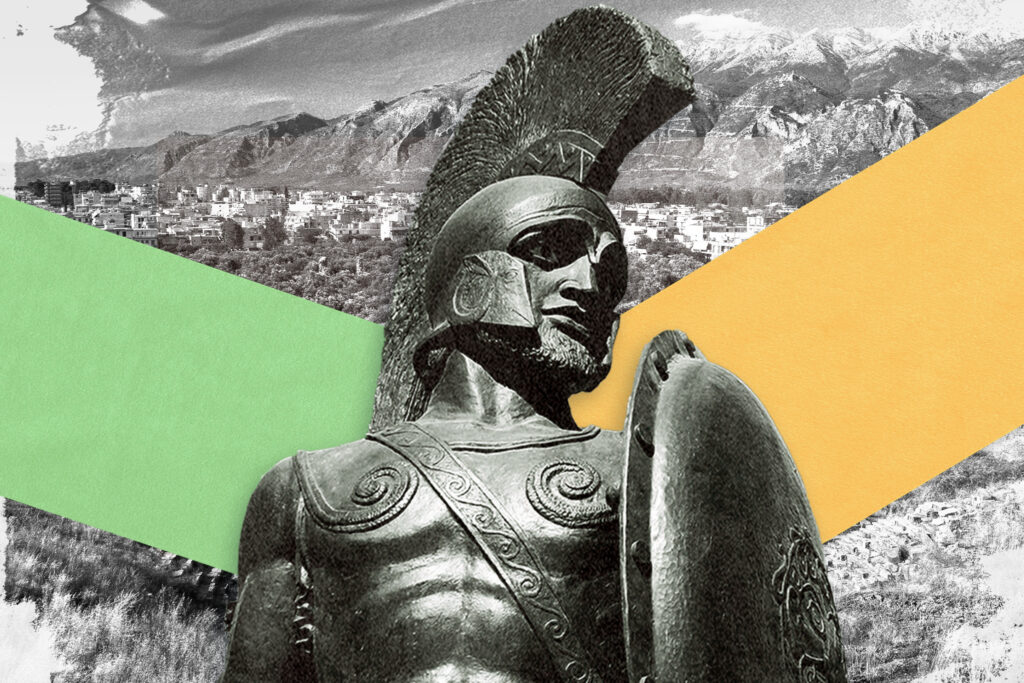
In Greece itself during the previous decade, the neofascist Golden Dawn party staged annual rallies at the historical site of Thermopylae. They would bear torches and flank a statue of legendary Spartan king Leonidas, chanting “Greece belongs to the Greeks!”
Golden Dawn was banned as a political party in 2020 for criminal offenses, but it was succeeded by a wave of influential far-right factions that entered Greece’s Parliament after elections in 2023. One of the more controversial parties in this cadre is named the Spartans.
Spartan themes have run through modern nationalism all along. “The Spartan chant, ‘We are what you were; we will be what you are,’” 19th-century French philologist Ernst Renan wrote in his seminal treatise on the idea of a nation, “is, in its simplicity, the abridged hymn of every fatherland.” The Spartan reputation for strict discipline, obedience and respect for hierarchy shaped the ethos of military cadet schools in mid-19th-century Prussia.
A half-decade ago, U.S. military planners cheered the United Arab Emirates as “little Sparta,” a recognition of the small kingdom’s ability to punch above its weight in the Middle East (and not, one imagines, its hierarchical social system that separates Emirati citizens and wealthy expats from a vast underclass of foreign laborers). Defense Secretary Pete Hegseth openly channels supposed Spartan values when he extols the newfound “warrior ethos” of the Trump administration, tightens the Pentagon’s standards for grooming and physical fitness and links the mission of the U.S. military more closely to the White House’s political agenda.
Hegseth’s approach, warned Bret Devereaux, a historian of ancient armies, jeopardizes a more democratic civil-military tradition. “Hegseth’s ideal army is one quite a bit more like those of Russia or Belarus: focused on the pageantry of physical fitness, prone to atrocity, and ultimately the tool of one man’s power rather than the shield of a free country,” Devereaux writes.
Norberg, separately, described societies like that of Russia and Belarus as inimical to innovation and beholden to the barracks — “all Sparta, no Athens.”
Proponents of neo-Spartanism see a world where “you’re better off if you stay at home, not engaging too much with others,” Norberg told me. “There’s very much the Spartan mentality — that the world is a zero-sum game, and if somebody else benefits, you’re worse off. And that seems to be the Trumpian worldview as well, and why Sparta is an ideal for people on the MAGA right.”
But it’s not just the right. Uncertain about the strength of U.S. commitments, European governments of various political persuasions are steeling themselves for the prospect of conflicts and investing in their defense capabilities.
In November, Finnish President Alexander Stubb declared that the “decade of the army is about to begin.” German Chancellor Friedrich Merz said this month that “the decades of the ‘Pax Americana’ are largely over for us in Europe, and also for us in Germany. It no longer exists as we knew it and nostalgia won’t change that. … The Americans are now very, very ruthlessly pursuing their own self-interests.” It was time, Merz suggested, for Europe to do the same.
Classical historians quibble with such blunt analogies. The past is always more complicated than how it’s remembered.
Far from being the civilizational bulwark some on the Western right envision, Sparta was “reliant on naval subsidies from the Persian Empire” in the latter wars against Athens, Barry Strauss, a professor emeritus at Cornell and a senior fellow at the Hoover Institution, told me. “So it’s not entirely the image we have of Sparta as this autarkic place.”
Right-wing idealization “exaggerates the degree to which Sparta was isolated and also underestimates the degree to which corruption was a problem in Sparta,” Strauss said.
Sparta did not have the grand public architecture of Athens that has survived through the ages to shape its memory. But it enforced a rigid social system that was a subject of fascination even in its day, interest in which has endured: A small class of citizens who did not engage in agriculture or commerce trained as warriors from childhood, with men living in communal barracks, supported by a vast class of enslaved farmers.
Many resources were held in common by the citizen elites. Paul Cartledge, a British historian of ancient Greece and professor emeritus at Cambridge University, noted how Spartan women “somewhat break the mold in terms of the oppression or subjection of women in ancient Greece.”
Still, even by the standards of its own time, Cartledge argued, Sparta was notorious for its brutality. “Sparta is not a role model,” he told me. “It’s a slave state, and it’s extremely unpleasant to its unfree population.”
Cartledge pointed to the echoes of Sparta in Europe’s darkest chapter. “The Spartans were very cautious about whom they reared and whom they cast out,” he said, referring in part to their purported practice of exposing unfit infants. “They were, presumably, eugenicists.”
The Nazis remembered them as such. “Sparta must be regarded as the first völkisch state,” Adolf Hitler once said, referring to a racially ordered polity. “The exposure of the sick, weak, deformed children, in short, their destruction, was more decent and in truth a thousand times more human than the wretched insanity of our day which preserves the most pathological subject.”
Netanyahu’s “Athens and super Sparta” speech tapped into a long tradition. Cold War policymakers raised the parable of Sparta and Athens in regard to the Soviet-U.S. contest: The former, in its communalism and closed economic order, more “Spartan” in nature; the latter, with its maritime dominance and capitalist zeal, more “Athenian.”
Harvard political scientist Graham Allison updated the paradigm for the 21st century when he brought into the mainstream the idea of the “Thucydides trap,” mulling the inevitability of conflict between the United States and China. In this analogy, Washington is like Sparta, a great status quo power threatened by the rise of an ambitious, increasingly assertive Athens.
Allison is an avowed practitioner of “applied history,” sifting through precedents for modern-day lessons. The contemporary resonance of Sparta “is very interesting,” Allison told me, but, he added, there are limits to the power of the metaphor given the “profound differences” separating us from the city-state.
“When people cherry-pick one or two features of an analogy,” he said, “that will frequently tell you more about the person and their views than it will about the illumination of the world.”
Sign up to receive WorldView, a free, thrice-weekly email newsletter from the international desk of The Washington Post.
The post How ancient Sparta explains 2026 appeared first on Washington Post.