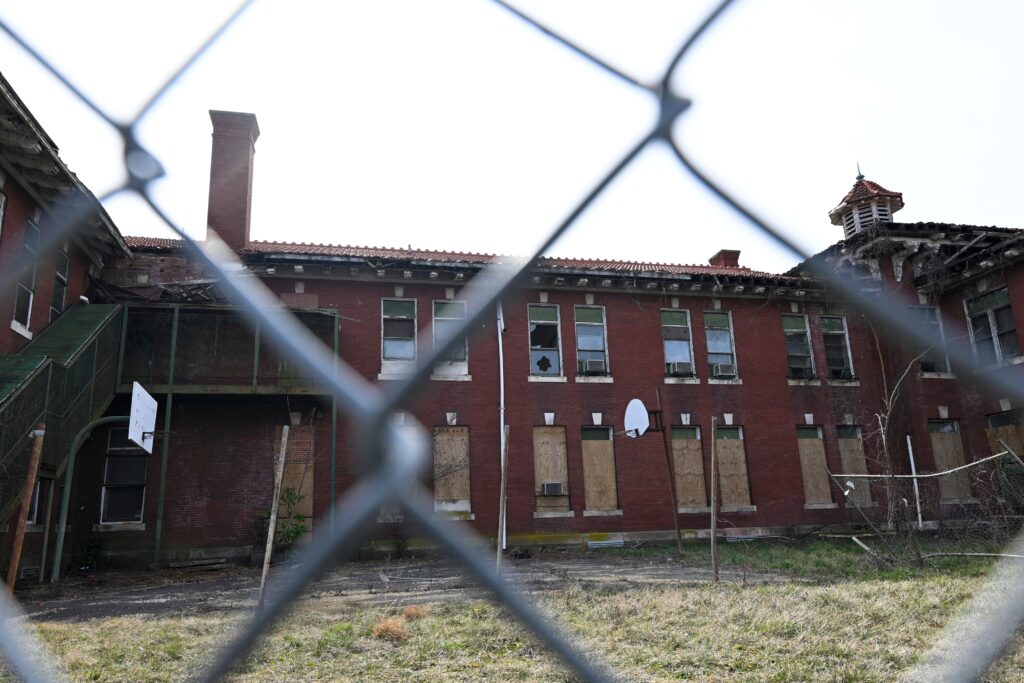
The Department of Homeland Security is seeking to fast track the demolition of more than a dozen historic buildings at St. Elizabeths in Southeast Washington, asserting that the conditions of the vacant structures represent an “emergency” and pose potential security risks, according to documents obtained by The Washington Post.
DHS Secretary Kristi L. Noem, in a Dec. 19 memo to the General Services Administration, said the buildings “constitute a present risk to life and property” on the 176-acre West Campus, a fortified complex that Homeland Security has been transforming into its new headquarters over the past 15 years.
“Demolition is the only permanent measure that resolves the emergency conditions,” Noem wrote in the memo. A risk assessment report undertaken by her agency “supports immediate corrective action,” she wrote.
The assessment report, which Noem included with her memo, concludes the vacant buildings “may be accessed by unauthorized individuals seeking to cause harm to personnel.” The structures “provide a tactical advantage for carrying out small arms or active shooter scenarios,” the report states.
DHS’s proposed demolition is prompting opposition from the National Trust for Historic Preservation and the D.C. Preservation League, which are seeking to participate in a detailed on-site assessment of the structures, nine of which they say were built in the late 1800s.
In a letter sent Sunday to the GSA, the preservationist organizations raise “strong objections” to the proposed demolition, contending that no evidence of an emergency exists beyond “Secretary Noem’s unilateral declaration” of one.
“A unilateral declaration like this is problematic because it bypasses the procedural safeguards designed to ensure stability, legitimacy and fairness,” reads the letter signed by Elizabeth Merritt, the National Trust’s general counsel, and Rebecca Miller, the Preservation League’s executive director.
Regarding the purported security risks, the preservationists wrote that the Homeland Security campus possesses “the highest security classification for a government facility.” Concerns about threats, they wrote, “imply a fundamental flaw in the facility’s security as a whole,” not the vacant buildings.
The concerns about St. Elizabeths echo those raised after President Donald Trump ordered the demolition of the East Wing of the White House in October to make way for a new ballroom. The National Trust earlier this month filed a lawsuit intended to require the White House to submit plans for a public review before constructing the 90,000 square foot ballroom.
Under the terms of the redevelopment of the St. Elizabeths West Campus, the federal government is required to provide preservationists three business days to respond to an emergency notification regarding the property, according to the preservationists.
The GSA notified the administration of D.C. Mayor Muriel E. Bowser (D) of the plan on the evening of Dec. 23. The GSA’s emailed letter to the city included Noem’s memo, as well as a safety assessment report completed Dec. 19.
Because of the federal holiday, the deadline is Dec. 31 for the city’s Office of Historic Preservation and the Advisory Council on Historic Preservation to offer comments, according to the preservation organizations.
David Maloney, D.C.’s state historic preservation officer, did not respond to a request for comment. Nor did a spokesperson for Homeland Security.
Marianne Copenhaver, a GSA spokesperson, said in an emailed statement that Homeland Security alerted her agency about “a present security risk to life and property” at St. Elizabeths “that may require us to demolish buildings.”
“Accordingly, we are following all applicable laws and regulations to address those issues,” she said.
Established by Congress in 1855, St. Elizabeths was originally known as the “Government Hospital for the Insane,” according to the GSA’s website. The complex has been listed on the National Register of Historic Places since 1979. The federal government certified it as a National Historic Landmark in 1990.
The Department of Health and Human Services classified the West Campus as “excess property” in 2001, after which the GSA took it over and led an effort to redevelop the property for Homeland Security. A master plan for the site conceived of a project that would answer Homeland Security’s need for more than 4 million square feet of office space and enough parking for 14,000 employees, according to the GSA website.
Because of the property’s landmark status, a protocol was established to respond to any proposed demolition of the buildings. Four of the 17 buildings that Homeland Security is seeking to raze already have been approved for demolition by the National Capital Planning Commission and the Commission of Fine Arts, Miller said.
The proposed razing of the 13 other buildings has not been reviewed, she said. Those buildings include Burroughs Cottage, which a wealthy couple built in 1891 to house their daughter and her nursing staff. After the patient’s death in 1917, the family donated the cottage to St. Elizabeths, according to a report the Preservation League submitted to the city in 2005, when it was seeking landmark status for the campus.
In the security assessment report, Homeland Security officials assert that the vacant buildings could be “exploited by malicious insiders who possess legitimate access, familiarity with the campus, or detailed knowledge of security procedures.” The report describes these insiders as employees, contractors, or others who use their access and position “to plan, stage, or execute harmful activities.”
“For senior leadership,” the report asserts, “the principal risks include targeting of executives, disruption of essential operations and compromise of sensitive information or infrastructure.”
In their letter to GSA, the preservationists contend that the buildings slated for razing have been vacant for many years and that the federal government has “not provided evidence of changed circumstances that would warrant ‘emergency’ demolition.”
“If the space within these vacant buildings is accessible,” they wrote, it’s the GSA and Homeland Security that have “failed to effectively secure them.”
The post Homeland Security seeks ‘emergency’ demolition of historic buildings in D.C. appeared first on Washington Post.