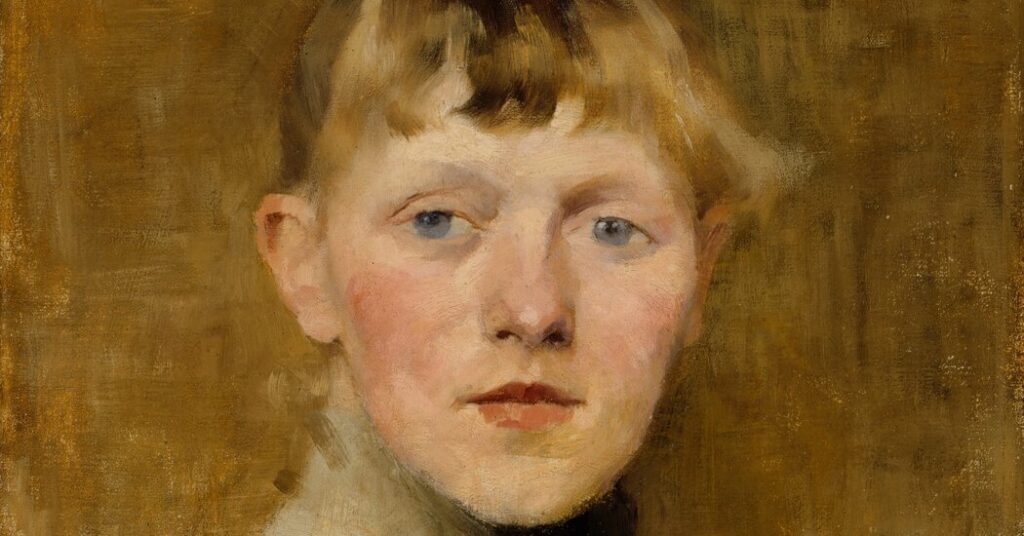
If you dislike the shortened daylight of winter, please know that you are luckier than Helene Schjerfbeck. A Finnish painter of copious gifts, she spent most of her life in or around Helsinki, contemplating cold skies and winters that lasted for more than half the year. On the other hand, she found an alternate light source through her paintings, many of which are portraits and self-portraits whose warm internal glow rescues their forms from surrounding darkness.
“Seeing Silence: The Paintings of Helene Schjerfbeck” offers a moving introduction to an artist whose name you probably do not know. Although Schjerfbeck, who died in 1946, at age 83, is one of the two or three most celebrated artists in Finland, where the tributes include the 2020 biopic “Helene,” she has remained a relative stranger here. This is the first major show of her work in New York in a generation, and the Met claims it owns the one and only painting of hers that resides in this country. Titled “The Lace Shawl” (1920), it was purchased in 2023, a crucial first step in building local recognition for an artist’s work.
A smallish, vertical canvas, “The Lace Shawl” happens to depict the artist’s landlady, a young woman with stringy black hair and plump red lips framed against a fern-green background. It offers a good example of Schjerfbeck’s penchant for applying paint with a palette knife and then scraping it down to reveal the weave of the canvas, a technique from which she coaxed a range of moods and effects. In this case, the picture’s abraded, scabby texture reinforces your sense of the landlady’s rough life. She glares sideways at no one in particular, a precursor of contemporary punk.
Sometimes Schjerfbeck’s scraping can achieve, to the contrary, a sense of optical luxury. “Fragment” (1904) is a small, stunning picture of an auburn-haired woman whose eyes are lowered as if in silent prayer. The gleaming gold-leaf background, much of which is scratched away, can makes you think you are looking not a 20th-century work but at a precious fragment that accidentally fell off a Renaissance fresco.
As we learn from the 56 paintings in the show, Schjerfbeck’s story is not the typical avant-garde tale of an artist who sets out to rebel against the masters of the past and forge a radical new style. When she started her career in the 1880s, she won recognition as a painter of conservative, academically-sanctioned scenes (think handsome soldiers and saucer-eyed children), and it wasn’t until she was in her 40s that she did an about-face, purging her human figures of descriptive detail and experimenting with lyrical blurs of color. Moreover, she stopped varnishing her paintings, a pointed gesture that gave her pictures an unfinished look and announced her freedom from rules.
Who was Helene Schjerfbeck? A shy, stocky woman who never married and wore her auburn hair in a bun, she first took up art as an antidote to illness. When she was 4 years old, she fell on the front steps of the family’s house in Helsinki and broke her hip. It healed imperfectly and left her with a limp. Her father, an office manager and an amateur artist, brought her pencils and watercolors during her convalescence, and she traced the awakening of her artistic life to that moment.
A natural draftswoman, she was awarded a scholarship to the Drawing School of the Finnish Art Society at the indecently early age of 11. Two years later, her father died of tuberculosis. The loss was immeasurable.
The theme of father-daughter affection defines the first painting that Schjerfbeck sent to the Paris Salon, the juried exhibition that could make a young artist’s reputation. Although she wasn’t Jewish, “Jewish Feast” (1883), her submission, is a large, horizontal painting that takes us inside a sukkah, or temporary hut, where a girl in a pink cotton dress and black boots reclines on a mattress beside her gray-bearded father, nestling her head against his thigh. Scholars have puzzled over the subject matter, since there were almost no Jews living in Helsinki at the time the painting was done. But it makes sense that an artist who longed for a different life and a different Finland, which was then under the stranglehold of Russian rule, might choose to identify with a persecuted people.
Another early work she sent to the Salon, “The Convalescent” (1888) is reportedly the single most famous painting in Finland. Sometimes referred to as a “hidden self-portrait,” it shows a young girl with feverish cheeks perched at the edge of a battered rattan chair. She’s transfixed by the sight of a budding branch, with its promise of growth and recovery.
I realized as I backed away from the painting that the outline of the fluffy pillow cushioning her chair can be read as a fluttering angel wing that’s attached to her body. Gustave Courbet, the French realist painter, once took a dig at religious painting by saying: “Show me an angel and I’ll paint one.” Schjerfbeck showed him.
By this point, Schjerfbeck was well-versed in the latest news out of the European art world. Awarded a government travel grant during her student days, she studied at the Académie Colarossi in Paris and spent much of the fabled 1880s painting in art colonies in France, England and Italy. Yet her stays in the capital of culture did not convert her into a modernist. It happened later, around 1902, when Paris was just a fond memory and she was weighed down with new problems. She began living with her widowed mother, Olga, in the small railroad town of Hyvinkaa, about two hours north of Helsinki. They shared a one-bedroom apartment, and Olga had “no interest in her daughter’s artistic career,” as we learn from a wall label at the Met. But at least her mother was willing to pose. In “Mother Reading” (1902) a woman with short, Gertrude Stein hair sits in a rocking chair, her immense back turned toward us. She seems so oblivious to our presence she makes James McNeill Whistler’s famously straight-backed mother seem cuddly by comparison.
Schjerfbeck was personally acquainted with Whistler, and she very much admired his work, with its gray fogs dissolving bridges and solid buildings into a field of indeterminate blurs. Whistler, an apostle of art for art’s sake, opposed the idea that pictures should tell a story. Schjerfbeck, by contrast, appears to have viewed her art as a vehicle for spirituality. In “Silence” (1907), a painting so soft-edged and hazy it could be mistaken for a pastel, a pale woman in a high-neck lavender dress is silhouetted against a black ground. Instead of a candle or other external source of illumination, the light on her face seems to be seeping out from some place under her skin.
On the eve of World War I, Schjerfbeck started “The Tapestry” (1914-1916), a major, three-feet-square painting that turned her signature blurs into a potent and bewitching drama. A man and a woman stand in a parlor, appearing to contemplate a scenic view of the quiet sea. In the far distance, you can make out a few dozen spindly trees, which are planted on a purple island shaped like a baguette. But you soon realize that the ostensible seascape is merely a decorative rug that is hanging indoors, and nothing in the world is stable or certain, except, perhaps, for imaginary visions. The man, whose legs are only half-painted, could be a figure in a daydream the woman is having. For whom was she longing? Schjerfbeck’s great love, Einar Reuter, an artist and critic who was two decades her junior, would publish a biography of her in 1917, before breaking her heart by marrying a young Swede.
Schjerfbeck’s later work might be described as Nordic noir. She has been widely lauded for her ’40s self-portraits, which are invariably characterized as unflinching explorations of the ravages of old age. But they’re not about frown lines or dark bags and the kind of defects a dermatologist can repair. Rather, they convey a poignant sense of the way the things that we love vanish over time. First color is drained from her work; then facial details give way to her bony scull, and even her locks of auburn hair disappear.
Disturbing? Yes. But one needs to remember when she painted them. The late self-portraits were done between 1939 and 1945, dates that bracket historical catastrophe. Finland was allied with Nazi Germany during much of the war, an alliance that Schjerfbeck privately opposed. Her late self-portraits evoke the haggard faces staring out from news photographs of concentration camps, and you suspect she was brooding not only on her own extinction but on that of civilization itself.
The show also includes an impressive wall of still lifes; they, too, can evoke the desperation of the war years. I was enraptured by “Still Life With Blackening Apples” (1944), a tiny painting whose ballooning green and lavender shapes are barely recognizable as five or six pieces of fruit resting in an oblong dish. Although two of the apples are discolored by rot, another apple casts a tall, richly colored shadow — pistachio-green — on the tabletop and lets us know that the world is still ebulliently there.
You hope the Met show, which was organized by the museum’s curator Dita Amory, will succeed in rescuing Schjerfbeck from her long obscurity in this country. In 1992, she had a highly praised show at the National Academy of Design, but afterward, she reverted to being underknown again and refiled in the gloomy category of “poised for rediscovery.” Much can be blamed on the patriarchal bias against women artists, but not everything. The problem, at least for American viewers, is that nearly all of Schjerfbeck’s paintings remain in collections in Finland and Sweden. And while some 2,000 of her letters survive, they have not been published in English, leaving us without a firm sense of her aesthetic or her personality. Anyone interested in translating the letters, which were written in her native Swedish, which is one of Finland’s two official languages? I look forward to learning more about her.
Seeing Silence: The Paintings of Helene Schjerfbeck
Through April 5, 2026, the Metropolitan Museum of Art, 1000 Fifth Avenue, 212-535-7710, metmuseum.org.
The post Her Nordic Noir Is Belatedly Capturing New York appeared first on New York Times.