For months, Chancellor Berrong, a 26-year-old in prison for assault and kidnapping, has been trying to tell the authorities that he killed a man in a Mississippi jail seven years ago.
He told a prison guard that he had information about the crime, attempted to confess to a detective and gave a written confession to a prison warden, he said, but agents with the Mississippi Bureau of Investigation, the state agency that typically investigates in-custody deaths, took no action.
In interviews, Mr. Berrong said that he attacked William Wade Aycock IV at the request of a guard in 2018. That allegation is disputed by a former inmate, who told reporters he overheard Mr. Berrong and others planning the assault to stop Mr. Aycock from implicating a member of their gang in an unrelated crime.
Previous reporting on the Rankin County Adult Detention Center, where Mr. Aycock died, revealed that for years, guards relied on some inmates as an attack squad to help keep order and to retaliate against troublemakers.
A review of the initial investigation of the death reveals that the authorities took steps that could have hindered a full accounting of what happened. Guards and inmates cleaned the cell where Mr. Aycock died with bleach before the state investigators arrived, according to four witnesses. In addition, the M.B.I.’s investigation file contains no photos of the cell, no security camera footage and no notes from interviews with inmates
Days after the death, M.B.I. agents and the state medical examiner determined that Mr. Aycock died by accident after falling off his bunk bed — without documenting the evidence that led them to this conclusion.
Mississippi Today and The New York Times have uncovered evidence that supports Mr. Berrong’s confession and suggests that the authorities ignored or destroyed evidence that could have helped solve the case. His account is the latest allegation of wrongdoing by law enforcement in Rankin County, a Jackson suburb where sheriff’s deputies have been accused of torturing suspected drug users.
Jason Dare, the spokesperson and attorney for the sheriff’s department, said he had forwarded reporters’ request for comment to the M.B.I. He declined to comment further.
The commissioner of the Mississippi Department of Public Safety, Sean Tindell, said that the M.B.I. would reopen the case based on the new information.
Mr. Berrong, a member of the Latin Kings street gang with a long criminal record, said that in June 2018, he yanked a sleeping Mr. Aycock off the top bunk in his cell, slammed him to the floor and stomped on his head. He said he never intended to kill the man, just to send him a message to keep his mouth shut.
Mr. Berrong said he has come forward out of a sense of guilt.
For seven years, he said, he had gotten away with the crime, in part because of missteps in the investigation. Shortly after killing Mr. Aycock, he watched a group of inmates and guards soak up the blood, which had spread past the cell door, and douse the cell in bleach.
A former inmate named John Phillips said he cleaned the cell before the M.B.I. arrived and compared the scene to a horror film. Two former guards who spoke on the condition of anonymity witnessed the cleanup and confirmed the former inmates’ accounts.
When the investigators arrived, they were “angrily talking with each other about the fact that the whole cell has been bleached,” Mr. Berrong said. “They said, ‘There’s nothing here.’”
The M.B.I.’s investigative report on Mr. Aycock’s death, provided by Mr. Tindell, makes no mention of the cleanup.
Mr. Tindell said he spoke with the agent responsible for the report, who said he did not recall the cell being cleaned or seeing men enter Mr. Aycock’s cell in security camera footage. Mr. Tindell said the footage was not preserved by the M.B.I.
The Rankin County Sheriff’s Department declined to release investigative records related to the case, citing a state law that allows police agencies to withhold such materials.
The M.B.I.’s file on the case amounts to a two-paragraph summary of the investigation and the autopsy report. There are no photos or security camera footage and no interview descriptions, even though several inmates said they were interrogated by investigators.
“The reporting at the time obviously left some things to be desired,” Mr. Tindell said in an interview.
In the years since he took over the department in 2020, the agency has improved its record-keeping practices by “making sure that we had witness lists, that we had narratives, that there was a narrative for everybody that you interviewed and that supervisors had to review their work,” he said. “In this report, there’s none of those things.”
Two days after the M.B.I. filed its report concluding that Mr. Aycock had died from an accidental fall, the Mississippi state medical examiner ruled his death an accident.
Three pathologists who reviewed the autopsy at the request of reporters said that while it was reasonable to conclude he had died accidentally given what the authorities knew at the time, Mr. Berrong’s account aligned with the injuries recorded in Mr. Aycock’s autopsy.
Dr. Thomas Andrew, the former chief medical examiner of New Hampshire, said that he would have told the agents assigned to the case to investigate further before he could reach a determination.
Details missing from the report, like pictures of Mr. Aycock’s cell and security camera footage, could have led examiners to a different conclusion, he said.
The M.B.I. had an opportunity to reopen the case in 2022, when an inmate eyewitness told a Rankin County Sheriff’s Department detective that he had seen Mr. Berrong and another inmate leave Mr. Aycock’s cell moments before guards found him lying in a pool of blood.
The witness, who was being held in the jail in 2018, spoke to reporters on the condition of anonymity, citing fears of retaliation from Mr. Berrong’s associates.
The detective relayed the information to an M.B.I. agent, the eyewitness said, but the authorities never contacted him again. The witness said that he also wrote a letter to the M.B.I. detailing what he had seen, and that his son called the Rankin County District Attorney’s Office to report the information, but they never heard back from the agencies.
The district attorney’s office did not respond to requests for comment.
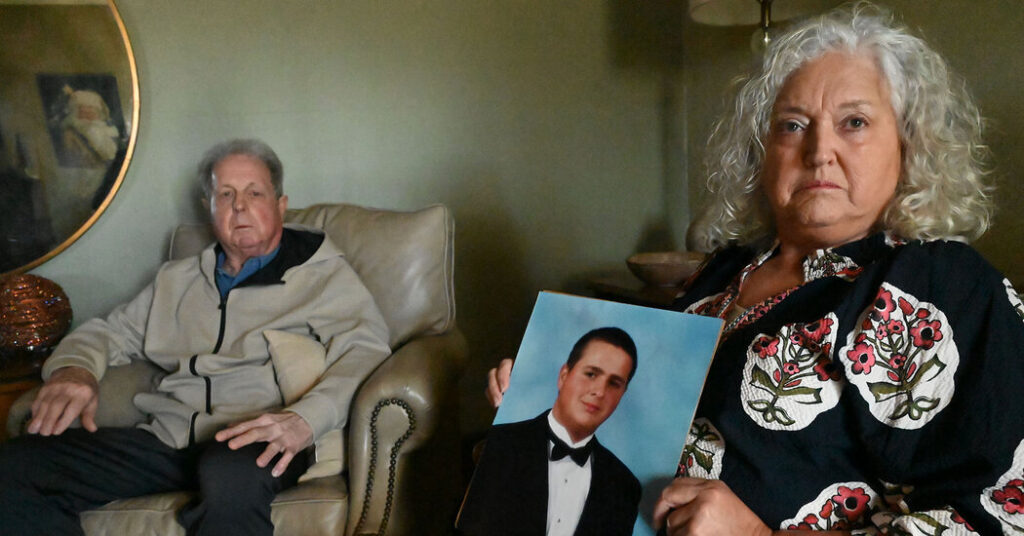
Mr. Aycock’s parents said they have long suspected that their son was killed. They described him as a jokester and as a loving father to his two daughters.
While grateful to have more answers about their son’s death, they said they were left with questions about how the sheriff’s office and the M.B.I. investigated the case.
“ We’ve gone seven years wondering what happened,” Mr. Aycock’s mother, Laurenda Provias, said. “I’m ready for closure.”
Mr. Berrong said his guilt over the killing has been eating at him for years.
“All I could think about was the fact that nothing was ever done,” Mr. Berrong said. “ What if it was me in a county jail that had been stomped to death and killed and nobody was ever charged?”
Over the past five months, he has tried to confess to the authorities on several occasions, he said.
While incarcerated at a state facility in Kemper County this year, Mr. Berrong said, he told a sheriff’s detective, Steve Windish, that he wanted to share information about Mr. Aycock’s death.
Mr. Windish said that he contacted an investigator at another agency to share that there might be new information on the case, but that the investigator said they had no interest in speaking to Mr. Berrong because they had spoken to him previously.
Mr. Berrong said that he and the other inmates in his cellblock were interviewed by M.B.I. agents the day after Mr. Aycock’s death, but he did not confess at the time.
Mr. Windish said he could not remember whether the investigator who declined to interview Mr. Berrong worked for the Rankin County Sheriff’s Department or the M.B.I.
Mr. Berrong said that he also began confessing to a Wilkinson County Correctional Facility guard, but that the guard interrupted him and said it was above his paygrade.
Mr. Berrong’s most recent attempt to confess came a few months ago, he said, when he gave a written statement to a deputy warden at the prison where he is serving a 20-year sentence.
Two law enforcement officers visited him afterward and gave him paperwork detailing his confession, he said, but he lost it when guards searched his cell for contraband.
Mr. Tindell said that the M.B.I. has no record of these interactions and that if agents had received these tips, he was unsure why they would not have responded.
“ When people contact us,” Mr. Tindell said, “ if there’s a stage in our organization where it’s just not being documented, then we need to address that.”
After repeated attempts to get the attention of the authorities, Mr. Berrong described Mr. Aycock’s death to reporters this month.
Mr. Berrong said several of his associates in the Latin Kings street gang assisted in the fatal assault by leading Mr. Aycock’s cellmate away from their cell and keeping watch while Mr. Berrong slipped inside.
After slamming Mr. Aycock to the floor, Mr. Berrong said, he stomped on his head as blood poured from his nose and ears. He could hear Mr. Aycock struggling to breathe as he fled the cell, a sound that still haunts him.
The former inmate who witnessed the encounter said that when Mr. Berrong and another inmate fled the cell, one of them had blood on his clothes.
After the attack, Mr. Berrong said, he returned to his own cell, showered and used the sharp edge of his bunk bed frame to cut his uniform into strips that he flushed down the toilet.
When guards found Mr. Aycock, they called paramedics, who took him to a nearby hospital where he was pronounced dead.
The account of the former inmate who witnessed the events largely aligned with Mr. Berrong’s, but it differed in one significant way: the motive for the attack.
Mr. Berrong said that the jail guard who recruited him to attack Mr. Aycock did not explain why. But the former inmate said that he overheard the men involved, including Mr. Berrong, plan the attack because they believed Mr. Aycock was cooperating with investigators who were pursuing a case against one of them.
Rankin County jail records show that after Mr. Aycock was arrested on a burglary charge, a detective separated him from other inmates so that he could be questioned.
During that time, at least three other people were arrested in connection with the same burglary. Jail records show that one of them was housed in the same cellblock as Mr. Aycock. Three former guards said this violated a standard practice at the jail of separating inmates arrested together to prevent them from fabricating alibis or harming each other.
The witness said that after the authorities ignored his attempts to report what he had seen, he wrote to Mr. Aycock’s mother from prison about witnessing her son’s murder. Those letters were reviewed by reporters.
“It’s really weird that no one of the Miss. Bureau of Investigation has come to speak with me about your son’s murder,” he wrote in November 2022. “Your family deserves to know the truth.”
Mukta Joshi contributed reporting.
This article was supported by the Fund for Investigative Journalism and the Alicia Patterson Foundation.
The post Death at a Mississippi Jail: Brutal Beating or a Fall From Bed? appeared first on New York Times.