Ismet Booley, a dentist in Cape Town, had a serious problem a few years ago. Patients showed up for appointments, only to find the power had gone out.
No power meant no X-rays, no fillings, no root canals. “I just couldn’t work,” Dr. Booley said.
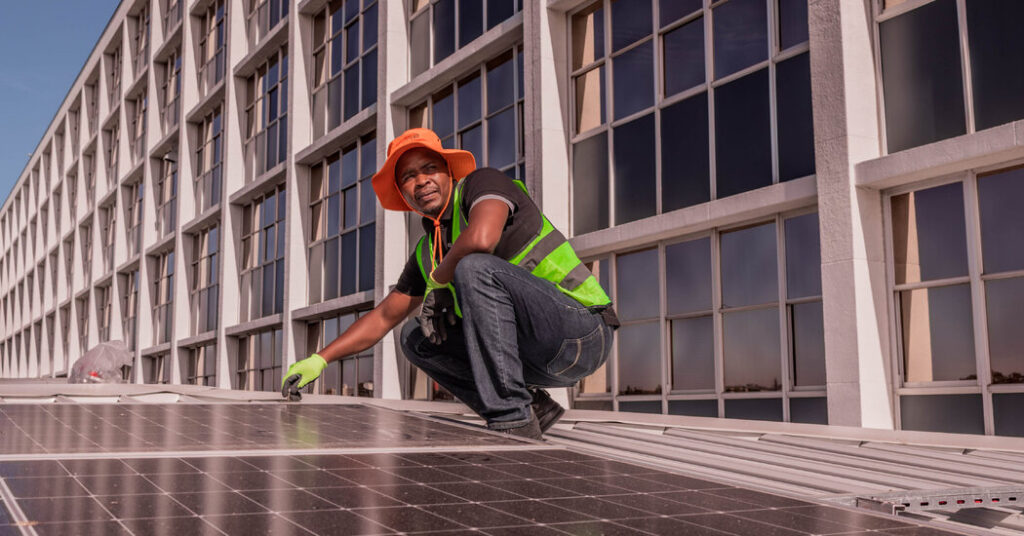
South Africans like Dr. Booley have found a remedy for power cuts that have plagued people in the developing world for years. Thanks to swiftly falling prices of Chinese made solar panels and batteries, they now draw their power from the sun.
These aren’t the tiny, old-school solar lanterns that once powered a lightbulb or TV in rural communities. Today, solar and battery systems are deployed across a variety of businesses — auto factories and wineries, gold mines and shopping malls. And they are changing everyday life, trade and industry in Africa’s biggest economy.
This has happened at startling speed. Solar has risen from almost nothing in 2019 to roughly 10 percent of South Africa’s electricity-generating capacity.
No longer do South Africans depend entirely on giant coal-burning plants that have defined how people worldwide got their electricity for more than a century. That’s forcing the nation’s already beleaguered electric utility to rethink its business as revenues evaporate.
Joel Nana, a project manager with Sustainable Energy Africa, a Cape Town-based organization, called it “a bottom-up movement” to sidestep a generations-old problem. “The broken system is unreliable electricity, expensive electricity or no electricity at all,” he said. “We’ve been living in this situation forever.”
What’s happening in South Africa is repeating across the continent. Key to this shift: China’s ambition to lead the world in clean energy.
Over the past decade, while the United States ramped up fossil fuel exports, China has focused on dominating renewables. Today, Chinese companies make so many of the world’s solar panels, electric vehicles and batteries that they are slashing prices and scrambling to find buyers.
Tariffs have thwarted them somewhat in the United States and Europe, but they’re finding enormous new markets in Africa, where around 600 million people lack reliable electricity. Across the continent, solar imports from China rose 50 percent the first 10 months of 2025, continuing a trend, according to a review of Chinese export data by Ember, a British energy tracking group.
South Africa was the largest destination for Chinese solar, but not the only one. Sierra Leone imported the equivalent of more than half its total current electricity-generating capacity, and Chad, nearly half.
China has much to gain. Not least, new markets and new geopolitical influence. Its companies are doing more than just exporting. State-owned Power China is also building utility-scale solar farms in South Africa, as in other developing economies.
And now China is bidding on contracts from the state-owned utility, Eskom, to add 14,000 kilometers (about 8,700 miles) of transmission lines that South Africa desperately needs to move its increasing supply of solar power around the country.
“Obviously we don’t have money for that,” South Africa’s deputy minister for electricity and energy, Samantha Graham-Maré, said in an interview, referring to the hefty upfront costs of expanding the grid.
Who does? China.
Chinese state-owned companies are among several international firms to bid on South Africa’s $25 billion grid expansion, vying to build the lines and then make money, in part, by operating them. Chinese firms hold similar build-operate contracts in countries including Brazil and the Philippines.
The solar surge does little to address the most pressing social and economic problems of developing countries like South Africa, the need to generate new jobs for millions of young citizens. Installation labor is local, but the panels and batteries are almost all made in China.
“The economic trade-offs are significant,” said Marvellous Ngundu, a researcher with the Institute of Security Studies, a think tank in Pretoria. “Jobs are created elsewhere. South Africa consumes advanced green technologies without capturing the industrial benefits.”
Then there are the security implications of a foreign company running the electricity grid. Asked about this, Ms. Graham-Maré said the outside companies could operate the lines for an unspecified period of time and that the grid as a whole would remain owned and controlled by the state. (In other countries, China’s State Grid owns stakes in national grids.)
Asked about security concerns, she said, “Our grid is very, very safe.”
The Race to Adapt
The rapid shift by so many businesses and people to install their own panels and batteries is causing headaches for Eskom, the already troubled utility.
Every kilowatt generated by privately owned solar installations is a hit to its bottom line. Eskom’s coal-burning plants, which provide most of South Africa’s power, are old and in poor shape.
Power cuts have subsided recently, but it wasn’t long ago that Eskom had to turn off electricity to some areas for hours at a time — a practice called “load shedding” that hurt the economy and fed public anger. During the worst days of load shedding, the latest of which came in early 2024, even Ms. Graham-Maré, the deputy electricity minister, installed a solar system in her home. Her energy bill, she said, fell by two-thirds.
Multiply her hack by the thousands and you have what South Africans call Eskom’s “death spiral.” Well-off customers lower their bills with solar, which causes Eskom to lose money, which in turn forces Eskom to raise prices and encourages more people to install solar.
It doesn’t help that some people tap power lines to draw electricity illegally, without paying for it, or that Eskom has suffered years of mismanagement.
In the past five years alone, South Africans installed solar panels representing more than seven gigawatts, or about a tenth of the total installed capacity of 55 gigawatts. Most is privately owned.
Now, unable to beat solar, Eskom is joining solar.
The utility has removed onerous licensing requirements on private installations. It has allowed people to sell power to the grid. And it has tweaked its rates so that customers pay a fixed charge in addition to the cost of any power they consume. Essentially, people pay simply to be connected to the grid, a standard feature in other nations that’s new in South Africa.
Eskom is now planning to erect large solar arrays on the grounds of shuttered coal plants. And by 2040 it intends to shift its predominantly coal-based system to cleaner sources. “That’s where the world is moving,” said Nontokozo Hadebe, Eskom’s sustainability chief.
If the speed of the change is remarkable, it’s still leaving some of South Africa’s most difficult economic problems unresolved, or is making them worse.
The problem, experts said, is that South Africa lacks policies to require local manufacturing. But creating them would drive up costs. The prices of made-in-China panels are by far the lowest in the world.
South Africa’s rapid pivot to Chinese solar gear, as affordable as it is, also doesn’t resolve a basic problem. The country’s poorest citizens still can’t afford to put up their own panels.
They lack the money to buy the gear outright and the ability to get loans.
In Langa township, one of Cape Town’s largest low-income suburbs, one of the rare businesses with solar is Colin Mkosi’s bicycle delivery service, Cloudy Deliveries. His single panel, donated by a charity, powers a few lights and computers. It doesn’t provide nearly enough to charge the electric bikes his business relies on.
The e-bikes are, of course, from China. But his power still comes from South Africa’s unreliable grid. “It’s expensive,” he said, and “we can’t operate without electricity.”
Mr. Mkosi’s wants are part of a broader problem. South Africa buys growing volumes of high-value technologies from China, while selling it raw materials of limited value. China overtook the U.S. as its biggest trading partner in 2008. With its trade gap rising to more than $9 billion in 2023, compared with barely $1 billion in 2000, there are increasing calls to make trade relations with China less unequal.
The difference between South Africa’s trade ties with China and with the U.S. is stark.
President Trump has imposed a 30 percent tariff on South African goods and excluded the government from participating in an international summit of the world’s 20 biggest economies. He has also reversed a Biden administration plan to help the country accelerate its planned closures of its oldest, dirtiest coal plants.
“As relations with the United States have become increasingly strained, Beijing has positioned itself as a reliable and sympathetic partner,” Dr. Ngundu said.
Sun and Wine
Far from the hand-wringing over trade and geopolitics, in South Africa’s storied wine region of Stellenbosch the sun is as bright as the chardonnay.
Which explains why, on the Lanzerac Wine Estate in December, workers were finishing installation of rows of solar panels between rows of vines. The panels would soon supply all the electricity to run the 54-room luxury hotel on the estate, and the winery’s operations.
Batteries would store power for the night. For only two or three months a year, during winter, would the winery need to buy much electricity from the grid.
Like many businesses, Lanzerac was initially drawn to solar to guard against blackouts. During the worst episodes, the hotel had to close at least three rooms because the growl of diesel generators annoyed guests paying upward of $800 a night.
Even after the blackouts subsided, Lanzerac went ahead with solar, ripping out a small patch of vines to make space. In roughly five years, according to Lanzerac’s operations manager, Tiaan Lategan, electricity for the estate will essentially be free. “The pros definitely outweigh the cons,” he said.
Lanzerac is hardly alone.
The company that installed its equipment, Aces Africa, has done the same for shopping malls and hospitals. Its next big job is a factory that makes transformers.
“China has driven the prices of solar panels so low it’s really rock bottom at the moment,” said Charl Gous, the company president.
Rock-bottom prices have enabled Dr. Booley, the dentist in Cape Town, to expand, too.
The panel and battery system at his office was paid off in less than four years.
He installed a bigger system for his home, and his electricity bills dropped to a fifth of what they were. He then raised money to add solar panels to a charitable school he supports nearby.
One recent evening, as dusk drew in, the lights in his house came on, powered by batteries, and his swimming pool was warm, heated by electricity from his panels. The family sat around a kitchen table, cooing over a grandchild. By next June, he expects his home system will be paid off.
This gives Dr. Booley solace. He’s planning for retirement, and solar has eliminated one of his worries, he said — “that I’ll not be able to afford electricity when I’m a pensioner.”
Daneel Knoetze contributed reporting from Cape Town.
Somini Sengupta is the international climate reporter on the Times climate team.
The post Cheap Solar Is Transforming Lives and Economies Across Africa appeared first on New York Times.