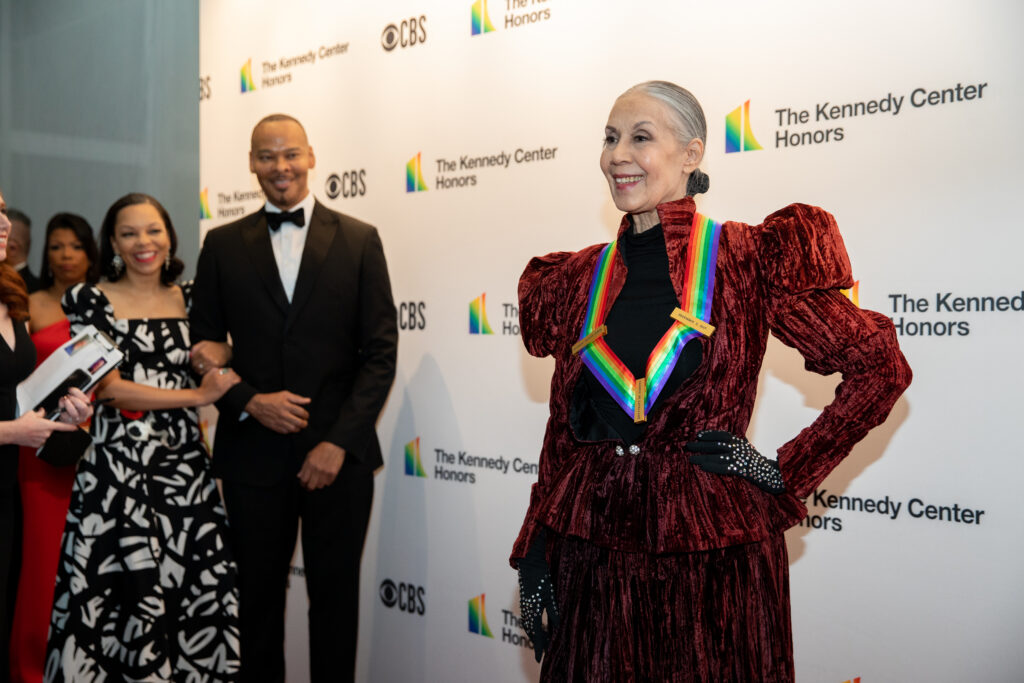
Carmen de Lavallade, a dancer whose transformative powers onstage and mesmerizing beauty inspired artistic collaborators as wide-ranging as Agnes de Mille, Alvin Ailey and her husband, Geoffrey Holder, and who helped lay the foundation for American modern dance, has died. She was 94.
Her death was announced in a statement Tuesday by the Alvin Ailey American Dance Theater, which did not share additional details.
Ms. de Lavallade was foremost a muse whose versatility and creative drive were never confined for an extended period to any single dance or theater company. She worked as an actress and choreographer and toggled between ballet and modern dance, film and television, the concert stage and the nightclub act.
Her noble bearing, high cheekbones, long, sinuous torso and impressive wingspan revealed a wide portfolio of characters experiencing torment or ecstasy, including the troubled jazz singer Billie Holiday, the martyred Joan of Arc and a sexually liberated Scheherazade.
Ms. de Lavallade beguiled audiences for seven decades, drawing reviews that often were rhapsodies of superlatives. Dance critic P.W. Manchester once singled out her performance as Salome as “an altogether remarkable conception, passionate, childishly capricious, lascivious, with a sheer physical beauty that compels a fascinated attention from the moment of her entry.”
Raised in a working-class Los Angeles home, Ms. de Lavallade was determined from childhood to make a career in dance. She worshiped her older cousin Janet Collins, who had faced daunting obstacles as an African American ballerina before her breakthrough in the early 1950s as the Metropolitan Opera’s first Black principal dancer. Eventually, Ms. de Lavallade succeeded Collins as prima ballerina with the Met, performing between 1955 and 1958 in “Aida” and “Samson and Delilah.”
The singer Lena Horne, then working in movies, was among the teenage Ms. de Lavallade’s most important artistic sponsors. Horne had seen the young dancer perform with the racially integrated Lester Horton troupe in Los Angeles and helped smooth her way into a handful of dance sequences in Hollywood fare such as “Demetrius and the Gladiators” and the all-Black musical “Carmen Jones,” which was set to Bizet’s music and released in 1954.
Ailey, who had been Ms. de Lavallade’s high school classmate, was similarly entranced after seeing her dance at a school assembly — a moment he described as life-altering. Ailey decided to forgo his study of gymnastics and soon joined Ms. de Lavallade at Horton’s studio.
Ailey eventually put his singular stamp on modern dance with Ms. de Lavallade as his frequent collaborator. He placed her at the center of one of his signature works, “Revelations” (1960), which represented African American perseverance, from slavery to the 20th century, through dance set to spirituals and the blues.
Starting in the late 1950s, she also helped build the trailblazing Alvin Ailey American Dance Theater, a primarily Black company that became one of the country’s most successful modern-dance ensembles.
In 1961, she and Ailey performed his duet “Roots of the Blues,” with music by Brother John Sellers, that left audiences in New York and at the prestigious Jacob’s Pillow Dance Festival in Becket, Massachusetts, screaming for more.
As for Holder, Ms. de Lavallade first cast her spell on the 6-foot-6 Trinidadian-born dancer and choreographer from afar, through her small but indelible screen parts. Both were cast as featured dancers in the Harold Arlen-Truman Capote Broadway musical “House of Flowers” in 1954, and he proposed to her four days after their first encounter. She once said Holder, whose towering height and sonorous, booming voice made him impossible to ignore, entered her life “like a dozen steel bands.” They married the next year.
For decades, Ms. de Lavallade and Holder worked together as a power couple in the arts. He achieved greater mainstream visibility in the 1970s when he won Tony Awards for his costume design and direction of the musical “The Wiz” and worked as a TV pitchman for 7Up and as a James Bond villain.
Ms. de Lavallade appeared frequently in his dance troupe. He designed her stage costumes as well as stunning assemblages for her day and evening wear. Even before her marriage, she was known for her ability to transform the long velvet train of a dress or heavy folds of a Mexican poncho into movement, akin to an alluring performance of it own.
Holder choreographed many works for her, among them “The Creation” (1972), which featured Ms. de Lavallade in a rapturous solo as God in a sleek, long red dress creating the universe.
Her appearance in “The Creation” was indebted to her earlier solo in “Come Sunday,” in which she embodied God in a long white dress and danced to the music of African American spirituals. “Come Sunday” was sometimes reminiscent of her “Wade in the Water” role in the first iterations of Ailey’s “Revelations.”
Even offstage, Ms. de Lavallade and her husband seemed to view any public appearance as a performance. Sali Ann Kriegsman, former executive director of Jacob’s Pillow and former director of the National Endowment for the Arts dance program, recalled the couple’s many arrivals at the Kennedy Center Honors in Washington.
“Carmen and Geoffrey would make their entrance on the red carpet to the Opera House,” she said. “No one, no matter how famous, had more presence. Geoffrey, tall, regal and splashed in colorful robes. On his arm Carmen, radiantly gowned in his gorgeous fabrics. Class. But even absent gala trappings, just sitting next to him, she embodied the very essence of dance, alive to the pore, attentive to each person, alert to a voice inside her and engaged in the world.”
Carmen Paula de Lavallade, the middle of three daughters, was born in Los Angeles on March 6, 1931. Her father was a bricklayer turned postman. Her mother’s increasingly poor health led to her placement in a sanitarium when Carmen was 7.
Ms. de Lavallade’s cousin Janet captured her imagination and helped guide her to Horton and his prominent dance school and company. Through Horton, she began her long affiliation with Jacob’s Pillow. After Horton died in 1953, his two most promising disciples — Ms. de Lavallade and Ailey — tried to sustain the troupe. But both were lured to Broadway, where Ms. de Lavallade soon met Holder.
He died in 2014. Survivors include their son, Leo Holder.
On TV, Ms. de Lavallade appeared as the personification of jazz in a 1957 CBS TV production of “A Drum is a Woman” featuring music by Duke Ellington and Billy Strayhorn. The same year, she also was a featured dancer on NBC in Gian Carlo Menotti’s Christmas opera “Amahl and the Night Visitors,” choreographed by John Butler (in whose dance company she often performed). And in 1961, she was featured on CBS in a 10-minute ballet sequence of the Gershwin folk opera “Porgy and Bess.”
For all the acclaim she drew in these and other works on stage and television, racial barriers came to define some of her prime dancing years. She often recalled an incident on Ed Sullivan’s CBS variety show in 1961 when Butler, known for his sensual choreography, proposed a duet between Ms. de Lavallade and White dancer Glen Tetley. Producers insisted on pairing her with Black dancer and Ailey stalwart Claude Thompson.
That same year, Ms. de Lavallade withdrew from an all-Black off-Broadway staging of Langston Hughes’s Christmas play “Black Nativity.” In 1967 — around the time she danced as a whimsical temptress on network TV alongside White dancer Wesley Fata — she told an interviewer: “The arts are colorless. That’s what civil rights is about … The arts are my way of contributing. I perform in integrated groups, and the performances are for everybody. As an entertainer, my role is to give joy, not to go on marches.”
Ms. de Lavallade said that her 1965 performance with the American Ballet Theatre as a guest artist in de Mille’s “The Four Marys” and “The Frail Quarry” signaled its own breakthrough because ballet practitioners had so heavily discriminated against other artists who were Black.
In the early 1970s, Ms. de Lavallade joined the Yale School of Drama as an instructor in choreography and performer in residence. More recently, in her 80s, she starred in an autobiographical solo show, “As I Remember It.” She received the Kennedy Center Honors in 2017.
Though esteemed among her peers, Ms. de Lavallade never achieved the wide public recognition attained by later generations of Black dancers. She did, however, take under her wing Misty Copeland, the American Ballet Theatre dancer who in 2015 became its first Black prima ballerina and who cited Ms. de Lavallade as an influence.
“History has a sense of justice,” Ms. de Lavallade told Time magazine that year. “The greatest struggle deserves the grandest stage.”
The post Carmen de Lavallade, mesmerizing dancer and choreographer, dies at 94 appeared first on Washington Post.